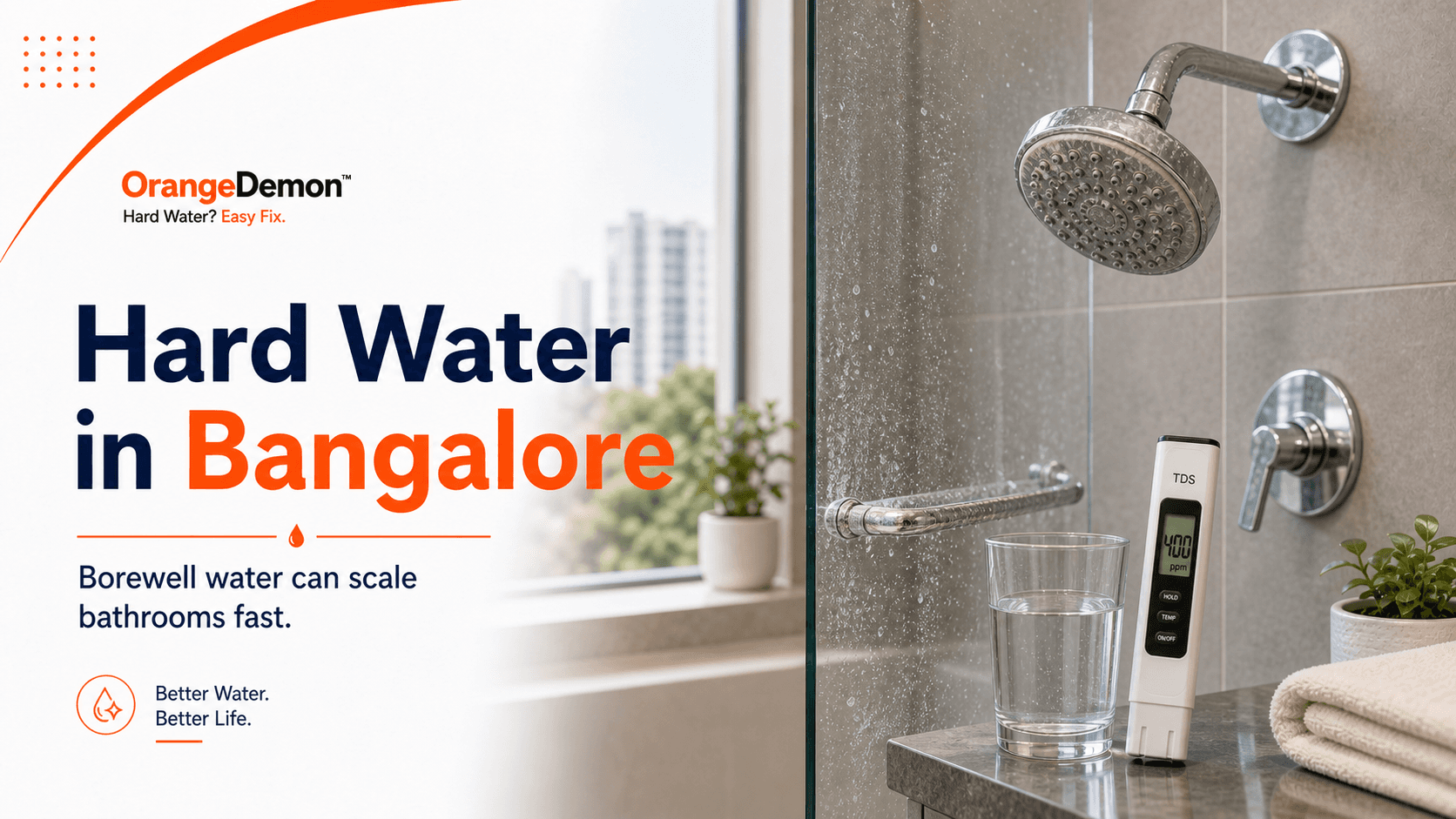
HARD WATER DATA / KARNATAKA

Hard Water in
Bengaluru

Bengaluru Urban district / Pincode 560001 / Karnataka

AVERAGE TDS

280ppm

Range: 230-330 ppm

MODERATE HARDNESS

WHAT THIS MEANS

Moderate mineral load. Scale builds gradually.

Bengaluru's water crisis isn't just about shortage - the borewell water filling apartments on tankers is some of the hardest in the country.

You will usually see kettle film and early heater residue within a few months. Quarterly descaling is the right baseline.

WATER SOURCE

BWSSB Cauvery supply reaches less than 60% of Bengaluru's residential buildings. The rest depend on borewells drawing from the Deccan Plateau hard-rock aquifer, which has very limited natural filtering capacity. Outer ring road areas - Whitefield, Electronic City, Sarjapur, Yelahanka - are almost entirely borewell-dependent and test 450-700 ppm. Apartment buildings on tanker supply have the least predictable and often highest TDS readings.

APPLIANCE IMPACT AT 280 PPM

??

Washing Machine

EVERY 3 MONTHS

Light scale - manageable with quarterly maintenance

KT

Kettle

EVERY 3 MONTHS

Scale appears within 2-3 months

??

Geyser / Water Heater

EVERY 6 MONTHS

Minimal impact - periodic maintenance sufficient

BENGALURU HOUSEHOLD CONTEXT

How hard water shows up in Bengaluru homes.

Bengaluru is a textbook borewell-and-tanker hard-water city. Residents are not debating whether the water is difficult; they are trying to decide how to keep apartment appliances alive when supply is inconsistent and mineral-heavy.

Bengaluru is best read as a full-home hard-water maintenance page. At 280 ppm, scale does not stay in one place - it shows up across washers, kettles, geysers, showerheads, and other daily-use appliances that repeatedly heat or evaporate water.

Bengaluru sits in Bengaluru Urban district, and this page uses pincode 560001 as its local baseline. Individual buildings can test higher or lower depending on borewell share, overhead tank cleaning, season, storage time, and plumbing condition, so treat the city number as a strong household reference point rather than a lab certificate for every tap.

HOW TO USE THIS PAGE

For Bengaluru, use this page as a prevention guide. The goal is to keep moderate mineral load from turning into avoidable washer, kettle, and geyser inefficiency over time.

  • -Visible white residue on fittings, glass, kettles, and heated appliances.
  • -More frequent washer, geyser, or showerhead performance complaints in daily use.
  • -The same water causing both appliance drag and bathroom-scale symptoms at home.

BENGALURU BOREWELL BELTS

WhitefieldSarjapurElectronic CityYelahankaOuter Ring RoadTanker-dependent apartments

These are the kinds of local pockets where residents usually notice hard-water symptoms first: more tank storage, mixed supply, frequent hot-water use, and higher day-to-day appliance load.

BEST NEXT STEP

Bengaluru responds well to apartment-routine messaging: one product, multiple appliances, repeat schedule, and clear guidance for borewell or tanker-heavy homes.

DATA NOTES

How to read this Bengaluru hard-water page.

LOCAL BASELINE

560001 - Bengaluru Urban, Karnataka

CITY TDS BAND USED

280 ppm average (230-330 ppm)

STATE COMPARISON

Ranked 201 of 262 tracked cities in Karnataka; 44 ppm below the state page average

READ THIS AS

A household maintenance baseline, not a lab certificate for every building in the city.

METHODOLOGY AND LIMITS

OrangeDemon maps this page to pincode 560001 in Bengaluru Urban district and uses the corresponding TDS band as the local baseline for Bengaluru. The appliance schedule and maintenance advice are then interpreted from that mineral-load tier, together with common household symptoms seen in cities with similar water profiles. Buildings can read higher or lower than the city baseline if they depend more heavily on borewell water, have poorly maintained storage tanks, or see seasonal supply shifts.

CHECK YOUR OWN TDS ->SEE KARNATAKA DATA ->Dataset reviewed April 18, 2026

SAME CITY, DIFFERENT BUILDINGS

Why one Bengaluru address can feel harsher than another.

The city number is the starting point, not the whole story. Two homes in Bengaluru can show different scale symptoms even when they sit in the same broad supply zone, because building-level storage and source mix change how hard water behaves in practice.

BOREWELL SHARE

Buildings in Bengaluru that rely more heavily on borewell top-up usually read harder than the city baseline, especially in summer or low-supply periods.

TANK AND STORAGE

Longer storage time, older overhead tanks, and poorer cleaning routines can make the same municipal supply feel harsher in day-to-day use.

SEASONAL MIX

Water source mix can shift through the year. The same Bengaluru address can behave differently in monsoon, summer, and high-demand weeks.

IN-BUILDING PLUMBING

Scale inside pipes, heaters, and showerheads can exaggerate symptoms even when the raw incoming TDS has not changed dramatically.

WHEN TO TEST YOUR OWN WATER

Use the Bengaluru average as a first filter, then test your own kitchen or utility tap if you want to size the right maintenance routine for your building and appliances.

HARD WATER GUIDE

Why Bengaluru's 280 ppm water damages your appliances.

BWSSB Cauvery supply reaches less than 60% of Bengaluru's residential buildings. The rest depend on borewells drawing from the Deccan Plateau hard-rock aquifer, which has very limited natural filtering capacity. Outer ring road areas - Whitefield, Electronic City, Sarjapur, Yelahanka - are almost entirely borewell-dependent and test 450-700 ppm. Apartment buildings on tanker supply have the least predictable and often highest TDS readings.

Why your geyser heats slowly in Bengaluru

At 280 ppm, scale buildup in your geyser is slow but persistent. Left unserviced for 2-3 years, the element develops a mineral coating that insulates it and forces it to run hotter and longer to reach temperature.

Geyser descaling every 6 months prevents element degradation and keeps heating times stable. Most plumbers offer this as a standalone service for Rs.500-Rs.1,500.

What 280 ppm does to washing machines

At 280 ppm, scale in washing machines builds slowly. Quarterly descaling keeps the drum clean and the element running at its rated efficiency, preventing the gradual performance decline that gets blamed on product quality.

Method: use one 50g WashDX sachet directly in the empty drum (not the detergent drawer). Run a hot empty cycle up to 60 minutes, then run a rinse cycle. For first-time cleans after 12+ months of no treatment, start with one 50g WashDX sachet.

Kettle boiling slower? It's the 280 ppm water

Kettles are the fastest-scaling appliance in any hard water home because every boil deposits minerals directly on the element. In Bengaluru at 280 ppm, scale appears within 2-3 months. The boil time increases slightly each month as the coating thickens.

Descale your kettle every 3 months: fill to the minimum line with warm water, add one 25g DescaleX Bio sachet, soak 20 minutes, then rinse three times. Do not boil the descaling solution unless your kettle manufacturer explicitly allows it.

One thermostat setting that slows scale in Bengaluru

Calcium carbonate precipitates faster at higher temperatures. Reducing your geyser thermostat from the factory default of 65-70 deg C to 55 deg C slows scale deposition by approximately 20-30%, reduces electricity use, and is adequate for all normal household hot water needs.

At Bengaluru's 280 ppm, this setting change combined with every 6 months descaling keeps your geyser at rated efficiency long-term.

Bengaluru in Karnataka has moderate hard water at an average TDS of 280 ppm (range: 230-330 ppm). The recommended descaling schedule for Bengaluru is: washing machine every 3 months with WashDX, kettle every 3 months with DescaleX Bio, geyser every 6 months with WashDX. Bengaluru's water crisis isn't just about shortage - the borewell water filling apartments on tankers is some of the hardest in the country. Hard-water descalers for Bengaluru: DescaleX for coffee machines, dishwashers, and showerheads; DescaleX Bio for kettles and food-contact appliances; WashDX for washing machines, geysers, and immersion rods.

RECOMMENDED FOR BENGALURU

Your Bengaluru descaling schedule.

WASHING MACHINE

Every 3 months

KETTLE

Every 3 months

GEYSER

Every 6 months

BEFORE YOU SET A ROUTINE

Check these things in your Bengaluru building first.

A good city page should help you verify the problem, not just tell you the city average. These quick checks usually tell you whether your building is tracking close to the Bengaluru baseline or running harder than the headline number suggests.

TEST THE TAP YOU ACTUALLY USE

A kitchen or utility-tap reading tells you more about day-to-day Bengaluru appliance load than a generic city average alone.

ASK ABOUT SOURCE MIX

Find out whether your building depends mostly on municipal supply, a mixed source, or heavy borewell top-up.

CHECK MORE THAN ONE SYMPTOM

If the same residue pattern shows on a kettle, showerhead, and washer, you are dealing with a water issue, not one bad appliance.

SEPARATE SCALE FROM SURFACE DIRT

Hard water usually shows up as crust, cloudiness, slower heating, or reduced flow, not just ordinary grime.

IF SCALE IS ALREADY VISIBLE

Match the descaler to
280 ppm water.

DescaleX covers coffee machines, dishwashers, and showerheads. DescaleX Bio covers kettles and food-contact appliances. WashDX covers washing machines, geysers, and immersion rods.

  • +DescaleX: coffee machines, dishwashers, showerheads
  • +DescaleX Bio: kettles, baby bottle warmers, food-contact appliances
  • +WashDX: washing machines, geysers, immersion rods
  • +Follow the product-specific instructions and rinse rules
  • +Use TDS to set routine, not to force one formula onto every appliance

COMMON QUESTIONS

Bengaluru hard water - answered.

Why is Bengaluru such a strong hard-water appliance market?+

Because a large share of the city lives on borewell, mixed, or tanker-supported water. That creates repeated mineral exposure for washers, geysers, kettles, and shower fittings in exactly the apartment-heavy environments where appliance wear becomes obvious fast.

Which Bengaluru areas usually show the hardest water behavior first?+

Whitefield, Sarjapur, Electronic City, Yelahanka, and other tanker- or borewell-dependent apartment belts are common starting points for hard-water appliance complaints.

Is Bengaluru a better fit for all-appliance messaging than one-appliance messaging?+

Yes. Bengaluru pages work best when they acknowledge that the same water problem affects the washer, geyser, kettle, and bathroom fittings together rather than pretending the issue is isolated.

What is the smartest first descaler setup for Bengaluru?+

For most Bengaluru apartments, the practical starting point is the right product for the appliance mix so you are not treating one symptom while the rest of the home keeps scaling. Use WashDX for washers and geysers, DescaleX for kettles and showerheads.

Will every locality in Bengaluru show the same TDS?+

No. Bengaluru's city average is a useful baseline, but individual buildings can test higher or lower depending on borewell share, tank storage, seasonal source mix, and plumbing condition. That is why one society may complain about fast kettle scale while another nearby building sees milder symptoms.

Should I trust the Bengaluru average or test my own tap water?+

Use the Bengaluru average as a first filter, then test your own kitchen or utility tap if you want to size the right maintenance routine for your building and appliances. A simple TDS meter reading from your kitchen or utility tap is the best way to confirm whether your building is tracking close to the city baseline or sitting materially above it.

SOUTH AND PLATEAU CITIES

Compare Bengaluru with related cities.

These nearby cities help you compare whether the appliance symptoms in Bengaluru look local, regional, or part of a broader hard-water pattern in the same state or metro belt.

AVAILABLE NOW / FREE SHIPPING

Match the descaler to Bengaluru's water, then to the appliance.

DescaleX handles coffee machines, dishwashers, and showerheads. DescaleX Bio handles kettles and food-contact appliances. WashDX handles washing machines, geysers, and immersion rods.