
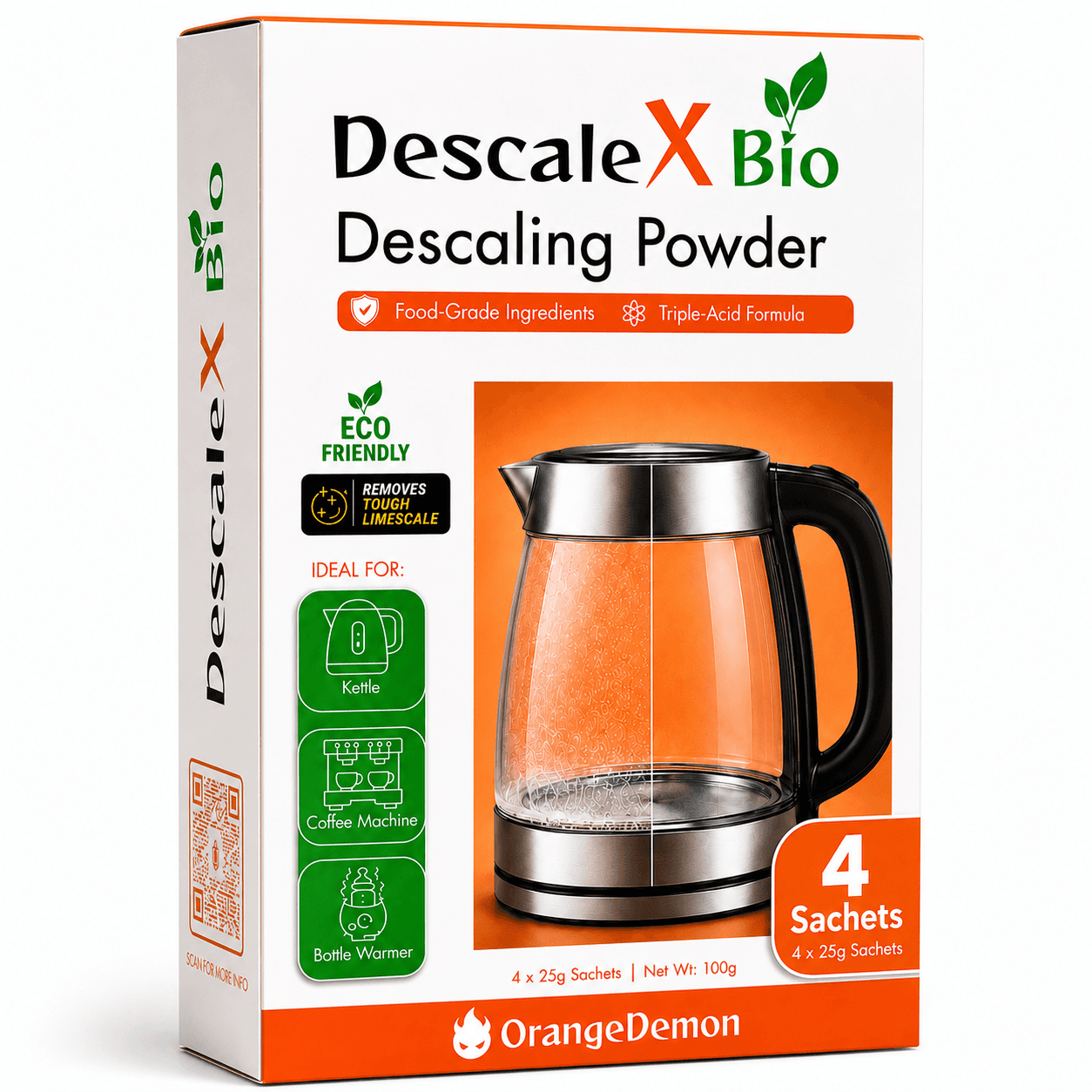


Bio line · Food-contact formula
DescaleX Bio Kettle Descaler
Food-contact descale for kettles, baby warmers, and daily boil-side maintenance.
- Food-contact formula
- Kettles & baby warmers
- Triple-acid
- Pre-measured sachets
Incl. all taxes · Rs.49.92 / sachet
Choose pack
3 boxes added. Cart updated.View cart
- No work, money back
- COD available
- Made in Hisar
Also available onAmazon
One cycle. See the difference.


3 steps. No measuring.
- 01
Add sachet to water
500ml cold water + 1 sachet. Stir to dissolve.
- 02
Warm, then soak
Heat gently, never boil. Soak 30 minutes.
- 03
Rinse 3 times
Pour out, then 3 plain water boils before drinking use.
Built for Indian hard water
Primary acid
Dissolves the bulk of calcium carbonate scale. The same acid in lemons, food-grade and anhydrous.
Cold-soluble
Penetrates the mid-layer of scale. Works faster than citric in cold water - the apple acid (E296).
Deep penetrator
Reaches into old, dense scale layers single-acid descalers can't touch. Found naturally in grapes.
Primary chelant
Food-contact chelant support that holds dissolved minerals in solution so they wash away instead of re-depositing.
vs what people try
| Feature | OrangeDemon | Cheap citric | Vinegar |
|---|---|---|---|
| Food-grade certified | Yes (E330/E296/E334) | Sometimes | Yes |
| Triple-acid system | Yes | No (citric only) | No |
| Safe on baby bottles | Yes (half dose) | Not labelled | Smell concern |
| Removes layered scale | Yes | Surface only | Partially |
| Built for 400-700+ TDS | Yes | No | No |
| Smell after rinsing | None | Mild acidic | Strong, lingers |
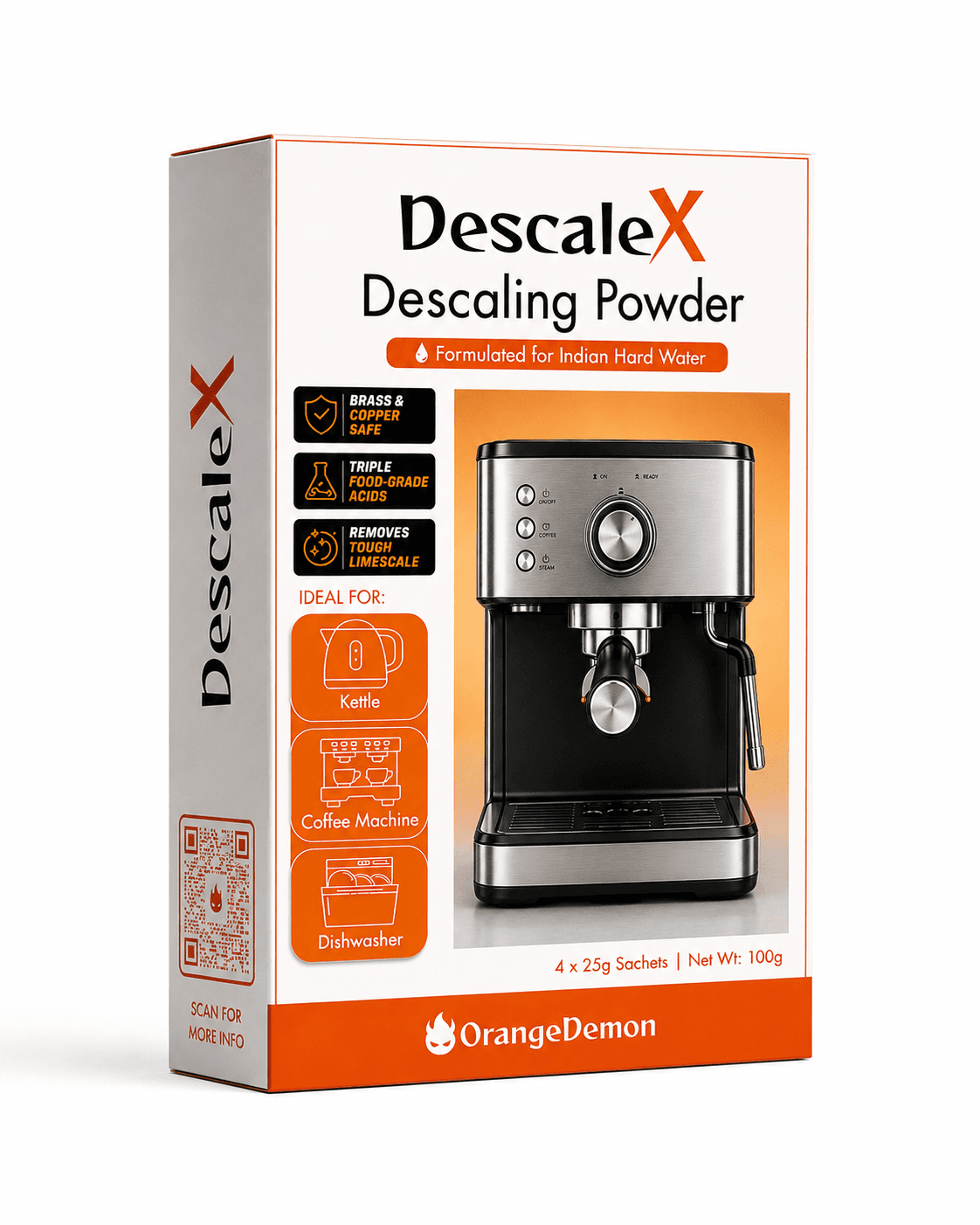
Coffee machine or dishwasher too?
CUSTOMER REVIEWS
What customers say.
4-star rating
Work superb but 75 for 1 pouch expensive 🫰 make it 40-50 I'll buy again
5-star rating
Using it regularly, doing well for me.
5-star rating
Worked much better than pure citric, left no marks.
5-star rating
Left no with streak like pure citric acid. 10 on 10 results.
Show all 6 reviewsShow fewer reviews
5-star rating
Effective product, pack can be bigger.
Really good product 😊
Clean the bottle really good also no smell after.
Details
How to use · Electric Kettle
- Empty kettle.
- Pour 500ml cold water and 1 sachet. Stir to dissolve.
- Heat gently - warm, not boiling. Switch off.
- Soak 30 minutes with lid closed.
- Pour out solution. Rinse with 3 plain water boils minimum before drinking use.
Warning: Never boil the descaling solution. Min 3 plain rinse cycles mandatory before drinking.
How to use · Drip Filter Coffee
- Empty machine. Remove filter and any used grounds.
- Dissolve 1 sachet in the full water reservoir.
- Run a full brew cycle. Discard solution.
- Run 2-3 plain water cycles before brewing again.
Warning: DO NOT use Bio on espresso machines with brass internals - use DescaleX instead.
How to use · Baby Bottle Warmer
- Empty and unplug the warmer.
- Dissolve 1 sachet in 300ml warm water.
- Fill warmer reservoir. Soak 30 minutes - do NOT heat.
- Pour out. Rinse 5 times minimum. Air-dry before next use.
Warning: Never heat the descaling solution inside a baby appliance. Soak only.
How to use · Baby Bottles
- Dissolve half a sachet (12.5g) in 500ml warm water.
- Submerge bottles fully. Soak 15 minutes.
- Rinse 5 times minimum under running water.
- Air-dry completely before next use.
Warning: Never use hot solution on plastic bottles - risk of deformation. Warm water only.
What's inside
- Citric AcidPrimary acid · 73.5%
Dissolves the bulk of calcium carbonate scale. The same acid in lemons, food-grade and anhydrous.
- Malic AcidCold-soluble · 9.0%
Penetrates the mid-layer of scale. Works faster than citric in cold water - the apple acid (E296).
- Tartaric AcidDeep penetrator · 8.0%
Reaches into old, dense scale layers single-acid descalers can't touch. Found naturally in grapes.
- Sodium GluconatePrimary chelant · 9.0%
Food-contact chelant support that holds dissolved minerals in solution so they wash away instead of re-depositing.
- Silicon DioxideAnti-caking · 0.5%
Food-grade flow agent. Keeps the powder pourable in humid conditions.
How often to descale (by TDS)
- Below 200
- Soft. Descale every 4-6 months.
- 200 - 400
- Moderate. Every 2-3 months.
- 400 - 600
- Hard. Every 6-8 weeks.
- 600+
- Very hard. Every 4-6 weeks. Double dose first time.
Why kettles get scale faster than other appliances
A kettle goes through more boil-evaporate cycles per week than any other appliance in the house. Every boil leaves a thin film of dissolved minerals on the heating element. At 400+ TDS Indian water, that film thickens into a hard crust within 4-6 weeks. Once the crust forms, the heating element has to push through an insulating layer - heating times go up, energy use goes up, and the element runs hotter than designed, shortening its life. Descaling every 4-6 weeks keeps the element clean and the kettle running like new.
What 'food-grade' actually means
Bio uses a food-contact ingredient profile built for kettles, baby warmers, and other rinse-critical jobs. The important part is not the label alone - it is the combination of the formula and the rinse protocol. Use the right dose, then complete the full rinse steps before the appliance goes back into drinking-water use.
Use Bio when / use regular when
Use Bio for kettles, baby items, drip coffee, and other food-contact appliances. Use regular DescaleX when the appliance has brass internals, the manual expects a machine-side descale formula, or the scale issue sits in an espresso or dishwasher route instead.
Why Bio has a separate ingredient profile
Bio is the version of the range built specifically for kettles, baby bottle warmers, and other rinse-critical food-contact jobs. That means the formula stays within a food-contact ingredient set while regular DescaleX keeps the metal-support additives needed for espresso machines and dishwasher routes. The separation keeps each formula clear about the job it is meant to do.
What DescaleX Bio is and is not safe on
Safe: stainless steel, glass, ceramic, silicone seals up to 2 hours, plastic appliances, all food-contact surfaces after thorough rinsing (5 rinses for baby items). Caution: aluminium with short contact time only, old cracked seals. Do not use on: espresso machines with brass boilers or group heads - no BTA means brass will corrode. Not for washing machines (use WashDX), chrome fittings, or natural stone.
Problem authority
Why DescaleX Bio fits kettle and food-contact scale.
DescaleX Bio is the food-contact route. These guides connect Bio to kettle scale, TDS frequency, buyer comparisons, and the exact rinse instructions.
Hub
Hard water and kettles
Explains why kettles scale quickly, how TDS changes frequency, and why Bio is the food-contact route.
Buying guide
Best food-grade descaling powder
Buyer-intent guide for kettles, baby bottle warmers, and rinse-critical appliances.
How-to
Best kettle descaler in India
White flakes, cloudy bases, slow boiling, and the right DescaleX Bio routine.
Use case
Kettle descaler buyer page
The product for electric kettles, stovetop kettles, baby warmers, and food-contact jobs.
Instructions
DescaleX Bio instructions
Dose, soak, rinse, and food-contact safety steps for Bio use.
TDS guide
TDS 400, 600, and 800
Use this when kettle scale keeps returning and you need a TDS-based schedule.
FAQ library
Questions, answered
Grouped by topic. Tap a topic to open.
Using it2 questions
How long until I see results?
One descale cycle. After running and rinsing, your kettle should boil faster, your coffee tastes cleaner, and any visible scale starts coming out as cloudy water. If your appliance had heavy buildup, run a second cycle.
Can I use Bio on my espresso machine?
Not by default. Many espresso machines use brass or copper internals and are better served by regular DescaleX. If the manual is unclear, check the material spec first or ask us before descaling.
Safety & food contact1 questions
Is it really safe for baby bottles?
Yes - when used correctly. Bio uses a food-contact ingredient set: citric, malic, and tartaric acids plus sodium gluconate and silicon dioxide. For baby bottles, use half a sachet in warm water (never hot), soak 15 minutes, then rinse 5 times. Air-dry before use.
Bio vs regular DescaleX2 questions
What's the difference between Bio and regular DescaleX?
Use Bio for kettles, baby warmers, and other food-contact jobs. Use regular DescaleX for espresso machines, dishwashers, and similar routes where the appliance needs a metal-support formula during the descale cycle.
Why does it cost more than the regular DescaleX?
Bio keeps a food-contact ingredient profile for rinse-critical appliances, and that changes both sourcing and formulation cost. We keep the gap small so it still works as a practical maintenance buy.
Orders & delivery1 questions
Is COD available?
Yes. Cash on delivery is available across India. You can also pay online via UPI, cards, or net banking.
DescaleX Bio
Rs.599
3 boxes / 12 sachets