
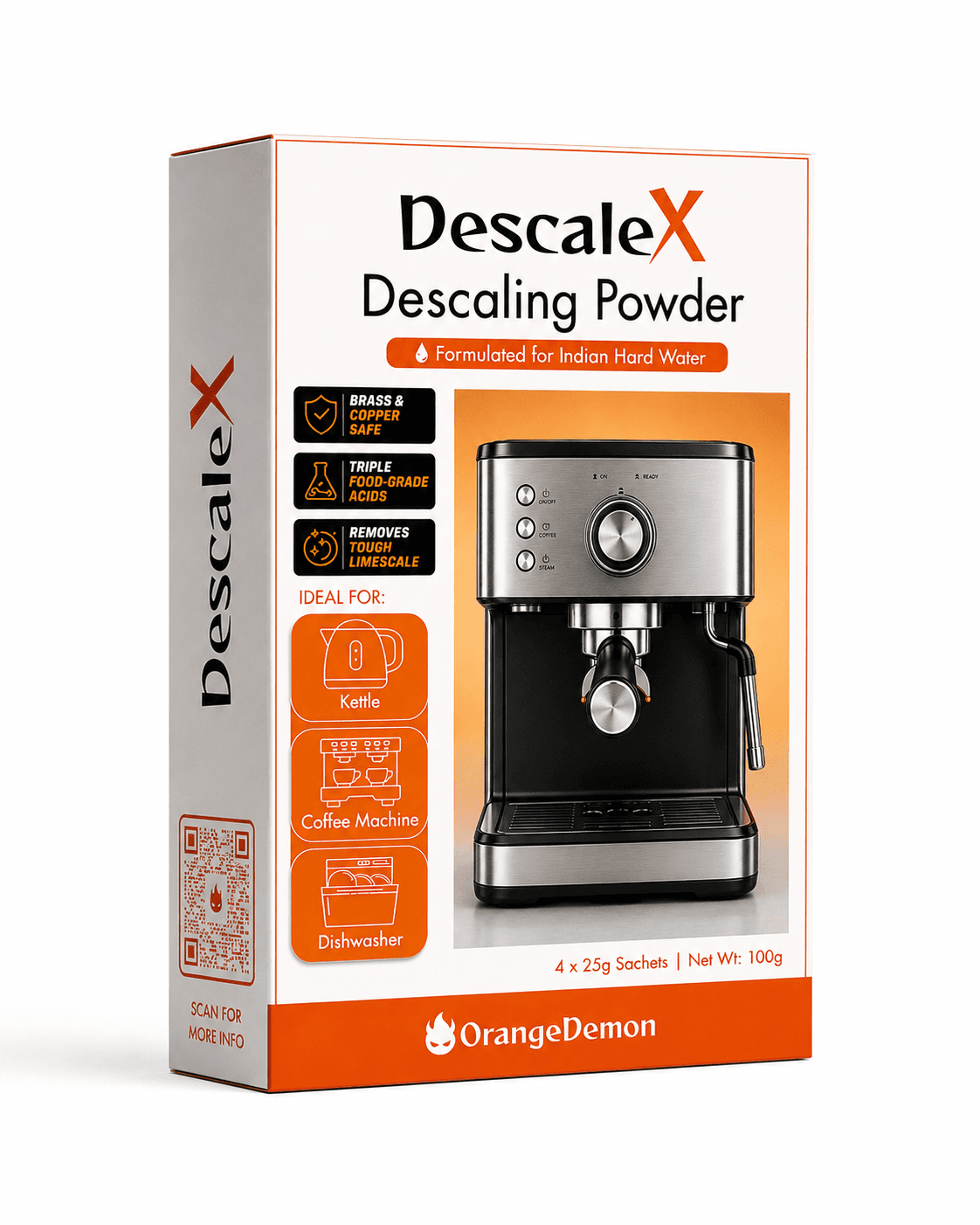


DescaleX Coffee Machine Descaler
Machine-side descale for coffee machines and dishwashers.
- Coffee & espresso
- For dishwashers too
- Protects brass (BTA)
- Pre-measured sachets
Incl. all taxes · Rs.58.25 / sachet
Choose pack
3 boxes added. Cart updated.View cart
- No work, money back
- COD available
- Made in Hisar
Also available onAmazon
One cycle. See the difference.


3 steps. No measuring.
- 01
Empty the machine
Remove pods, grounds or filters.
- 02
Dissolve 1 sachet
In the full water reservoir.
- 03
Run, then rinse
Run the descale cycle, then 2-3 plain water cycles.
Built for Indian hard water
Primary acid
Dissolves the bulk of calcium carbonate scale. The same acid in lemons, but anhydrous and food-grade (E330).
Cold-soluble
Stays fully active in cold water, so soak-based cleans work without heating. Handles the mid-layer of scale (E296).
Deep penetrator
Reaches into old, dense scale layers that single-acid descalers can't touch. Found naturally in grapes (E334).
Primary chelant
Holds dissolved minerals (Ca, Mg, Fe) in solution so they wash out instead of redepositing on the metal (E576).
vs what people try
| Feature | OrangeDemon | Cheap citric | Vinegar |
|---|---|---|---|
| Removes calcium scale | Yes | Yes (surface only) | Partially |
| Removes iron / borewell stains | Yes (EDTA) | No | No |
| Protects brass / aluminium | Yes (BTA) | No | No (corrodes) |
| Pre-measured doses | Yes | No | No |
| Built for 400-700+ TDS | Yes | No | No |
| Smell after rinsing | None | Mild acidic | Strong, lingers |
CUSTOMER REVIEWS
What customers say.
4-star rating
Price n product is great, but box was messed up upon delivery
5-star rating
No written review provided.
Trustworthy young Brand
Recommended for Nespresso as I tried on that. Results are good, no mess or measuring and stuff. One not to the mark is pouch packaging it could be better for a premium product like this, seems using manual packing as of now, let's see if I becomes a next permanent stop for me or fades away like many brands did.
Recommended
Just tried it yesterday, got a trustpilot reminder, so here I am to give a nice 5 star to this honest brand.
Show all 6 reviewsShow fewer reviews
Works well No faul chemical smell
I have nespresso Essenza Mini - other brand descaling powder felt more expensive than coffee itself, and cheap options very unclear about what they have- and GPT helped me to decide this one, worked well for me . I mean 300 for 6 month is a good try, will buy agin.
Best delivery
Got my order in just 2 days, happy with result , recommend 💯
Details
How to use · Coffee / Espresso
- Empty machine. Remove pods, grounds, or filters.
- Dissolve 1 sachet in the full water reservoir.
- Run the descale cycle, or one full brew cycle. Discard solution.
- Run 2-3 plain water cycles before brewing again.
Warning: If 600+ TDS or skipped descaling for 6+ months, use 2 sachets on the first cycle.
How to use · Dishwasher
- Fully empty the machine - no dishes, racks if removable.
- Pour 2 sachets directly into the empty drum.
- Run the hottest available wash cycle.
- Run one plain rinse cycle before loading dishes.
Warning: Wipe door seal with damp cloth after. Refill salt compartment if your dishwasher uses one.
How to use · Showerhead
- Remove showerhead from arm if possible.
- Dissolve 1 sachet in a bowl of warm water.
- Submerge showerhead 30-60 minutes.
- Rinse under running water and reattach. Run shower 1 minute to flush.
Warning: Fixed showerhead? Fill a plastic bag with solution, secure over head, soak 1 hour.
What's inside
- Citric AcidPrimary acid · 73.5%
Dissolves the bulk of calcium carbonate scale. The same acid in lemons, but anhydrous and food-grade (E330).
- Malic AcidCold-soluble · 9.0%
Stays fully active in cold water, so soak-based cleans work without heating. Handles the mid-layer of scale (E296).
- Tartaric AcidDeep penetrator · 8.0%
Reaches into old, dense scale layers that single-acid descalers can't touch. Found naturally in grapes (E334).
- Sodium GluconatePrimary chelant · 8.35%
Holds dissolved minerals (Ca, Mg, Fe) in solution so they wash out instead of redepositing on the metal (E576).
- Disodium EDTAIron chelant · 0.5%
Scavenges the iron and manganese (Fe2+/Fe3+) citric acid cannot touch. The reason yellow-brown borewell staining actually clears.
- BTAMetal protector · 0.15%
Forms a protective molecular layer on copper and brass during descaling. Acid attacks the scale, not the metal. Espresso boilers included.
- Silicon DioxideAnti-caking · 0.5%
Inert food-grade mineral flow agent. Keeps the powder pourable through humid Indian storage.
How often to descale (by TDS)
- Below 200
- Soft. Descale every 4-6 months.
- 200 - 400
- Moderate. Every 2-3 months.
- 400 - 600
- Hard. Every 6-8 weeks.
- 600+
- Very hard. Every 4-6 weeks. Double dose first time.
What hard water actually does to your coffee machine
Indian water often runs at 400-700+ TDS. Each brew cycle leaves behind dissolved calcium and magnesium that crystallise into limescale on the heating element, boiler, and brew head. Within 6 months you lose temperature consistency, flow rate drops, and the pump strains harder. Espresso shot times stretch. Most people blame the machine. The water did it.
Why most descalers fail at Indian TDS
Most descalers sold in India are single-acid citric formulas built for European water at 150-250 TDS. Indian water is two to four times more concentrated, and scale here builds in dense layers across repeated heat cycles. Citric alone clears the fresh surface film and leaves the old layers - and the iron - untouched. You get an appliance that looks cleaner and still heats slow.
The iron problem nobody talks about
Borewell supply across North India carries dissolved iron that deposits as yellow-brown staining bonded deep into scale layers. Citric acid removes the calcium and leaves the iron behind. DescaleX carries disodium EDTA to scavenge iron and manganese ions, plus sodium gluconate chelation so everything dissolved actually drains out instead of resettling.
Three acids, because scale has layers
Citric acid (71.5%) does the fast bulk dissolution. Malic acid stays fully effective in cold water, so showerhead soaks work without heating. Tartaric acid penetrates the dense aged layers single-acid products only surface-etch. One sachet covers all layers in one pass - light film and years-old crust in the same application.
When to use 1 sachet vs 2
One 25g sachet handles a standard coffee-machine descale at 200-600 TDS when the appliance has been maintained within the last 3 months. Use 2 sachets if any of these apply: TDS over 600, no descaling in 6+ months, dishwasher cycle, heavy visible scale, or a borewell water source. Doubling on the first cycle saves you running it twice.
Built for clean rinsing, not maximum acid strength
No phosphoric acid, no sulfamic acid, no hydrochloric - all three acids are biodegradable food E-number ingredients. The goal is to remove scale without damaging the appliance: BTA shields copper and brass, gluconate chelation carries dissolved minerals out with the rinse, and the appliance is food-contact safe after the rinse cycles.
What DescaleX is and is not safe on
Safe: stainless steel, copper, brass (BTA protected), glass, ceramic, silicone seals up to 2 hours, food-contact surfaces after full rinse, appliance-grade plastics. Caution: aluminium (short contact only), old or cracked rubber seals, vintage tin-lined kettles. Do not use on: natural stone (marble, granite), chrome fittings, shower glass, or tiles - use TapStrike Intense for taps, sinks and tiles, or Fighter for shower glass. Not for washing machines or geysers (use WashDX). Not for kettles or baby items - use DescaleX Bio for those.
Related guides
Why DescaleX fits coffee and dishwasher scale.
More on DescaleX for specific appliance and water problems.
Use case
Dishwasher descaler buyer page
The DescaleX guide for white film, cloudy glassware, and dishwasher mineral scale.
Guide
Dishwasher cleaner vs descaler
Explains when a dishwasher needs mineral descaling instead of grease or odour cleaning.
Use case
Coffee machine descaler page
The buyer guide for coffee and espresso machine scale in Indian hard water.
Guide
Best showerhead descaler
Use this when flow drops because mineral scale blocks showerhead holes. DescaleX is the showerhead-side descaler.
Instructions
DescaleX instructions
Dose, cycle, rinse, and appliance-specific DescaleX safety steps.
TDS guide
TDS 400, 600, and 800
Use this when the same hard water is affecting dishwashers, coffee machines, and showerheads.
FAQ library
Questions, answered
Grouped by topic. Tap a topic to open.
Using it3 questions
Is one sachet enough?
One 25g sachet handles a standard coffee-machine descale. Use 2 sachets if you have a dishwasher, 6+ months of accumulated scale, or TDS over 600. Doubling on the first clean saves running it twice.
How long until I see results?
One descale cycle. After the descale and rinse cycles you should immediately notice faster heating, better flow, and clearer water. Heavy buildup may need a second cycle.
Can I drink from the appliance after descaling?
Yes - after the mandatory rinse cycles (2-3 plain water cycles for machines, 3x minimum for anything you drink from). All three acids are food-grade E-number ingredients and the rinse flushes the chelants completely.
Safety & machine care4 questions
Will this damage my coffee machine?
No. BTA in the formula coats brass and copper internals with a protective molecular layer while the acid dissolves scale, and sodium gluconate keeps dissolved minerals from resettling. Follow the rinse instructions (2-3 plain water cycles) and it is safer than vinegar and most generic descalers.
What should I never mix it with?
Nothing. Never bleach or chlorine cleaners (toxic gas), never alkaline cleaners (neutralises the acid). Use DescaleX on its own and rinse fully before any other product touches the appliance.
Can I use it in my washing machine or geyser?
No - use WashDX. It is built for the drum and tank environment: sulfamic acid for rust-integrated scale, zero foam, aluminium spider-arm protection. DescaleX is the kitchen-appliance formula.
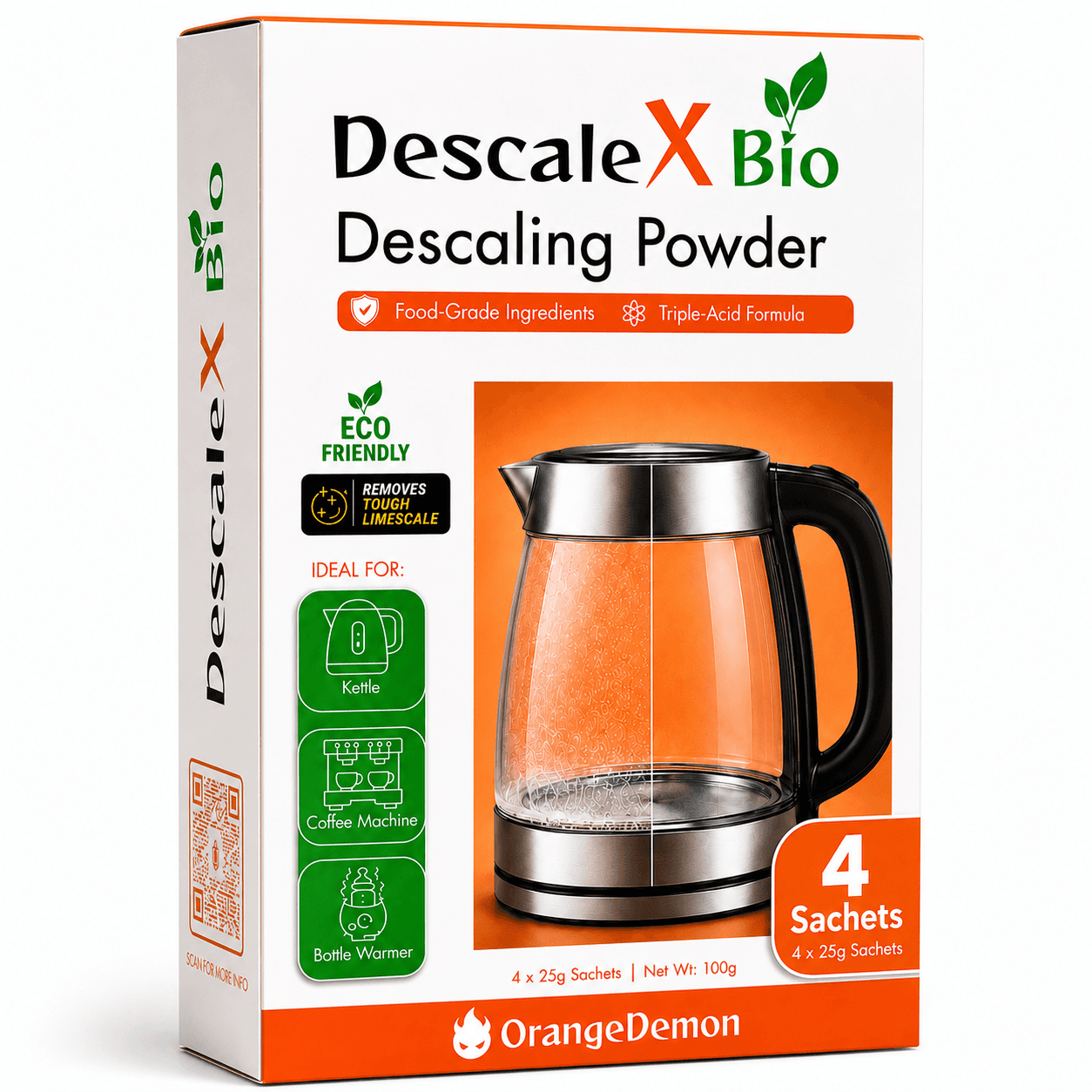
Which OrangeDemon product should I use for an electric kettle?
Use DescaleX Bio. It is the 100% food-grade kettle-side formula for drinking-water appliances like kettles, tea makers, and baby bottle warmers. Regular DescaleX is for coffee machines, dishwashers, and showerheads - and is the right choice for espresso machines with brass internals, which Bio cannot protect.
Hard water & scale2 questions
How is this different from cheap citric acid powder?
Plain citric is a single acid built for European water at 150-250 TDS. It clears light surface film but cannot penetrate dense old layers and has zero effect on iron deposits. DescaleX adds malic and tartaric acids for layered scale, EDTA for iron, gluconate chelation to stop redeposition, and BTA metal protection. At Indian TDS the difference shows in one clean.
Why does my appliance still have yellow-brown stains after other descalers?
That is iron, not calcium. Borewell water across North India deposits dissolved iron that citric acid cannot dissolve or hold. DescaleX carries disodium EDTA specifically to scavenge iron and manganese ions - the stains dissolve and rinse out instead of staying behind.
Orders & delivery1 questions
Is COD available?
Yes. Cash on delivery is available across India through our delivery partner. You can also pay online via UPI, cards, or net banking.
DescaleX
Rs.699
3 boxes / 12 sachets