
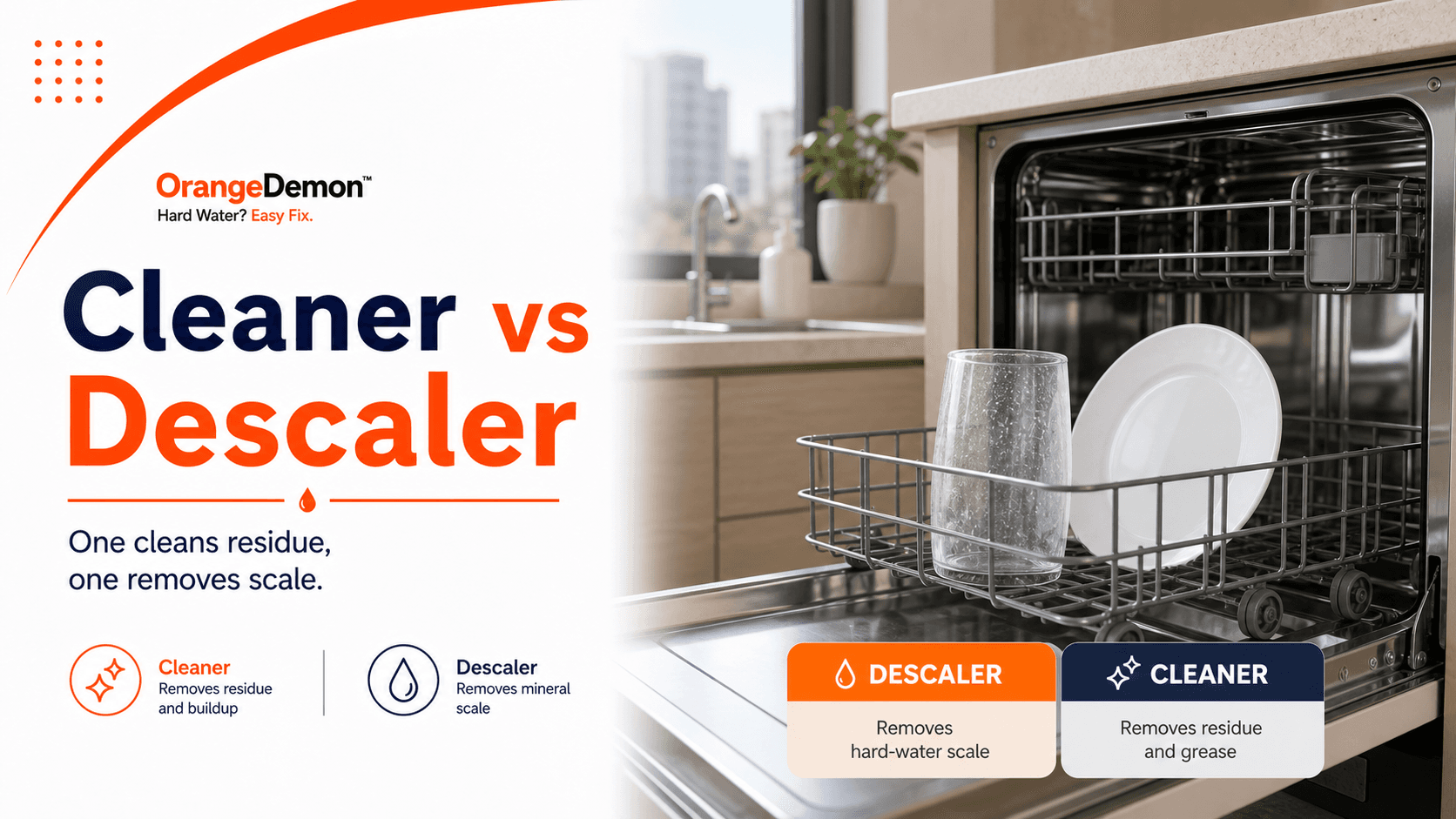
One of the most common dishwasher mistakes in India is using a cleaner when the machine actually needs a descaler.
The symptoms look familiar:
- white haze on glasses
- chalky deposits inside the tub
- weaker spray performance
- dishes that come out clean-looking but not truly clear
When that happens, a dishwasher cleaner may not fix much because it is solving the wrong problem.
Quick answer
A dishwasher cleaner removes grease, food residue, and smell. A dishwasher descaler removes hard-water mineral buildup. If your main issue is white film, cloudy glassware, or chalky deposits, you need a descaler. In OrangeDemon's lineup, that role belongs to DescaleX.
Best product route
| If your problem is | Best next page | Product route |
|---|---|---|
| Dishwasher white film or cloudy glassware | Dishwasher descaler product route | DescaleX |
| Your home also has hard-water TDS symptoms | TDS 400, 600, and 800 guide | DescaleX for dishwasher scale |
| Showerhead or coffee machine scale too | All product routes | DescaleX for rinse-clean appliance paths |
Short answer for buyers: dishwasher cleaner is for grease and smell; dishwasher descaler is for mineral film. Use DescaleX when the problem is hard-water scale, not food residue.
Why this confusion is so common
The word "cleaner" sounds broad enough to cover everything.
But dishwasher deposits usually fall into two different categories:
Cleaner problem
- grease
- food residue
- sludge near the filter
- stale odor
Descaler problem
- calcium buildup
- hard-water haze
- chalky white film
- scale inside spray arms and hot-water paths
Many Indian homes have both. But if hard water is the main problem, a cleaner-only cycle will not get to the root cause.
What hard water does inside a dishwasher
A dishwasher combines hot water, repeat cycles, and enclosed internal paths. That makes it a natural scale collector in hard-water homes.
Mineral buildup can collect on:
- the heating system
- spray arms
- tub surfaces
- hidden water channels
Siemens' dishwasher support guidance notes that limescale can affect the heating system and recommends descaling when calcification is the issue.
Signs you need a cleaner first
Start with a cleaner if:
- the machine smells bad
- the filter zone is greasy
- there is visible sludge
- you see food residue rather than chalky deposits
Signs you need a descaler first
Start with a descaler if:
- glasses come out cloudy or chalky
- the machine has white mineral marks
- drying quality has dropped
- spray pressure seems weaker
- the machine looks "clean" but still performs poorly
Sometimes you need both
This is the most honest answer.
A neglected dishwasher can have:
- organic grime
- mineral scale
Those are different deposits, so they may require separate maintenance cycles.
The simplest order is:
- run a cleaner cycle if smell and grease are obvious
- run a descaling cycle separately if white film and scale remain
Do not expect one chemistry to solve both jobs equally well.
Why this matters more in India
In hard-water conditions, dishwashers do not only deal with food residue. They also deal with repeated mineral loading from every hot wash.
That is why an Indian household can feel like the dishwasher is "aging fast" even when the real problem is just untreated scale.
Where DescaleX fits
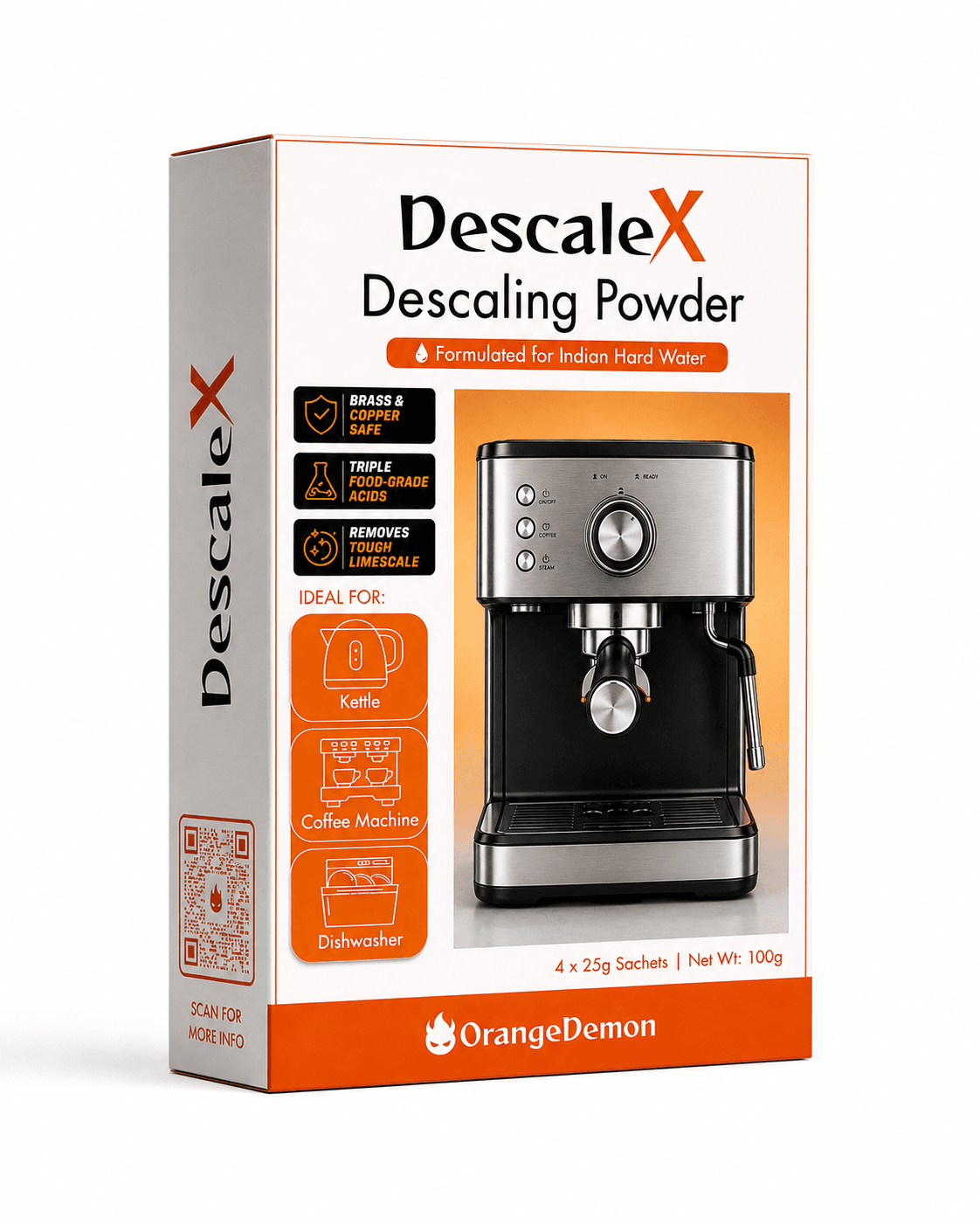
DescaleX is the mineral-scale side of dishwasher maintenance. It is not positioned as a degreasing dishwasher detergent. That is actually a good thing, because it keeps the expectation clear.
If your dishwasher problem is hard-water buildup, use a descaler.
How often should you descale a dishwasher
Use your water condition and machine behavior as a guide.
| Water condition | Practical dishwasher descale rhythm |
|---|---|
| Mild to moderate hardness | Every 3-6 months |
| Hard water | Every 2-3 months |
| Very hard water | Every 1-2 months |
| Severe hard-water symptoms | Monthly or whenever white film returns quickly |
If glasses are already coming out cloudy, you are past the point of "wait and see."
Short FAQs
Can dishwasher cleaner remove white film on glasses
Not reliably if the film is mineral scale. That is a descaling job, not just a cleaning job.
Why do my glasses stay cloudy after a cleaning cycle
Because grease may not be the problem. Hard-water minerals often leave a chalky haze that needs descaling chemistry.
Can I use descaler with dishes inside
No. Run descaling cycles with an empty dishwasher unless the product instructions say otherwise.
How do I know if I need cleaner or descaler first
If the issue is smell and sludge, cleaner first. If the issue is chalky film and mineral haze, descaler first.
Which OrangeDemon product is for dishwashers
Use DescaleX for dishwashers and coffee machines. Use WashDX for showerhead flow blockage. Keep kettles on DescaleX Bio.
The honest answer
If your dishwasher still leaves white film after a cleaner cycle, stop buying stronger cleaners and calling it maintenance.
You probably do not need harsher detergent chemistry. You need a real descaler.
Read next: Why Your Dishwasher Leaves White Film on Glasses in India
References
- Siemens: Dishwasher care and limescale guidance
- Siemens: Dishwasher error guidance mentioning descaling
- U.S. Geological Survey: Hardness of Water
If white film is your real dishwasher problem, use the chemistry built for scale. View DescaleX.
Follow OrangeDemon: Instagram | YouTube | Twitter / X