
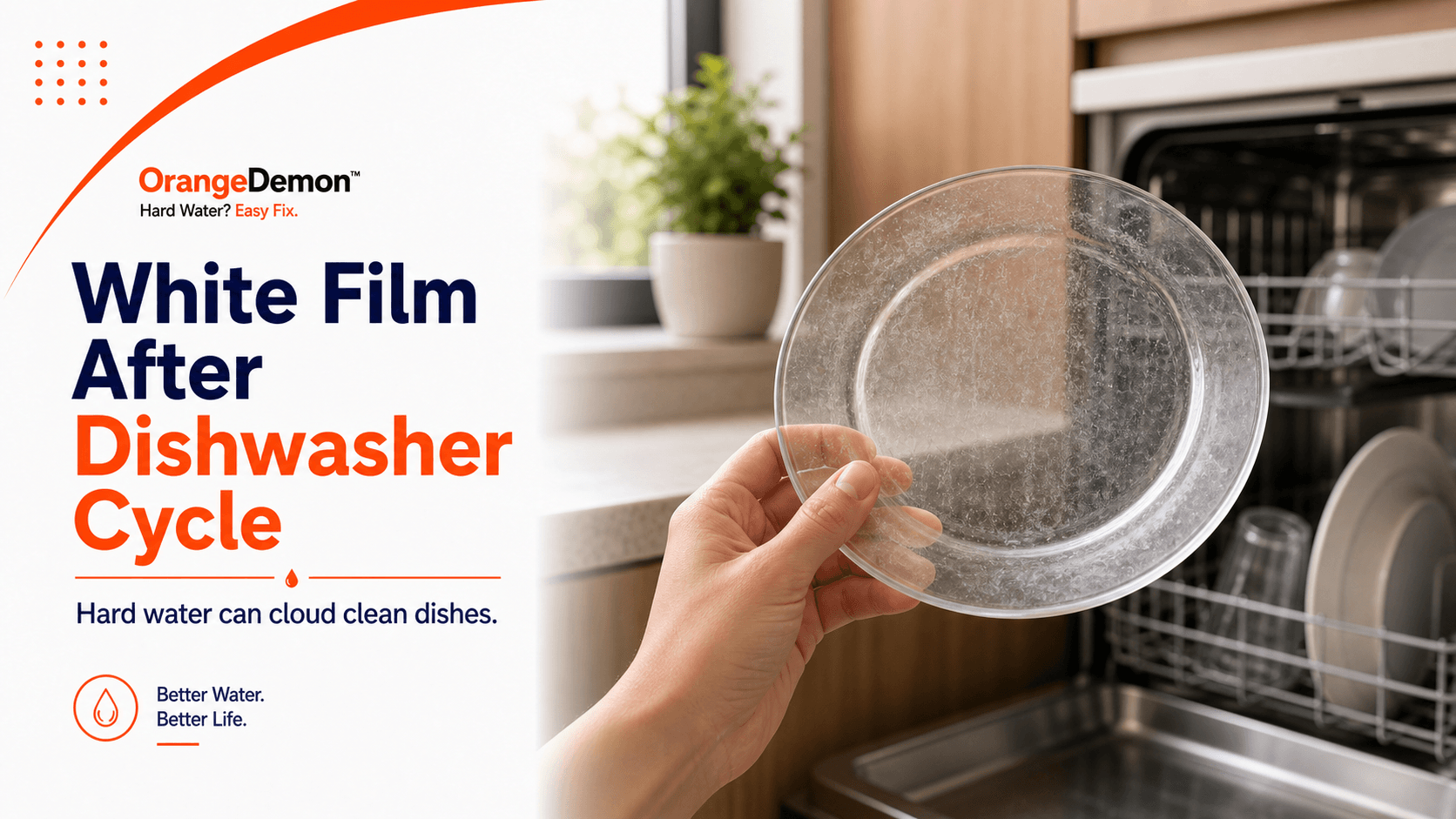
Quick answer: why dishes have white film after a dishwasher cycle
White film on dishes is often hard-water mineral residue, especially when glasses look cloudy and the dishwasher tub has chalky marks. Detergent changes may help if the film is soap or dosing residue, but existing mineral scale needs a dishwasher descaling cycle.
Just want the fix? For the full step-by-step routine, dose, frequency, and the best descaler to use, see our main guide: dishwasher white residue — diagnose and descale. This page focuses on telling hard-water film apart from permanent glass etching, which descaling cannot reverse.
Source context before changing detergent again
Hard-water scale comes from minerals such as calcium and magnesium, which can leave deposits as water is heated or evaporates (USGS hardness guide). Dishwasher brands also separate cleaning, salt/softener support, and descaling maintenance, which matters because white film is not always solved by one more detergent tablet (Bosch dishwasher descaling guidance).
| If the film looks like | More likely issue | Better action |
|---|---|---|
| Chalky white haze on glasses | Hard-water minerals | Descale empty dishwasher |
| Greasy or smelly tub | Food/organic residue | Clean filter and cleaner cycle |
| Salt warning or poor softener support | Softener/salt issue | Refill salt if model supports it |
| Permanent rainbow etching | Glass damage | Descaling may not reverse it |
Why dishes come out with white film
If your glasses, plates, or dishwasher walls look cloudy or white after a wash cycle, the issue may not be detergent alone. In hard-water homes, minerals can remain behind after water dries. Over time, those minerals build up inside the dishwasher and on dishes.
This is common in Indian homes because many water supplies have high mineral content. If the same white film appears even after changing detergent, hard water may be the real cause.
Dishwasher detergent cannot always remove scale
Dishwasher detergents are made to remove food soil, grease, and stains. They are not always enough to dissolve existing mineral deposits inside the machine. Once scale builds up, you need an acidic descaling cycle.
Which OrangeDemon product should you use?
For dishwashers, OrangeDemon DescaleX is the correct product. It is designed for coffee machines and dishwashers, with the chemistry and rinse profile suited to those appliance-side jobs.
How to descale a dishwasher with DescaleX
- Empty the dishwasher completely.
- Pour two sachets into the empty dishwasher drum.
- Run the hottest cycle.
- After the cycle, run one plain rinse cycle.
- Then load dishes again.
Do not mix descaler with detergent. Do not run descaling cycles with dishes inside.
How often should you descale a dishwasher?
- Soft water: every 4-6 months
- Moderate water: every 2-3 months
- Hard water: every 6-8 weeks
- Very hard/borewell water: every 4-6 weeks or repeat if film persists
If white film returns quickly, check water hardness, dishwasher salt settings, rinse aid, and detergent dose.
Descaler vs dishwasher salt
Dishwasher salt helps the machine's water softening system work properly. It helps prevent future scale. But if scale has already formed inside the machine, salt alone may not remove it. A descaler helps dissolve existing mineral buildup.
Both may be needed in hard-water homes: salt for prevention, descaler for maintenance.
Can you use WashDX in a dishwasher?
No. WashDX is for washing machines, geysers, boilers, water tanks, immersion rods, and RO pre-filter housings. For dishwashers, use DescaleX.
Final word
White film after dishwasher cycles is often a hard-water warning. If detergent changes do not solve it, descale the dishwasher. For Indian hard-water dishwashers, DescaleX is the correct OrangeDemon product.
If white film keeps returning, descale the machine with DescaleX — full routine in the dishwasher white residue guide.