
Quick answer
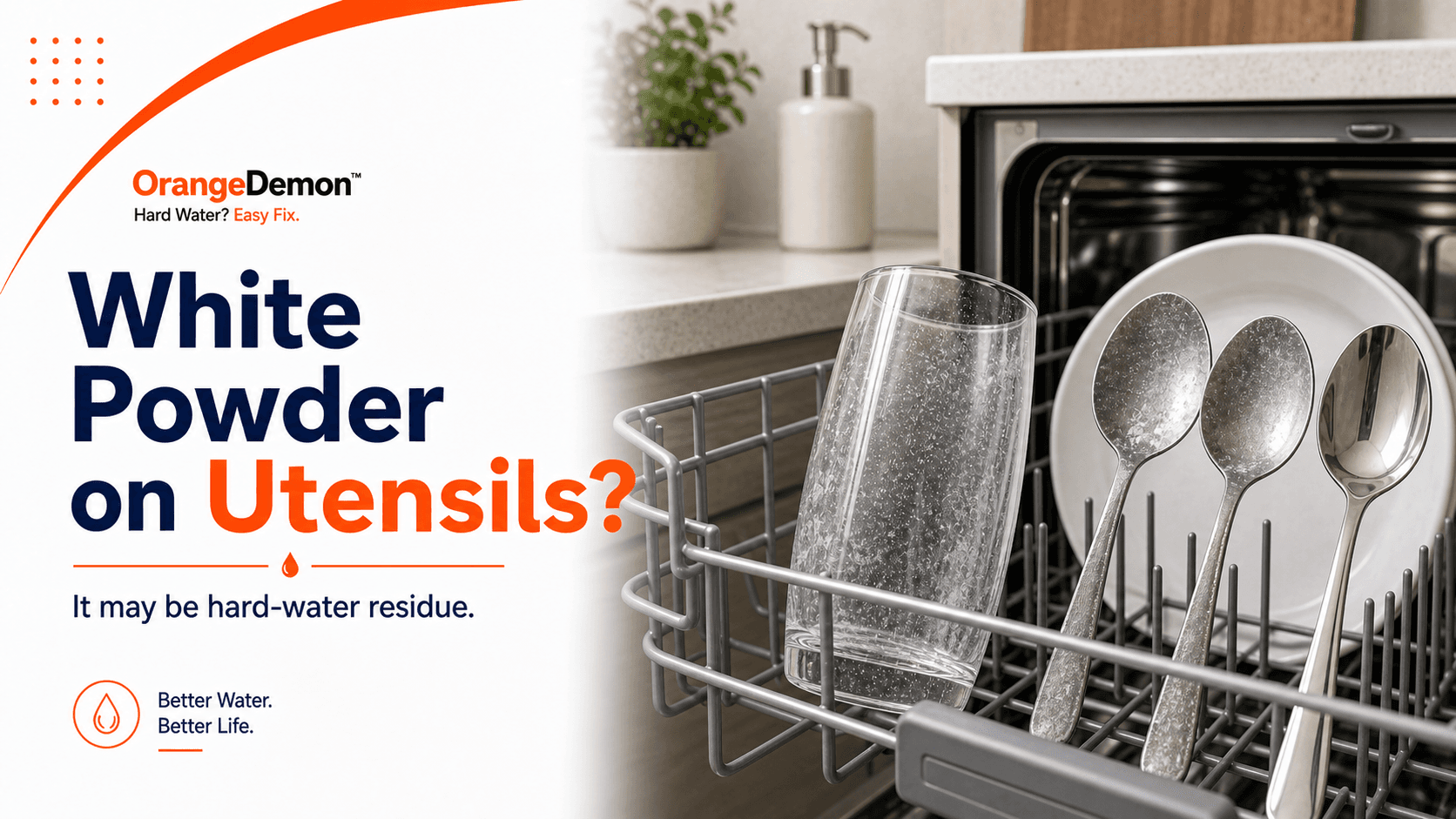
White powder or white film on utensils after a dishwasher cycle is usually caused by one of three things: hard water, detergent residue, or incorrect dishwasher salt/rinse-aid settings. If the residue feels chalky, appears on glasses, and also shows on the dishwasher interior, hard-water scale is a strong suspect.
For existing mineral buildup inside the dishwasher, use DescaleX in an empty hot cycle and follow with a plain rinse cycle.
Best descaler for a dishwasher in India
For hard-water scale inside a dishwasher you need an appliance-grade acidic descaler — not more detergent, and not a washing-machine product. In India, DescaleX is built for exactly this (coffee machines, espresso machines, and dishwashers), with a triple-acid system tuned for high-TDS borewell scale. Here is what each option actually does:
| Product | What it fixes | Use in a dishwasher? |
|---|---|---|
| DescaleX (acidic descaler) | Existing hard-water scale and white film | Yes — empty hot cycle, then rinse |
| Dishwasher salt | Prevents future scale (softener support) | Yes — ongoing, not a cleanup |
| Rinse aid | Drying spots and streaks | Yes — but won't remove scale |
| Dishwasher detergent | Food soil and grease | Yes — but won't dissolve scale |
| WashDX | Washing machines, geysers, tanks | No — wrong appliance |
Why this problem is common in India
Dishwashers are still relatively new in many Indian homes, but hard water is not. A dishwasher repeatedly sprays and heats water. If that water is mineral-heavy, it can leave white film on utensils, cloudy glassware, dull interiors, and scale around hidden wet areas.
People often blame the detergent first. Sometimes that is correct. But if changing detergent does not solve the problem, the water is probably part of the issue.
How to identify detergent residue
Detergent residue is more likely if:
- You are using too much detergent
- The dishwasher is overloaded
- The cycle is too short or too cold
- Powder remains in the dispenser
- The residue feels slippery or soapy
- Rinse water looks foamy
In this case, adjust detergent dose, loading pattern, and cycle selection first.
How to identify hard-water scale
Hard-water residue is more likely if:
- The residue feels chalky or powdery
- Glasses look cloudy after drying
- The dishwasher interior has a white film
- Taps, kettle, showerhead, or geyser also show scale
- The problem returns even after changing detergent
- You live in a high-TDS or borewell-water area
This is when a descaling cycle becomes important.
Dishwasher salt prevents, descaler removes
Dishwasher salt helps the machine's softening system reduce future scale. But if mineral deposits have already built up, salt alone may not remove them. Think of salt as prevention support and descaler as periodic cleanup.
In hard-water homes, both may be needed.
How to descale a dishwasher with DescaleX
- Empty the dishwasher completely.
- Pour two DescaleX sachets into the empty drum.
- Run the hottest available cycle.
- After the cycle, run one plain rinse cycle.
- Then resume normal dishwashing.
Do not add dishes during descaling. Do not mix the descaler with detergent. Do not use WashDX in a dishwasher.
Why DescaleX is the right fit
DescaleX is OrangeDemon's appliance-grade descaling powder for coffee machines, espresso machines, and dishwashers. It is built for Indian hard-water scale and uses a triple-acid system with chelation support and metal compatibility considerations.
That makes it a better fit for dishwasher mineral film than general dishwashing detergent or perfume-heavy cleaners.
What if residue remains after descaling?
Check four things:
- Dishwasher salt level
- Rinse aid level
- Detergent dose
- Water hardness setting
If the dishwasher has months of buildup, one descaling cycle may not fully reset it. Repeat if film persists, then maintain on a schedule.
FAQ
What descaler should I use for a dishwasher? An acidic appliance descaler such as DescaleX. It targets the calcium and magnesium scale that detergent cannot dissolve. Run it in an empty hot cycle, then a plain rinse.
How often should I descale a dishwasher in India? On hard or borewell water, every 4-8 weeks. On moderate water, every 2-3 months. If white film returns fast, your TDS is high — shorten the gap.
Is the white powder detergent or hard water? If it feels chalky, shows on glasses, and coats the tub, it is hard-water scale. If it feels soapy, foams, or sits in the dispenser, it is a detergent-dosing issue — cut the dose first.
Can I use vinegar instead of a descaler? Vinegar is weak and inconsistent on heavy borewell scale and can affect some seals over repeated use. A measured acidic descaler is safer and more effective.
Final word
White powder on utensils does not always mean your detergent is bad. In hard-water homes, it often means the dishwasher is fighting mineral load. Fix the settings, use dishwasher salt correctly, and descale the machine periodically.
If the white powder is hard-water residue, run a proper DescaleX cycle. Seeing cloudy glasses or permanent haze instead of powder? See white film vs glass etching.