
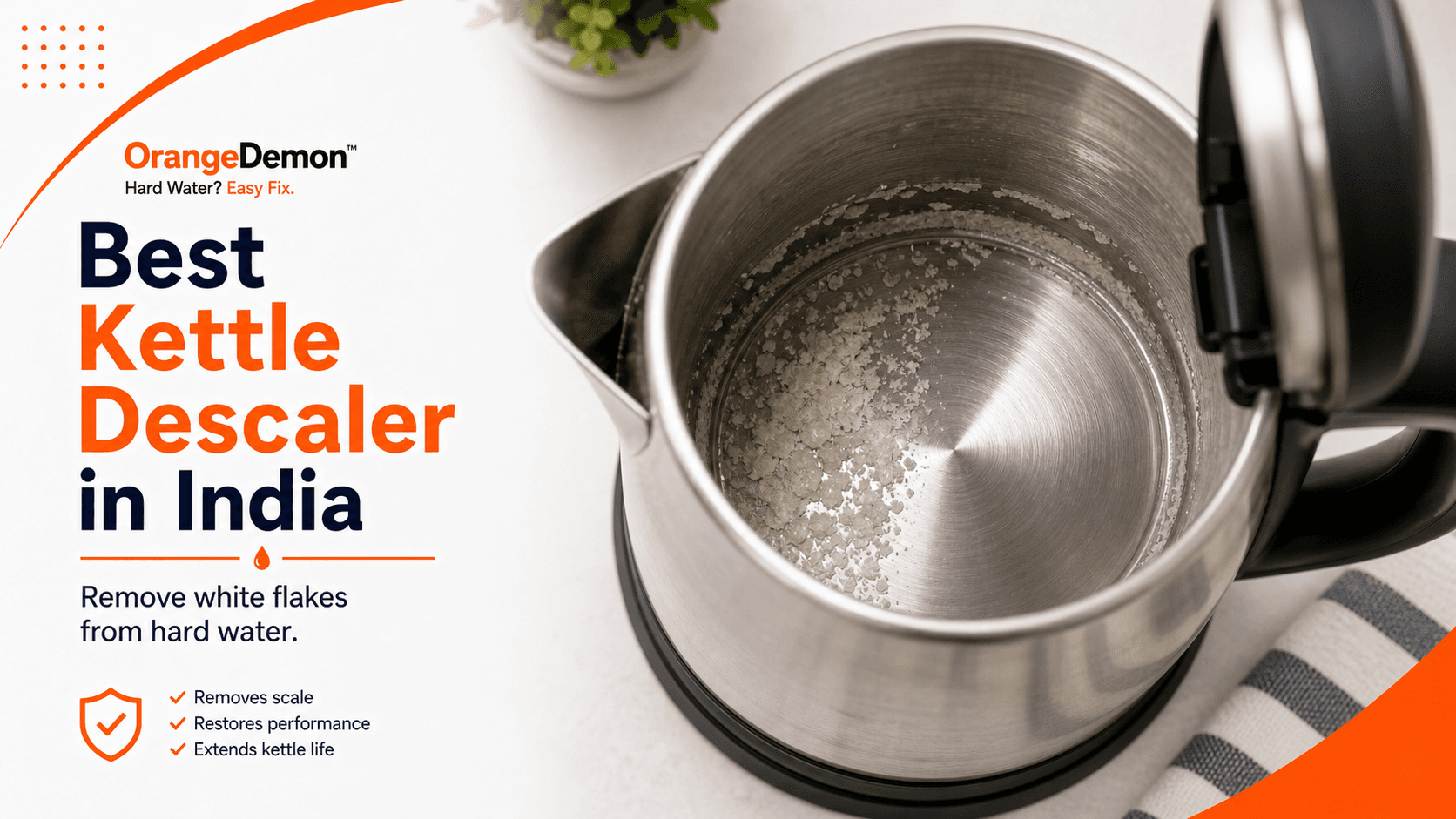
If your kettle is taking longer to boil, leaving white flakes in the water, or building a rough chalky crust inside, it usually is not a kettle-quality problem.
It is a hard-water problem — the TDS level in your city decides how fast the crust returns. If you just want the method, jump to how to descale an electric kettle step by step.
Kettles are one of the first appliances to show scale because they do the exact thing scale loves most: heat the same water again and again.
Quick answer
The best kettle descaling powder is one that dissolves mineral scale efficiently, rinses out cleanly, and is simple enough to use on a real maintenance schedule. In OrangeDemon's lineup, that role belongs to OrangeDemon DescaleX Bio.
Best product route
| If your problem is | Best next page | Product route |
|---|---|---|
| White flakes, cloudy kettle base, or slow boiling | Hard water and kettles | DescaleX Bio |
| You want the exact kettle buyer page | Kettle descaler product route | Buy DescaleX Bio |
| Your city is 400+ ppm TDS | TDS 400, 600, and 800 guide | DescaleX Bio on a schedule |
Short answer for buyers: kettles are food-contact appliances, so use DescaleX Bio rather than WashDX. WashDX is for washing machines, geysers, tanks, boilers, and immersion rods.
Why kettles scale so fast
A kettle is basically a hard-water stress test.
When water is heated repeatedly, dissolved minerals are more likely to drop out and attach to the heating surface. Over time, those deposits become visible limescale.
Scale in a kettle can lead to:
- slower boil time
- more electricity use
- white flakes in poured water
- reduced heater efficiency
- shorter element life over time
Philips notes that regular descaling helps prolong kettle life, and also recommends more frequent descaling in harder water.
Why Indian kettles often need more attention
In many Indian homes, kettle scale is not a once-or-twice-a-year issue.
If you live in a hard-water city or use borewell water, scale may return fast enough that descaling becomes part of normal monthly maintenance.
That is why kettle care should be built around repeatability, not rescue.
Descaling powder vs vinegar for kettles
Vinegar can work for kettles, and Philips includes it as an option. But that does not automatically make it the best default.
Here is the practical difference:
| Option | Strength | Drawback |
|---|---|---|
| Vinegar | Easy to find | Smell can linger, less tidy routine |
| Descaling powder | Purpose-made, compact, easier to dose | Needs you to keep a sachet ready |
If you descale rarely and do not mind the smell, vinegar can work. If you want a cleaner, repeatable routine for a household that scales up often, descaling powder is the better long-term answer.
Signs your kettle needs descaling now
Do not wait for the inside to look cemented over. Descale when you see:
- white or grey film inside
- rough deposits on the base
- boiling taking noticeably longer
- white particles floating in poured water
- the kettle getting ugly again very quickly after cleaning
How often should you descale a kettle
Use this as a practical guide:
| Water condition | Practical kettle descale rhythm |
|---|---|
| Mild water | Every 2-3 months |
| Hard water | Every 4-8 weeks |
| Very hard water | Monthly |
| Severe recurring scale | Every 3-4 weeks or as deposits reappear |
Philips recommends about every 3 months in soft water and about every
month in hard water. That lines up with what many Indian households
already experience.
Why OrangeDemon DescaleX Bio fits
OrangeDemon DescaleX Bio is the food-contact descaling option in the OrangeDemon range, intended for kettles, baby bottle warmers, and similar drinking-water appliances.
That matters because kettles need a cleaner ingredient story than coffee-machine or washing-machine descalers.
Short FAQs
Is kettle scale harmful
The bigger issue is appliance performance, not panic. Scale reduces efficiency and makes the kettle slower and harder to keep clean.
Can I use vinegar instead of descaling powder
Yes, you can for many kettles. But descaling powder is usually cleaner, easier to repeat, and better suited to households where scale returns often.
Why does scale come back so fast in my kettle
Because your water hardness is still the same. Descaling removes current buildup; it does not change the mineral load in the incoming water.
How often should I descale in a hard-water area
Monthly is a realistic starting point for many hard-water homes, then adjust based on how quickly deposits return.
Which OrangeDemon product is for kettles
Use OrangeDemon DescaleX Bio for kettles and other food-contact appliances.
The honest answer
If your kettle is scaling quickly, the goal is not just to clean it once. The goal is to make descaling easy enough that you actually repeat it before performance drops again.
That is why descaling powder usually beats improvisation.
Read next: Why Kettle Scale Comes Back So Fast in India
References
- Philips: Kettle descaling guidance and frequency
- De'Longhi kettle manual guidance mentioning regular descaling
- U.S. Geological Survey: Hardness of Water
If your kettle is the first appliance showing hard-water stress, start there and build the habit. View the DescaleX Bio kettle route.
Follow OrangeDemon: Instagram | YouTube | Twitter / X