
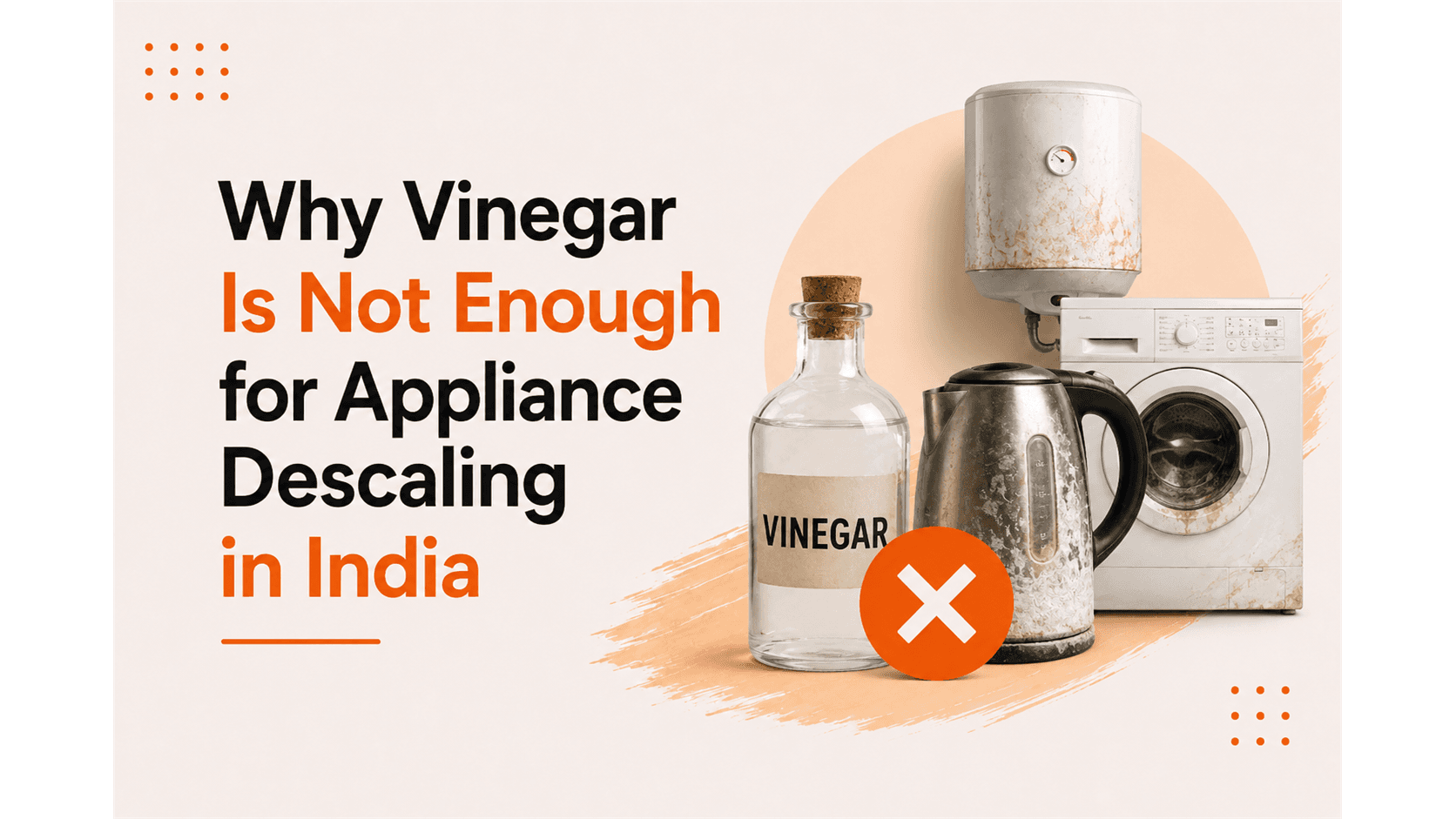
Vinegar is the most recommended descaling hack on the internet.
And that is exactly the problem.
It is the kind of advice that sounds sensible because it is familiar, cheap, and "natural." But appliance descaling is not a lifestyle trend. It is a chemistry and maintenance problem.
When you look at it that way, vinegar starts to look less like a smart default and more like a weak compromise.
Why vinegar became popular
Vinegar is acidic, and mineral scale needs acid to dissolve.
That basic idea is true.
The problem is that "acidic" is not the same as "ideal for repeated appliance maintenance in hard-water conditions."
In many Indian homes, the mineral load is simply too high for vinegar to be a consistently satisfying answer -- especially once deposits become dense, layered, or old. (Not sure how hard your water is? Start with what TDS and hard water mean.)
The issue is not whether vinegar can work at all
It can help on light scale in some cases.
The real question is whether it is the best choice for:
- repeated appliance use
- predictable results
- severe hard-water conditions
- people who want a maintenance system, not a one-off experiment
That is a different standard.
And under that standard, vinegar often falls short.
Problem 1: Indian hard water is not mild
A lot of online descaling advice comes from markets with relatively lower hardness or different appliance assumptions. In India, many homes deal with:
- borewell water
- municipal water with high dissolved solids
- year-round mineral exposure across multiple appliances
That means the scale problem is not occasional. It is structural.
A weak, improvised remedy feels cheap on day one and inefficient by month two.
Problem 2: Vinegar is messy as a maintenance habit
Even people who like vinegar usually admit the routine is not elegant:
- you guess the amount
- you hope the concentration is enough
- you repeat when the first try underperforms
- you deal with the smell
- you still need to rinse thoroughly
That is not a good maintenance product. That is a household workaround.
Problem 3: Appliance makers often prefer proper descalers
This is the part many people skip.
Manufacturers of appliances such as washing machines and coffee machines frequently recommend using purpose-made descalers and following machine- specific descaling routines, rather than improvising with household products.
That should tell you something.
Descaling is not just about removing visible scale. It is about doing it in a way that suits the appliance, the internal water path, and the expected maintenance cycle.
What a proper appliance descaler does better
A purpose-built appliance descaler gives you:
- clearer dosing
- a repeatable process
- chemistry intended for appliance scale
- easier pack planning across the home
- better fit for multi-appliance maintenance
OrangeDemon's descaling range is built around that logic.
It is not sold as a kitchen hack or bathroom myth. It is sold as an appliance descaler for:
- washing machines
- kettles
- dishwashers
- showerheads
That alone is a major difference. It is a maintenance product, not a substitution.
The better question to ask
Instead of asking: "Can vinegar descale"
Ask: "What is the most reliable way to keep my appliances free of hard-water scale in Indian conditions"
That question immediately changes the answer.
Now you care about:
- strength
- repeatability
- dosing
- convenience
- long-term use
And vinegar usually loses on those points.
Where vinegar still fools people
The first rinse after using vinegar can create a false sense of success.
The appliance may smell cleaner. Loose residue may come off. The visible surface may improve. But if the deeper buildup remains, performance issues come back.
This is especially common with:
- older washing machines
- kettles with heavy wall deposits
- dishwashers with repeated white-film problems
- showerheads with restricted flow
The real test is not "Did it look better today" It is "Did it stay better"
Why DescaleX is the better long-term buy
DescaleX solves the biggest practical weakness of vinegar: it turns descaling into a system.
Instead of buying random acids, guessing quantities, and repeating weak cycles, you get:
- fixed-dose sachets
- appliance-specific guidance
- multi-appliance usability
- pack sizes matched to household maintenance
For a one-time experiment, vinegar feels cheap.
For a real household routine, a proper descaler is cheaper in time, frustration, and repeated failed attempts.
The honest conclusion
Vinegar is not useless.
It is just over-recommended.
If your water is hard, your appliances are scaled, and you want reliable results, vinegar is usually not enough -- not because it is not acidic, but because it is not a proper maintenance solution for the scale burden many Indian homes actually face.
That is the difference between internet advice and appliance care.
Read next: Best Washing Machine Descaler in India
Fixed-dose descaling now comes in three lanes: OrangeDemon DescaleX Coffee for coffee machines, dishwashers, and showerheads; OrangeDemon DescaleX Bio for kettles and food-contact appliances; and WashDX for washing machines and geysers. See all OrangeDemon descalers.
Follow OrangeDemon: Instagram / YouTube / Twitter / X