
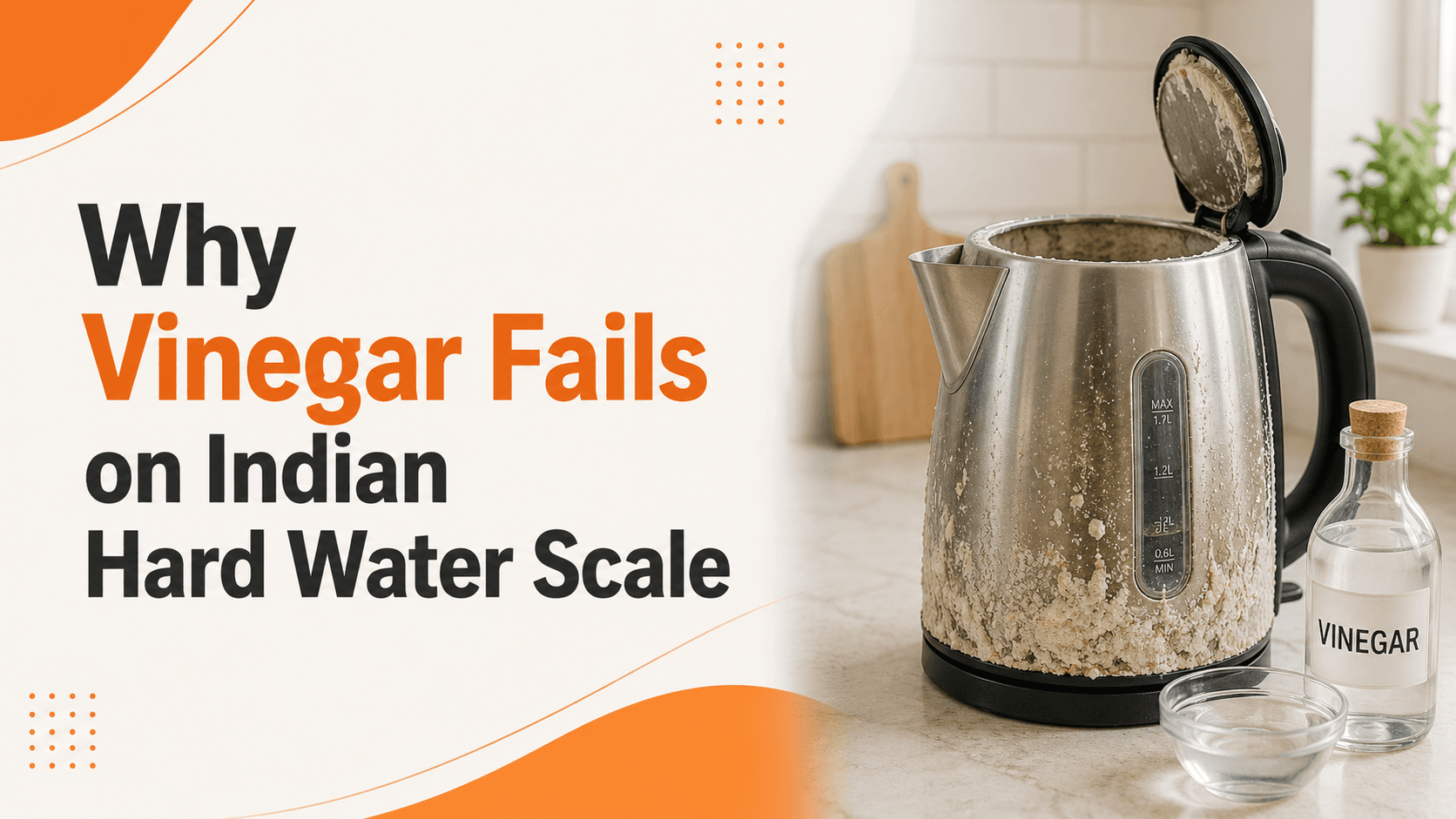
The internet has one answer for hard water stains: vinegar. It's cheap, it's natural, it's always in the kitchen. For mild scale in soft-water countries, it works. For India's 400--900 TDS borewell water, it's mostly a waste of time. Here's exactly why.
Why Acid Works on Scale --- The Basic Chemistry
Hard water stains are primarily calcium carbonate (CaCO3) and magnesium sulphate (MgSO4). These are alkaline mineral compounds. The only way to dissolve them is with acid - a substance with a pH below 7. Acid donates hydrogen ions (H+) that react with the carbonate group in calcium carbonate, breaking the compound apart into calcium ions, water, and carbon dioxide gas. The reaction is fast and complete. (New to this? See what TDS and hard water mean.)
This is why acid-based cleaners work and alkaline cleaners don't - it's not a matter of strength, it's a matter of chemistry. You can scrub alkaline cleaner into calcium scale forever and it won't dissolve because the pH environment doesn't allow the reaction.
Vinegar's Actual pH and Why It Isn't Enough
Household white vinegar (acetic acid) has a pH of approximately 2.4--3.4, depending on the concentration. Standard 5% vinegar is typically around pH 2.5. That sounds acidic - and it is. For light mineral deposits from water at 150--250 mg/L TDS, it can dissolve scale slowly.
The problem is that acid strength isn't just about pH - it's about the type of acid and its ability to sustain the reaction against a dense mineral layer. Acetic acid is a weak acid. It dissociates partially in water, which means there are fewer free H+ ions available for the dissolution reaction. On a thin film of scale, that's enough. On a dense crust of calcium carbonate built up by 700 mg/L water over weeks or months, it runs out of reactive capacity before it penetrates the layer.
Indian borewell water at 500+ mg/L deposits mineral layers orders of magnitude denser than European tap water at 150 mg/L, for which most vinegar cleaning advice was written. The recommendation isn't wrong for its original context. It's simply not fit for Indian conditions.
What Actually Works --- Strong Acid Systems
Effectively dissolving dense Indian scale requires acids that fully dissociate in water - what chemists call strong acids - or acid blends designed to work synergistically on different mineral compounds. Hydrochloric acid (HCl) is the traditional industrial choice, but it's corrosive to chrome, brass, and steel and releases toxic fumes. It's not suitable for bathroom use.
Modern professional formulations use combinations of organic and mineral acids that balance cleaning power with surface safety. Methane sulfonic acid (MSA) is particularly effective - it dissolves calcium and magnesium deposits efficiently, is biodegradable, and is substantially safer on metal surfaces than HCl. Gluconic acid and lactic acid provide additional cleaning action while buffering the overall pH to prevent damage to chrome and glass coatings.
The Vinegar Test You Should Actually Do
Here's a simple experiment: take a teaspoon of white vinegar and apply it to a patch of scale on your shower glass. Leave it for 10 minutes. Check if the scale has dissolved, softened, or is unchanged. If your TDS is below 250 mg/L, you'll probably see some softening. If your TDS is above 400 mg/L, the scale will be largely unchanged.
This isn't vinegar failing because you applied it wrong. It's vinegar failing because the chemistry is insufficient for the mineral density your water creates. No amount of soaking time or concentration will change the fundamental limit of acetic acid against dense Indian scale.
The Baking Soda and Vinegar Myth
The combination of baking soda (alkaline) and vinegar (acidic) is widely recommended as a 'powerful cleaning combo.' The reaction produces carbon dioxide bubbles, water, and sodium acetate. The bubbling looks dramatic and effective. In practice, the acid and the alkali neutralise each other, producing a solution that is close to neutral pH - exactly the worst possible environment for dissolving acid-resistant mineral scale. The fizzing is theatre. The cleaning effect is mostly mechanical, from the bubbles creating slight agitation on loose deposits.
TapStrike Intense is OrangeDemon's heavy-duty spray for limescale, hard-water marks and soap scum on taps, sinks, washbasins and glazed tiles. See TapStrike Intense.
Seen results with OrangeDemon? Share a before/after on Instagram @orangedemon.in or tag us on Twitter/X @OrangeDemonIn.
Follow OrangeDemon: Instagram / YouTube / Twitter / X