
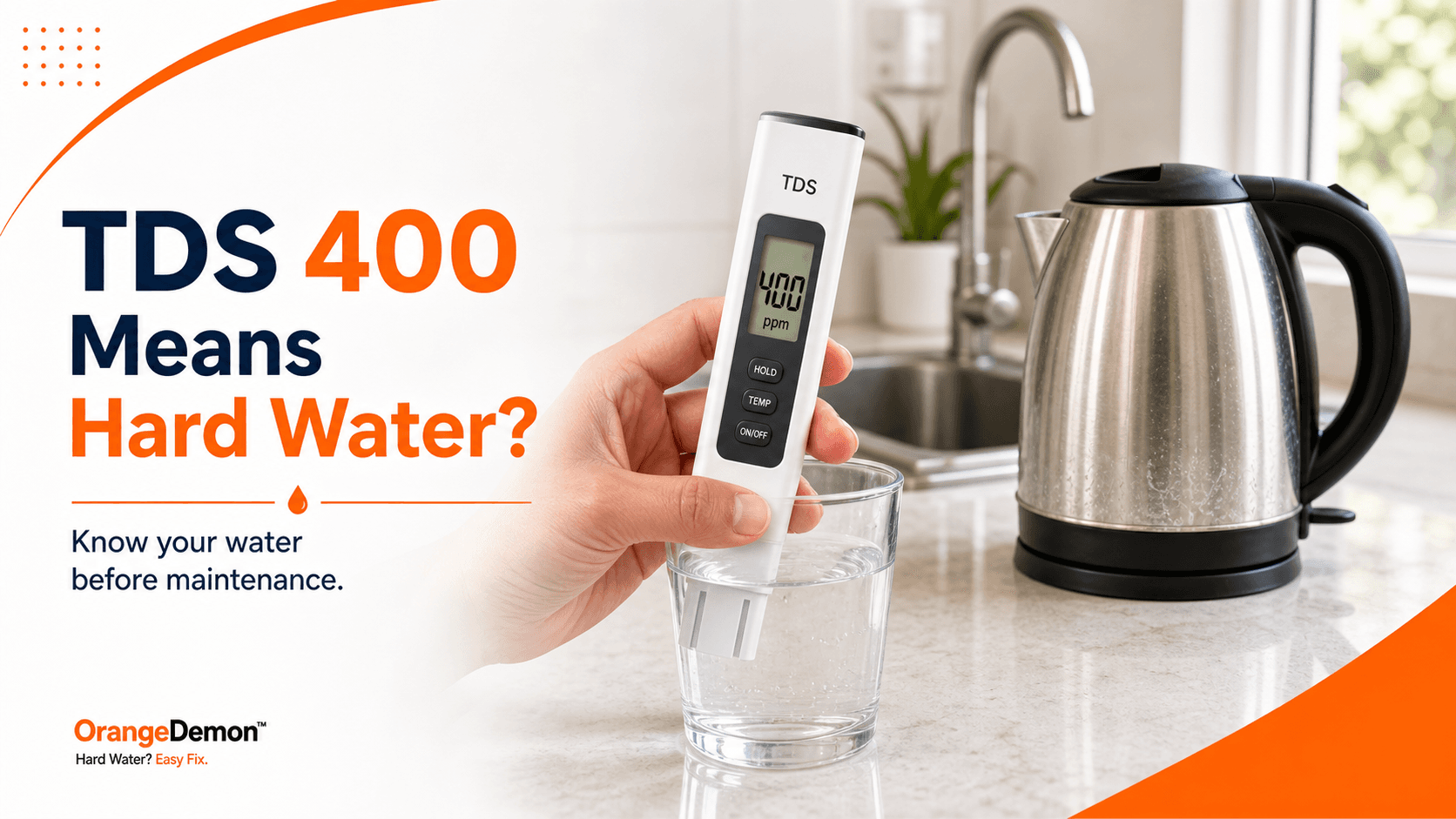
Quick answer: what does TDS 400 mean?
TDS 400 means the water contains about 400 mg/L of dissolved solids. In Indian homes, 400 ppm usually behaves as hard water: kettles scale faster, bathroom fittings get white residue, dishwashers can leave film, and washing machines or geysers need routine descaling.
TDS is not a complete drinking-water safety report. It is a mineral-load number. For OrangeDemon buyers, it is most useful because it predicts how quickly scale returns inside appliances.
Use TDS to set frequency. Use the appliance to choose the product.
Buyer guide: if your TDS is around 400 ppm or higher, choose by appliance before buying. Use DescaleX Bio for kettles, DescaleX for dishwasher or coffee-machine scale, WashDX for washers, geysers, and showerheads, or the Starter Combo when more than one appliance is scaling.
Source context: TDS, hardness, and scale are related but not identical
TDS is a total dissolved-solids number. Hardness is mainly the calcium and magnesium part of that mineral load. The U.S. Geological Survey explains hardness in terms of calcium and magnesium and the scale these minerals can leave behind (USGS hardness guide). The BIS drinking-water specification treats TDS, total hardness, calcium, magnesium, alkalinity, and other parameters as separate measurements, which is why TDS should not be used as a full safety report by itself (BIS IS 10500:2012 PDF).
TDS is useful because it helps predict how quickly scale will return. Your local water level and appliance symptoms should decide the exact routine:
| If you need | Better next page |
|---|---|
| City TDS or local water hardness | Check your city TDS |
| 400, 600, or 800 ppm meaning | TDS 400, 600, and 800 guide |
| Washing-machine scale | Washing-machine hard-water guide |
| Kettle scale | Kettle hard-water guide · how to descale a kettle |
TDS chart: TDS levels in water (ppm scale)
A TDS chart maps a meter reading (in ppm) to water quality. As a quick scale: 50-150 ppm is the ideal drinking range, up to 300 ppm is good, 300-500 ppm is hard and where appliance scale becomes active, and 500+ ppm usually needs treatment. In India, BIS IS 10500 sets 500 ppm as the acceptable limit and 2000 ppm as the maximum permissible when no better source exists.
| TDS reading (ppm) | Water quality rating | India / appliance note |
|---|---|---|
| 0-50 | Too low — flat taste, low minerals (over-purified RO) | Add a remineraliser; not a scale concern |
| 50-150 | Ideal — best taste and mineral balance | Minimal scale |
| 150-250 | Good — pleasant, safe daily range | Slow scale buildup |
| 250-300 | Acceptable — mild mineral taste | Scale starts to appear |
| 300-500 | Hard — BIS acceptable limit is 500 ppm | Appliance scale active; plan descaling |
| 500-900 | Hard to poor — treatment advised | Fast scale; borewell-grade |
| 900-2000 | Poor — BIS permissible maximum is 2000 ppm (no alternative source) | Heavy scale; RO plus routine descaling |
| Above 2000 | Not acceptable for drinking | Severe; treat the supply |
TDS is a mineral-load estimate, not a full safety test — the type of dissolved solids, metals, and biological quality also matter. Use this chart to read a TDS meter, then use the appliance-specific table below to decide what to descale first.
What 300, 400, 430, 560, and 600 ppm mean
| TDS reading | Practical meaning in Indian homes | Best next action |
|---|---|---|
| Below 200 ppm | Relatively soft for scale. Appliances still need normal cleaning, but mineral buildup is slower. | Check symptoms before buying a descaler. |
| 300-399 ppm | Scale is active. Kettles, showerheads, and washer drums can start showing residue. | Move from occasional cleaning to scheduled maintenance. |
| 400 ppm | Hard-water behavior. This is where scale becomes a practical household issue. | Choose the descaler by appliance, not by one generic acid powder. |
| 430 ppm | Firm hard water. Kettles and dishwashers usually show faster visible symptoms. | Use DescaleX Bio for kettles and DescaleX for dishwasher or coffee scale. |
| 560 ppm | High hard-water load. Geysers and washing machines should not wait for annual service. | Use WashDX for washer, geyser, boiler, tank, or immersion-rod scale. |
| 600+ ppm | Severe scale risk. Repeat maintenance matters more than one rescue clean. | Build a monthly or near-monthly routine for heavy-use appliances. |
Best product by TDS and appliance
| If the symptom is | Use this OrangeDemon product | Why |
|---|---|---|
| Kettle flakes, white ring, baby bottle warmer scale | DescaleX Bio | Food-contact product with rinse-first logic. |
| Dishwasher white film, cloudy glasses, coffee-machine slow flow | DescaleX or coffee guide | Rinse-clean appliance path for mineral film and flow issues. |
| Washing-machine residue, stiff laundry, geyser slow heating, showerhead blockage, immersion-rod crust | WashDX or geyser guide | Machine-side product for heater, drum, and flow scale. |
| More than one appliance is scaling | Starter Combo | Covers DescaleX, DescaleX Bio, and WashDX in one first order. |
Short answer for buyers: if your TDS is around 400 ppm or above, do not buy one vague descaler for everything. Match the product to the appliance: Bio for kettles, DescaleX for dishwasher and coffee jobs, and WashDX for washers, geysers, and showerheads.
Is 430 TDS water safe or hard?
430 TDS water is hard from an appliance-maintenance point of view. It can be drinkable or not depending on biological quality, metals, storage, and treatment, but the TDS number alone tells you mineral scale will be active.
For household maintenance, 430 ppm usually means:
- kettle scale returns quickly
- showerheads and taps get white residue
- dishwashers can leave cloudy glassware
- washing machines benefit from a planned descaling rhythm
Use a handheld TDS meter or the OrangeDemon TDS checker to confirm your local baseline before setting the schedule.
What does 560 TDS water mean?
560 TDS water is high enough that appliance scale should be treated as a routine cost, not a surprise. Heated appliances are the main concern because heat converts dissolved minerals into hard deposits faster.
At this level, prioritize:
- WashDX for washing machines, geysers, boilers, tanks, and immersion rods.
- DescaleX Bio for kettles and food-contact appliances.
- DescaleX for dishwashers, coffee machines, and espresso machines.
- WashDX for showerheads when flow holes are blocked by scale.
If the same home has kettle flakes, washer residue, and slow hot water, start with the appliance showing the strongest symptom, then set a repeat schedule.
What is a normal bath water TDS level?
There is no single normal bath water TDS level across India. Below 200 ppm usually feels low-risk for scale. Around 300-450 ppm, visible residue becomes common. Above 450 ppm, shower glass, taps, tiles, and showerheads usually need more frequent scale control.
Bath water TDS matters because bathroom water often bypasses drinking-water filters. Even if your RO water is low TDS, your shower, geyser, washing machine, and utility taps may still receive the hard building supply.
Why TDS is not the same as hardness
TDS measures all dissolved solids, not only calcium and magnesium. Hardness is specifically about scale-forming minerals. In practice, many Indian high-TDS homes also have scale symptoms, which is why TDS is useful as a first filter.
Use TDS to decide how seriously to investigate. Use visible symptoms and appliance behavior to decide what to descale first.
How to check your city's TDS
The fastest path is the OrangeDemon TDS checker. Enter your city or pincode to see the average TDS range, severity tier, and appliance maintenance direction.
The more precise check is to test your own tap:
- Fill a clean glass from the kitchen or utility tap.
- Dip a calibrated TDS meter.
- Test again from the bathroom or borewell-fed tap if your building has multiple sources.
- Use the highest daily-use reading to set appliance maintenance.
Final buyer answer
TDS 400 means your water is already in the hard-water zone for Indian appliances. At 430 ppm, scale is clearly active. At 560 ppm or above, washer and geyser maintenance should be planned, not delayed.
Start here: check your city TDS, then choose the product that matches the appliance: WashDX, DescaleX Bio, DescaleX, or the Starter Combo.