
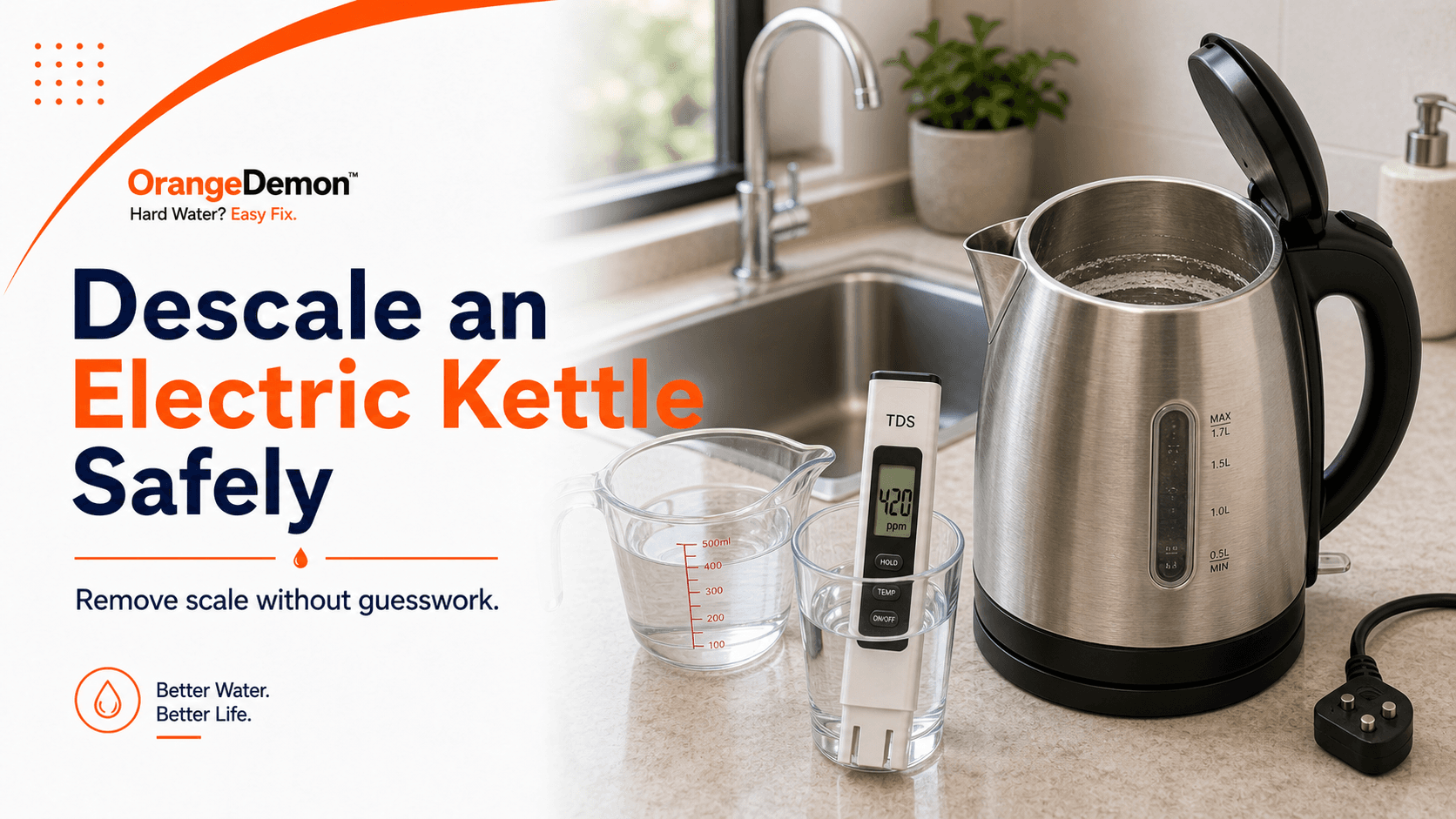
How to descale an electric kettle (step by step)
To descale an electric kettle, fill it with water and a food-safe descaler — descaling powder, citric acid, or diluted white vinegar — warm it without boiling, soak for 30 minutes, then pour out and rinse several times before use.
- Empty the kettle and add 500 ml of cold water.
- Add a food-safe descaler: one descaling-powder sachet, 1–2 tsp citric acid, or 1 part white vinegar to 3 parts water.
- Warm gently until just hot — do not boil the solution.
- Switch off and soak for 30 minutes (up to 60 minutes for heavy scale).
- Pour out the solution and rinse at least three times with clean water.
- Run one or two plain-water boils and discard before drinking use.
How often to descale in India: every 4–6 weeks above 500 ppm TDS, and every 2–3 months at moderate hardness (full TDS schedule below). For repeat use in hard-water cities, a triple-acid food-contact powder like DescaleX Bio clears both old and fresh scale in one soak, where single-acid citric or vinegar leaves the dense layers behind.
Open the kettle descaler buyer page or buy DescaleX Bio.
Safety check before you start
Kettle scale is usually calcium and magnesium residue left behind when hard water is heated. The U.S. Geological Survey notes that these minerals are the main drivers of water hardness and scale formation (USGS hardness guide). In India, TDS and hardness are separate water-quality measurements, so a high TDS reading is a useful scale warning but not a complete drinking-water safety test (BIS IS 10500:2012 PDF).
Use this rule before adding anything to a kettle:
| Situation | Use this route | Avoid this |
|---|---|---|
| Drinking-water kettle or tea kettle | Food-contact descaler plus repeated rinses | Washing-machine or geyser descaler |
| Baby bottle warmer | Gentle soak, no harsh cleaner, thorough rinse | Hot acidic solution on deformable plastic |
| Heavy white crust | Longer soak, then repeat later if needed | Scraping the heating plate aggressively |
| Persistent taste or smell after cleaning | More plain-water rinses | Drinking from it immediately |
Vinegar vs citric acid vs descaling powder: which works in India?
The three common home methods behave very differently at Indian TDS levels. Here is the honest comparison:
| Method | What it does well | Where it fails at Indian TDS |
|---|---|---|
| White vinegar | Removes light surface scale | Smell lingers after rinsing; needs many rinse cycles; ineffective on old dense layers at 400+ ppm |
| Citric acid powder (pharmacy grade) | Cheap, dissolves fresh calcium carbonate | Single acid — misses magnesium scale, leaves iron staining, no chelation to stop redeposition |
| Food-contact descaling powder (triple-acid + chelant) | Clears bulk, mid-layer and old scale in one soak; chelants prevent redeposition | Costs slightly more than pharmacy citric |
At Indian tap or borewell TDS of 300–700 ppm, single-acid citric acid clears the fresh film and leaves the dense old layers and any iron staining behind. Vinegar does the same, with stronger odour. A triple-acid formula with chelation (citric + malic + tartaric + gluconate) clears all layers in one soak and keeps dissolved minerals suspended so they drain out instead of redepositing.
If your kettle re-whites within 2–3 weeks after a citric or vinegar clean, your TDS is high enough to need a proper chelated formula.
How to tell your kettle needs descaling
| Sign | What it means |
|---|---|
| White or grey ring at the waterline | Calcium-magnesium deposits from repeated heating |
| Chalky flakes floating in boiled water | Scale breaking off the element; descale immediately |
| Kettle takes noticeably longer to boil | Insulating scale layer on the element — wastes electricity |
| Rough or textured coating on heating plate | Heavy buildup; may need two soak cycles |
| Cloudy glass on glass-body kettle | Scale film on interior glass |
Do not scrape scale off heating elements — scratching the surface accelerates future buildup.
Why your kettle gets white scale
If your electric kettle develops a white ring, chalky flakes, cloudy glass, or rough deposits on the heating plate, that is usually limescale. It forms when hard water is heated and minerals separate from the water.
In Indian homes, kettles often scale quickly because many areas have high-TDS water. If you boil water daily for tea, coffee, baby bottles, or cooking, the kettle becomes one of the first appliances to reveal hard-water behavior.
Kettle descaling steps with DescaleX Bio
- Empty the kettle completely.
- Add 500 ml cold water.
- Add one DescaleX Bio sachet.
- Stir or swirl gently to dissolve.
- Heat gently until warm, not boiling.
- Switch off the kettle.
- Keep the lid closed and soak for 30 minutes.
- Pour out the solution.
- Rinse at least three times.
- Run plain-water boils before drinking use.
For heavy scale, extend the soak to 60 minutes and repeat later if needed. Do not boil the descaling solution.
Why DescaleX Bio is the OrangeDemon kettle route
Kettles are food-contact appliances. Anything used inside them must rinse out properly and must fit surfaces that touch drinking water.
DescaleX Bio is the OrangeDemon food-contact descaling route for:
- electric kettles
- stovetop kettles
- baby bottle warmers
- tea makers
- rinse-critical food-contact appliances
It is separate from WashDX, which belongs to washing machines, geysers, tanks, boilers, and immersion rods.
How often should you descale a kettle?
| Water condition | Kettle descale rhythm |
|---|---|
| Lower TDS, slow scale return | Every 4-6 months |
| Moderate TDS | Every 2-3 months |
| 300-500 ppm hard water | Every 6-8 weeks |
| 500+ ppm or borewell water | Every 4-6 weeks |
| White ring returns within two weeks | Descale now and check city TDS |
Use the TDS checker if you want to compare your city baseline with your scale-return speed.
A faster way to judge frequency: if white film returns within 2–3 weeks of a clean, you are in the 4–6 week cycle. If it comes back in 6–8 weeks, you are in the 2–3 month window. Cities like Delhi, Faridabad, Gurgaon, Nagpur, Jaipur, Ahmedabad and Surat typically sit in the 4–6 week bracket; Mumbai, Bengaluru and Chennai borewell users vary by area.
Can you use vinegar?
Vinegar can remove light kettle scale, but it smells strong and can leave taste behind. It can also need multiple rounds in glass kettles or high-TDS homes.
For repeat use, a measured food-contact descaling powder is easier to dose and easier to build into a routine.
How to descale a kettle with citric acid if you want a home method:
- Dissolve 1–2 teaspoons of food-grade citric acid in 500 ml cold water.
- Pour into the empty kettle. Warm gently — do not boil.
- Soak 30–45 minutes. Pour out.
- Rinse 3–4 times with fresh water, run one plain-water boil, discard.
This works for light-moderate scale. For heavy buildup or borewell water, a triple-acid chelated formula clears what citric leaves behind.
Baby bottle warmer and food-contact caution
For baby bottle warmers, unplug the warmer, dissolve one sachet in warm water, soak without heating, then rinse thoroughly and air dry.
For baby bottles themselves, use a gentler half-sachet routine only when appropriate for the material, rinse under running water, and air dry. Never use hot acidic solution on plastics that can deform.
What not to use in a kettle
Do not use:
- WashDX
- bathroom cleaners
- bleach
- detergent
- toilet cleaner
- unlabelled acid powder
- descaler meant only for geysers or washing machines
Also avoid using DescaleX Bio on espresso machines with brass internals. For coffee and espresso machines, use the DescaleX coffee route and follow the machine manual.
What happens if you do not descale your kettle
Scale is a thermal insulator. A kettle with heavy limescale buildup uses measurably more electricity per boil than a clean one — the heating element has to push heat through a mineral jacket before the water receives it. At 400–600 ppm TDS, this effect shows within 2–3 months of skipped cleaning. Over a year, the energy difference from a single scaled element is small per boil but constant, 365 days compounding. The element itself runs hotter when insulated, which shortens its life.
The economic argument is simple: one DescaleX Bio sachet every 4–6 weeks costs less than the extra electricity a scaled element burns in the same month.
Kettle descaling: what to check after cleaning
- Water boils back to normal speed: yes — element is clear
- No chalky taste in boiled water: yes — rinse was thorough
- White film returns in less than 2 weeks: scale is heavy, consider a second soak or check your TDS
If taste or smell persists after 3+ rinse cycles and plain-water boils, run one more rinse cycle. DescaleX Bio acids are food-grade and biodegradable — they rinse out completely.
Final buyer answer
If the query is "how to descale kettle," the safe buying answer is food-contact descaling, clear rinsing, and repeat maintenance. In OrangeDemon's range, that means DescaleX Bio.
Start here: Kettle descaler India.