
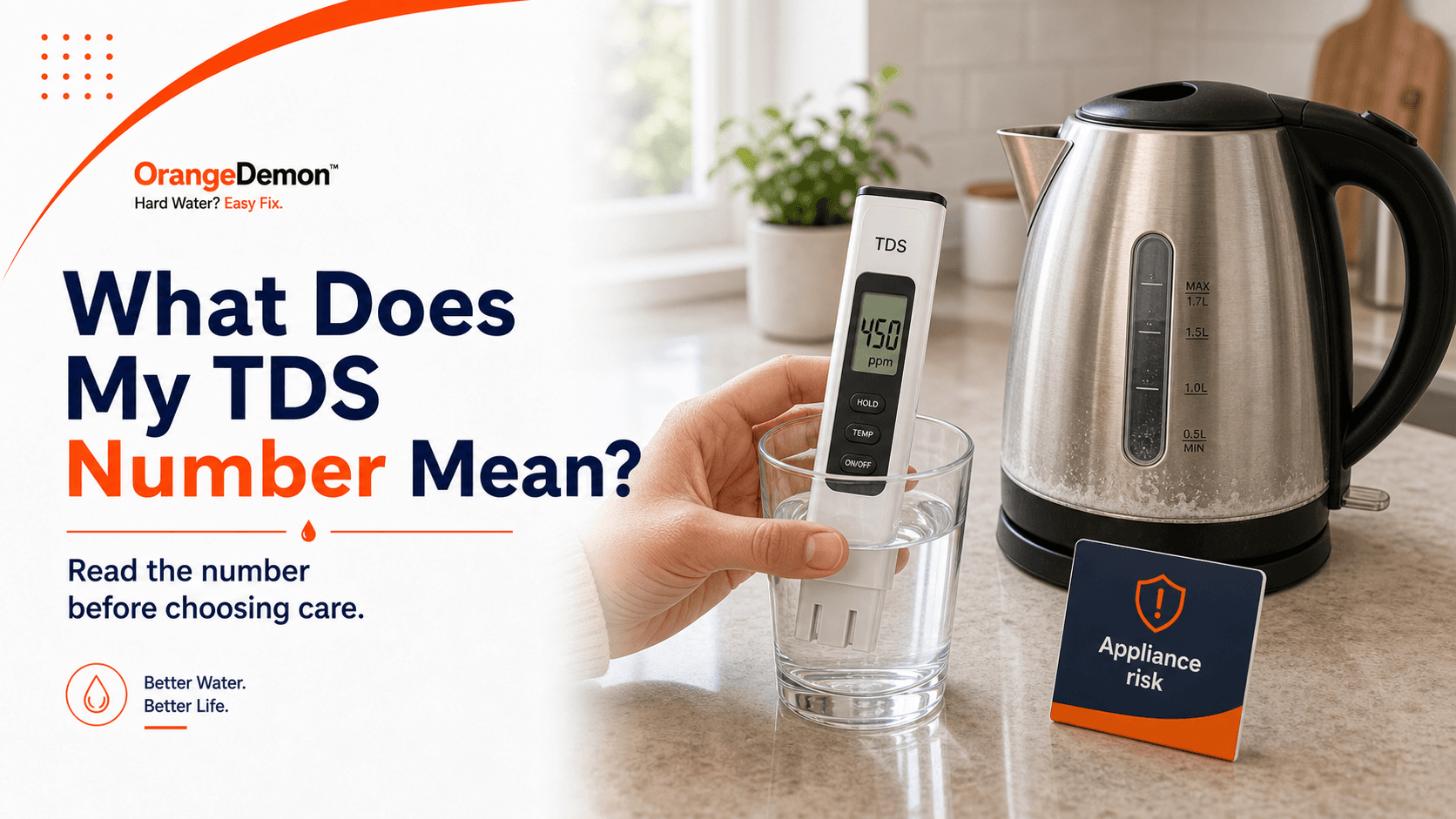
You checked your water's TDS - or you've seen a number on a report or an app - and now you want to know what it actually means. Not a technical definition. What it means for your kettle, your washing machine, your geyser, and your bathroom.
Here's a direct breakdown by TDS band.
Quick answer: what your TDS number means
For Indian appliance maintenance, TDS below 300 ppm is usually a lighter scale signal, 300-450 ppm is active hard-water maintenance territory, 450-600 ppm is high scale risk, and 600+ ppm needs a stricter routine. TDS does not prove drinking-water safety by itself, but it helps decide how seriously to maintain kettles, washing machines, geysers, and bathroom fittings.
What TDS Measures
TDS stands for Total Dissolved Solids - the concentration of all dissolved minerals in your water, measured in ppm (parts per million) or mg/L (the same unit). The primary minerals in Indian water are calcium and magnesium carbonates and bicarbonates. These are the compounds that form white scale on heating elements and surfaces.
The higher the number, the more mineral is deposited every time water is heated or evaporates. For the full explainer on how TDS and hard water work in Indian homes, see what TDS and hard water actually mean.
Quick answer: 400 TDS means hard water for most Indian homes. 430 TDS water is firmly hard and should be treated as a monthly-maintenance signal for kettles, washing machines, and heater-side appliances. Bath water at these levels can leave white residue on glass, taps, tiles, and showerheads.
Source context before interpreting the number
Use TDS as a scale-risk signal, not as the whole water-quality report. The U.S. Geological Survey explains that hard-water scale is mainly driven by calcium and magnesium minerals (USGS hardness guide). The BIS drinking-water specification separates TDS, total hardness, calcium, magnesium, and alkalinity, so two homes with similar TDS can still behave differently depending on mineral mix and appliance use (BIS IS 10500:2012 PDF).
| TDS question | Better interpretation |
|---|---|
| Is this safe to drink? | TDS alone is not enough; use a full water-quality test for safety |
| Will appliances scale? | TDS plus visible symptoms is a strong maintenance signal |
| How often should I descale? | Use TDS band, appliance type, and scale-return speed |
| Which product do I buy? | Match the descaler to the appliance, not only the number |
Best next page by intent
| If you came here to decide | Best next page | Product route |
|---|---|---|
| What 400, 600, or 800 ppm means | TDS 400, 600, and 800 guide | Choose by appliance |
| What to do for a washing machine | Hard water and washing machines | WashDX |
| What to do for a kettle | Hard water and kettles | DescaleX Bio |
| What to do for a geyser | Hard water and geysers | WashDX |
Short answer for buyers: if your TDS is above 400 ppm, pick the descaler by appliance. Use DescaleX Bio for kettles, DescaleX for coffee machines, dishwashers, and showerheads, and WashDX for washing machines, geysers, tanks, boilers, and immersion rods.
Below 200 ppm - Soft Water
Where you'll find it: Kerala, Assam, Himachal Pradesh hill stations, Manali, Coorg.
What it means: This is soft water. Scale forms very slowly - a kettle might take 6-12 months to show any visible deposits. Your bathroom glass will stay cleaner longer. Washing machines can run for years without descaling and not show meaningful efficiency loss.
What you should do: Descale appliances once or twice a year as preventive maintenance. Not urgent. You're in a small minority of Indian households with genuinely soft water.
200-300 ppm - Low Hardness
Where you'll find it: Coastal Karnataka, Goa, much of Kerala, parts of Meghalaya and Manipur, Himalayan foothills cities.
What it means: Light scale over several months. You'll see white marks around tap bases and on chrome within 3-4 months. Kettle element shows light coating within 6 months. Not aggressive - manageable.
What you should do: Quarterly appliance descaling keeps machines running at efficiency. Wipe bathroom chrome weekly. No urgency, but neglecting it for a year means buildup starts hardening.
300-450 ppm - Moderate Hardness
Where you'll find it: Chandigarh (~380 ppm), Ludhiana (~380 ppm), Amritsar (~360 ppm), Pathankot (~330 ppm), Dehradun (~250 ppm), Pune (~300 ppm), much of Punjab, coastal Maharashtra.
360 ppm specifically: This is typical Punjab/Haryana foothills water. You'll see kettle scale build up over 2-3 months of daily use. A white film appears on chrome taps within 2 months. Washing machine drum shows deposits within 8-10 months. Quarterly descaling is the correct interval.
430 ppm specifically: Common in central Haryana, NCR fringe, eastern UP. Faster than 360. Kettle needs attention every 6-8 weeks. Washing machine: monthly descaling is justified. At this level you can feel the water is "harder" - soap doesn't lather as easily.
What you should do: Monthly or quarterly descaling depending on whether you're closer to 300 or 450. Kettle is the first to show symptoms - use it as your indicator.
450-600 ppm - High Hardness
Where you'll find it: Delhi (400-550 ppm depending on zone), Gurgaon (~480 ppm), Noida (~520 ppm), Hyderabad (~420 ppm), Nagpur (~510 ppm), Faridabad (~520 ppm), most of Haryana, central UP.
What it means: This is the most common TDS band for major Indian cities. Scale is a real, active problem.
- Kettle: White crust visible within 4-6 weeks of daily use. Boil time increases measurably over months.
- Washing machine: Element and drum accumulate deposits within 6 months. Monthly descaling is the right baseline.
- Geyser: Significant scale within 12-18 months. Heating will slow. Rumbling sounds are scale cracking.
- Bathroom: Tap bases and shower glass show deposits within weeks. Chrome loses its shine. Shower glass etches over time if deposits are left to bond.
560 ppm specifically: This is close to EXTREME tier. You're probably in Delhi NCR, Jodhpur fringe, or central Rajasthan. Monthly descaling for all appliances. Geyser servicing every 4-6 months.
What you should do: Establish a monthly descaling routine. First-clean with 2 sachets if machines haven't been serviced in 6+ months.
600-800 ppm - Extreme Hardness
Where you'll find it: North Delhi (~600-640 ppm), Jaipur (~580-620 ppm), Jodhpur (~650 ppm), Ajmer (~620 ppm), Alwar (~580 ppm), Rajasthan interior, some Gujarat cities.
What it means: Hard water is your appliances' primary adversary at this level.
- Kettle: Significant scale within 3-4 weeks. The element can become completely coated in 3 months without maintenance.
- Washing machine: Monthly descaling is mandatory, not optional. Without it, efficiency drops measurably within a year and element failure risk rises sharply by year 3-4.
- Geyser: Annual professional service is justified. The element can fail within 4-5 years without maintenance.
- Bathroom: Shower glass etches. Chrome pits. White mineral stains bond within days after cleaning.
What you should do: For washing machines, start with 2 WashDX sachets on the first clean if the appliance has never been descaled before, then maintain monthly with 1 sachet. Use DescaleX Bio separately for kettles, use DescaleX for coffee machines and dishwashers, and use WashDX for showerhead flow loss. Do not skip months - recovery descaling is harder than maintenance descaling.
Above 800 ppm - Very Extreme Hardness
Where you'll find it: Bikaner (~770 ppm), Churu (~700 ppm), Nagaur (~710 ppm), Sri Ganganagar (~700 ppm), Hanumangarh, deep Thar Desert zones, some parts of coastal Gujarat near the Rann.
What it means: This is industrial-level mineral load in a residential context. Appliances at this level face scale accumulation rates that standard maintenance schedules don't account for.
- Kettle: Needs descaling every 2 weeks. The element can become unusable in 6-8 weeks without treatment.
- Washing machine: Descale every 2-3 weeks. Start with 2 WashDX sachets on the first clean.
- Geyser: Professional servicing every 3-4 months is realistic in Bikaner and Churu.
- Shower glass: May be beyond saving with standard cleaners after 6+ months without treatment. Acid gel (Fighter) is the only thing that works on hardened mineral glass bonds at this TDS.
What you should do: Start with 2 WashDX sachets on the first washing-machine clean, then continue bi-weekly maintenance with the correct product for the appliance. Use DescaleX Bio for kettles, use DescaleX for coffee machines and dishwashers, and use WashDX for showerhead flow loss. Accept that appliance replacement cycles will be shorter than in softer-water cities unless maintenance is consistent.
How to Find Your Exact TDS
Three options:
-
Free online check: orangedemon.in/check-tds - enter your pincode or city name. Returns your area's average TDS, tier, and recommended maintenance schedule. 4,940 towns covered.
-
TDS meter: Available on Amazon and Flipkart for Rs.200-Rs.500. Accurate for your specific tap. Different floors in the same building can read differently depending on tank age and pipe material.
-
Municipal water quality reports: Your local municipal body publishes annual water quality data. Find it by searching "[your city] water quality report annual."