
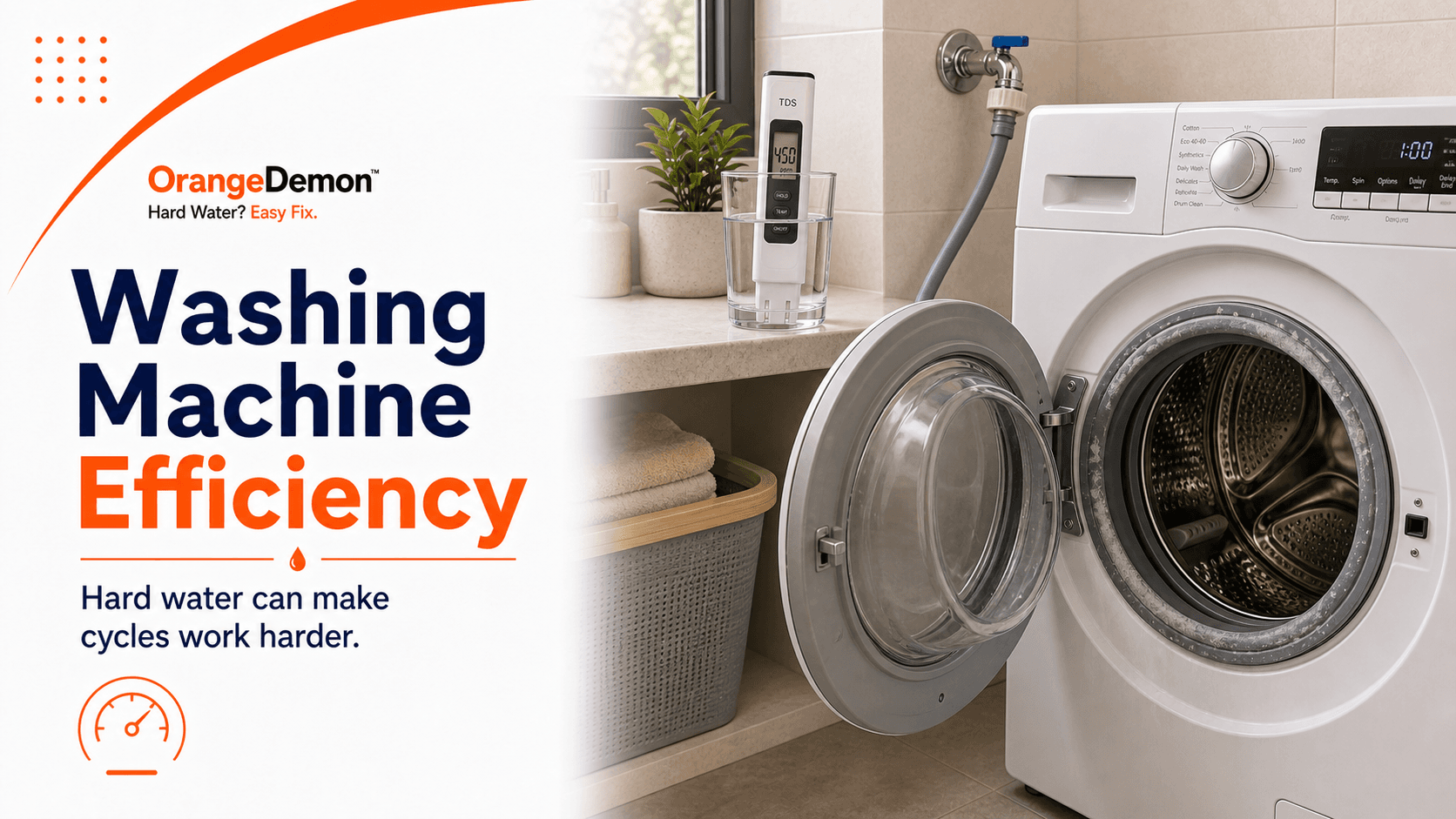
A front-load washing machine bought in Delhi or Jaipur will not perform the same in year 3 as it did in year 1 - not because of product quality, but because of what's in your water.
At 400-600 ppm TDS, mineral scale accumulates on two critical surfaces: the stainless steel drum interior and the heating element. Both reduce efficiency. The element degradation is the more expensive problem.
This is not a new appliance vs old appliance issue. It's a maintained appliance vs unmaintained appliance issue. A 4-year-old machine that's been descaled monthly will outperform a 2-year-old machine that's never been descaled in the same city.
What Scale Does to a Washing Machine
The drum: Hard water deposits calcium carbonate on the stainless steel drum interior, door gasket, and soap dispenser. You'll see white patches, a rough texture on the drum surface, and detergent residue that doesn't rinse away. This is cosmetic but also functional - rough scale traps detergent, creates odour, and can transfer mineral staining to clothes.
The heating element: This is the critical failure point. Washing machines with a heater (front-loaders with temperature cycles) accumulate scale on the heating element exactly as a kettle does. A scaled element runs hotter than rated (because heat cannot transfer efficiently into the water), draws more electricity, and has a shorter lifespan.
The pump and pipes: Fine scale particles that break loose from the drum circulate in the wash cycle and can accumulate in the pump impeller and drain pipe. Over years, this reduces drainage efficiency.
How Fast Does This Happen
At 500 ppm TDS - typical of Delhi, NCR, central Haryana - a front-load washing machine running one daily hot wash cycle will have visible scale on the drum within 6-8 months. The heating element will have a light coating. By 18 months, the element coating is significant enough to affect efficiency measurably.
At 600+ ppm - North Delhi, Jaipur, Jodhpur - the same timeline is accelerated. Drum scale appears within 4-5 months. Element efficiency loss within 12 months.
At 300-400 ppm - Punjab, Chandigarh, parts of Maharashtra - scale is slower. Drum deposits appear within 10-12 months. The element can run for 2+ years before efficiency loss is noticeable.
Signs Your Washing Machine Has Scale Buildup
White patches or rough texture inside the drum. Run your hand across the drum interior - it should be smooth. Roughness or white patches mean scale.
Clothes not coming out as clean or bright as before. Scale on the drum traps detergent residue. Clothes cycling against a scale-coated drum surface pick up a dull grey cast over time.
Washing machine smells. Scale traps detergent and organic matter. The combination creates the distinctive washing machine smell that no amount of cleaning with standard detergent eliminates. Descaling dissolves the mineral matrix that's trapping the smell.
Higher electricity bill. Difficult to isolate to the washing machine specifically, but a scaled heating element is a real electricity drain.
Cycle takes longer than expected. A scaled element heating water to 60 deg C (a standard hot wash) takes longer. The cycle doesn't end on schedule.
How to Descale Your Washing Machine
What you need: One WashDX sachet (50g). No other cleaner, detergent, or bleach.
Step 1: Empty the machine completely - no clothes, no detergent.
Step 2: Pour WashDX directly into the drum: 1 sachet for front load, 2 for top load. Do not put it in the detergent drawer.
Step 3: Select the longest programme with normal tap water. No hot setting needed.
Step 4: Run the full cycle. You may notice the drum interior looking cleaner even from the door during the wash - the effervescent reaction (fizzing) is visible and confirms the acids are active.
Step 5: Run one plain rinse cycle immediately after to flush the machine.
For machines not serviced in 12+ months: Start with one proper WashDX cycle, inspect the result, then use 2 sachets on a later first-reset cycle only if the machine is still heavily scaled.
The Right Frequency for Your City
| TDS Level | Descale Frequency |
|---|---|
| Below 300 ppm | Every 6 months |
| 300-450 ppm | Every 3 months |
| 450-600 ppm | Monthly |
| 600+ ppm | Monthly (2 sachets on first clean) |
If you're unsure of your city's TDS, check at orangedemon.in/check-tds.
A Common Mistake: Washing Machine Cleaner Tablets
Most "washing machine cleaner" products sold in India are enzyme-based or detergent-based. They clean the drum of organic residue - detergent buildup, mould, and body soil. They do not remove mineral scale.
Acid-based descalers are chemically different. The acids dissolve calcium carbonate. Enzymes and detergents do not. You need both types of cleaning - one for organic fouling, one for mineral scale - and they address different problems.
If your drum has the rough texture and white patches described above, an enzyme cleaner will not fix it. Only an acid descaler will.
Does Descaling Work on Front-Loaders and Top-Loaders
Both. Front-loaders with hot cycles benefit most from element descaling. Top-loaders without a heater benefit primarily from drum descaling (no element to protect, but drum and pipe scale is still an issue). The method is the same for both: sachets directly into the drum, longest normal-water cycle. Front load takes 1 sachet, top load takes 2.
What About the Detergent Drawer
Scale builds up here too. The powder detergent compartment, the liquid detergent guide, and the fabric softener cup can all accumulate deposits that stop detergent from dispensing correctly. Remove the drawer, clean it separately, and keep it part of your regular maintenance routine.
WashDX - machine descaler for washing machines and geysers.
Related: what your TDS number means for appliances and the best washing machine descaler in India.