
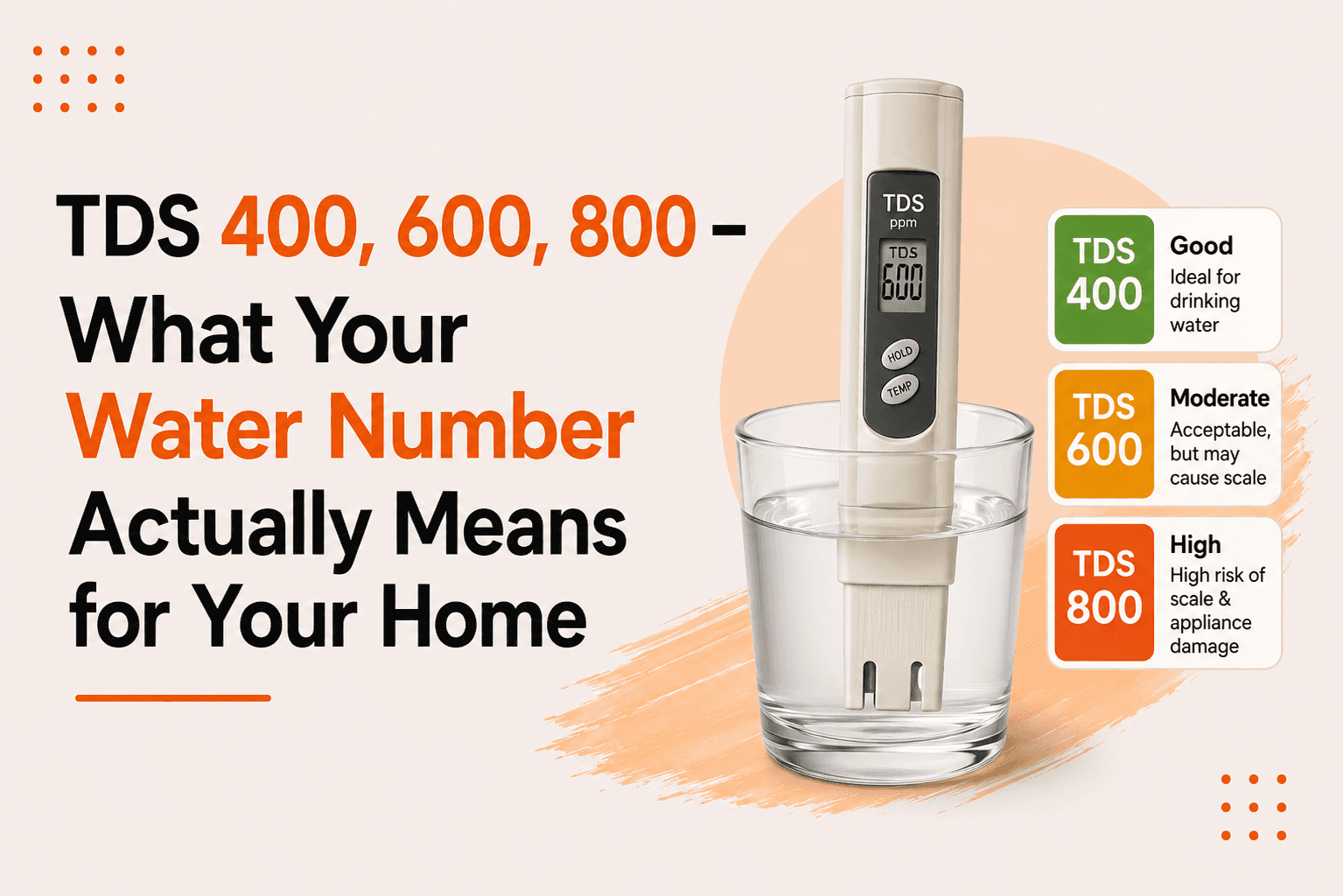
Everyone has heard TDS mentioned. Most people know a higher number means harder water. Fewer people know what the number actually measures, why it changes city to city, or - most importantly - what a specific TDS level means for the surfaces and appliances in their home.
What TDS Actually Measures
TDS stands for Total Dissolved Solids. It measures the combined concentration of all dissolved substances in water - expressed in milligrams per litre (mg/L), which is equivalent to parts per million (ppm).
The primary contributors to TDS in Indian water are calcium, magnesium, sodium, carbonates, sulphates, and chlorides. What matters for scale formation specifically is the calcium and magnesium content - referred to as water hardness - which is a subset of TDS.
In Indian borewell water, calcium and magnesium typically make up 60-80% of total dissolved solids. This is why high-TDS Indian water is almost always also hard water. For the full explainer, see what TDS and hard water actually mean.
Why Indian Water Has High TDS
India's TDS problem is geological as much as infrastructural.
Much of northern and western India draws water from alluvial aquifers - groundwater that has moved through mineral-rich rock and sediment over centuries. Rajasthan, Haryana, Gujarat, and parts of Maharashtra sit on geology that naturally produces very hard water regardless of treatment.
Municipal treatment removes biological contaminants but does not significantly reduce mineral content. RO systems in homes reduce TDS - but most Indian homes don't have RO for their washing machines, kettles, or geysers. The water that enters your appliances is essentially raw borewell or municipal supply.
The result: appliances designed for 150-200 ppm European water are running on 500-800 ppm Indian water. Scale buildup is faster by a factor of 3-5x.
What Each TDS Level Means, Practically
Below 200 ppm - Soft Water
Most of South India (parts of Kerala, coastal Karnataka) falls in this range. Scale is slow to form. Descaling once or twice a year is sufficient maintenance.
200-400 ppm - Moderately Hard
Scale is visible after 3-6 months. Quarterly descaling is appropriate for kettles and washing machines.
400-600 ppm - Hard Water
This is the most common TDS range in urban India. Delhi, Bengaluru, Pune, Hyderabad, and most NCR towns fall in this band. At this level:
- Kettle scale is visible within 6-8 weeks of regular use
- Washing machine heating elements scale significantly within 12-18 months
- White deposits on shower glass appear within days of cleaning
Monthly descaling of appliances is the right baseline.
600-800 ppm - Very Hard
Much of Rajasthan, Haryana, Gujarat, and borewell-dependent areas of Maharashtra. The scale formation timeline compresses significantly:
- Kettle scale visible within 3-4 weeks
- Washing machine elements at risk within 8-12 months without maintenance
Monthly descaling with higher sachet quantities (2-3 for first deep clean).
800+ ppm - Extremely Hard
Borewell water in parts of Rajasthan (Jodhpur, Barmer, Bikaner), parts of Gujarat, and some industrial zones. Scale is aggressive enough to be a structural concern for older appliances. Bi-monthly appliance descaling minimum.
How to Find Your TDS
Use the OrangeDemon TDS checker. Enter your city or pincode on the homepage for an approximate reading.
Buy a TDS meter. Available on Amazon for Rs.150-Rs.400. Dip it in your tap water for a reading in under 10 seconds.
Check your RO system display. Many RO units sold in India include a TDS display for the input feed water.
TDS and Your Appliance Maintenance Schedule
| Appliance | 400-600 ppm | 600-800 ppm | 800+ ppm |
|---|---|---|---|
| Washing machine | Monthly | Monthly (1 WashDX sachet routine / 2 sachets first reset) | Bi-monthly |
| Kettle | Monthly | Every 3 weeks | Every 2 weeks |
| Geyser / water heater | Every 6 months | Every 3-4 months | Every 2-3 months |
| Dishwasher | Every 2 months | Monthly | Monthly |
| Showerhead | Every 2 months | Monthly | Every 3 weeks |
TDS is not an abstract water quality metric. It is a maintenance predictor. Most Indian households are running on maintenance schedules designed for soft water. That mismatch, compounded over years, is what appears as premature appliance failure and high electricity bills.
Knowing your TDS is the first step. The second is actually adjusting your maintenance to match it.
Check your TDS and find the right product
Match the right OrangeDemon descaler to the appliance
OrangeDemon's TDS data is sourced from municipal reports, BIS water quality surveys, and user-submitted readings across Indian cities and towns.