
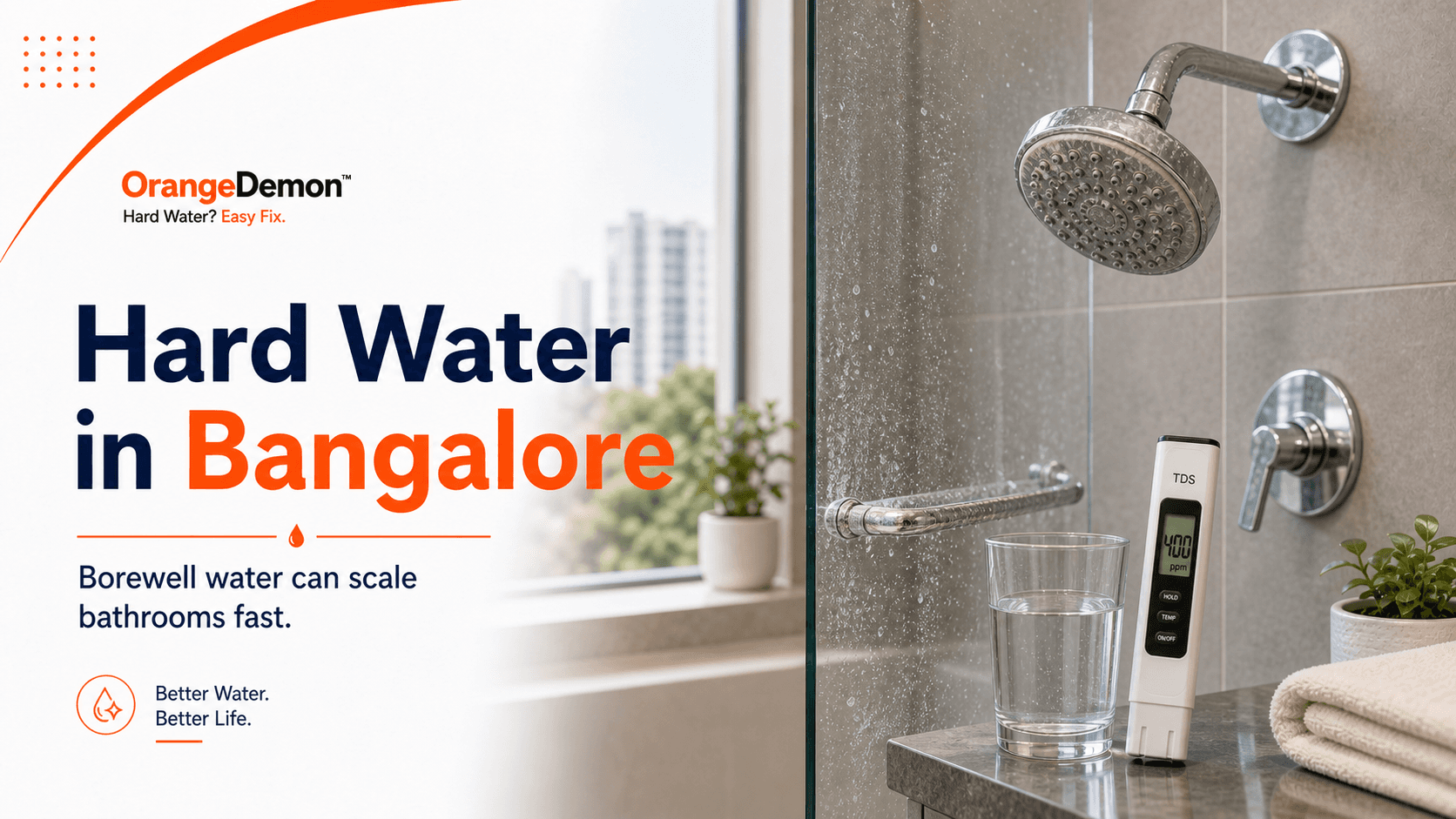
Quick answer: is Bangalore water hard?
Bangalore water is highly building-dependent. Cauvery/BWSSB supply can be much softer than borewell or mixed apartment supply, but many homes in Whitefield, Sarjapur Road, Electronic City, HSR Layout, and newer corridors behave like hard-water homes. (New to TDS? See what TDS and hard water mean.) If scale appears quickly, use the Bengaluru hard-water page, test your tap, and set an appliance routine.
| Bengaluru area pattern | Likely water story | Maintenance route |
|---|---|---|
| Core BWSSB/Cauvery supply | Often lower scale than borewell zones | Test and descale preventively |
| Whitefield, Sarjapur, Electronic City | Borewell or mixed apartment risk | Scheduled washer, geyser, kettle care |
| HSR, ORR, Kanakapura Road growth belts | Building-by-building variation | Use tap TDS plus symptoms |
| Tanker or mixed-supply societies | TDS can shift by source and season | Recheck before setting schedule |
Bangalore has a water crisis that isn't often discussed openly: the city's piped water supply covers only a portion of its actual residential demand, and most of the shortfall is met by borewells that deliver hard, mineral-rich water directly into the homes of one of India's most affluent urban populations.
Source context and buyer check
The city-specific detail still has to be confirmed at building level, but the water-quality logic is not guesswork. The Central Ground Water Board's 2024 national groundwater-quality work explains why groundwater quality varies by location and source (PIB release on CGWB Annual Ground Water Quality Report 2024). The BIS drinking-water specification separates TDS, hardness, calcium, magnesium, and alkalinity, which is why one TDS reading should be treated as a scale-risk signal rather than a full safety report (BIS IS 10500:2012 PDF).
Practical buyer rule: if a Bengaluru home has fast kettle scale, stiff laundry, slow geyser heating, or blocked showerhead flow, choose by appliance: WashDX for washer, geyser, and showerhead scale, DescaleX Bio for kettles, DescaleX for dishwasher and coffee jobs, or Starter Combo for a first full-home routine.
Bangalore's Groundwater Reality
The Bruhat Bengaluru Mahanagara Palike (BBMP) estimates that Bangalore has over 400,000 borewells - one of the highest concentrations of any Indian city. The Cauvery water supply from the BWSSB meets the needs of only a fraction of the city's 13+ million residents. In areas like Whitefield, Sarjapur Road, Electronic City, HSR Layout, and most of the newer residential corridors, borewell water is the primary or sole source.
Bangalore sits on hard Deccan Plateau rock - ancient granite and gneiss - which weathers slowly and contributes calcium, magnesium, and silica to groundwater. TDS from Bangalore borewells typically ranges from 400 to 800 mg/L, with some pockets in eastern Bangalore testing above 900 mg/L. Cauvery supply, by contrast, is softer at 150--250 mg/L.
The New Apartment Problem
The irony of Bangalore's hard water problem is that it's worst in the newest, most premium apartments. Older properties in core areas of the city are more likely to have BWSSB piped supply. New developments in Whitefield, Sarjapur, or Kanakapura Road were built on the city's expanding periphery where piped infrastructure had not yet reached, and they run exclusively on borewell water.
A Rs.2 crore apartment in a new complex off Outer Ring Road draws water at 500--700 mg/L TDS. The premium German bathroom fittings and floor-to-ceiling glass enclosures that sold the flat are coated in white mineral scale within a month of possession. This is the Bangalore bathroom problem in one sentence: premium investment, hard water, no solution that came with the apartment.
Identifying Your Water Source
If you're on Cauvery supply from BWSSB and your TDS is below 300 mg/L, standard maintenance with occasional acid cleaning is sufficient. If you're on borewell water - test it. A Rs.400 TDS meter tells you exactly what you're dealing with. Above 400 mg/L, you need an acid-based cleaning protocol. Above 700 mg/L, weekly treatment is essential.
Your apartment's maintenance team or builder should be able to tell you the water source. If they say 'mixed supply,' test it - mixed supply in most new Bangalore projects means Cauvery water during supply hours and borewell water the rest of the time, stored in a common sump and delivered at borewell-level TDS to your flat.
Bangalore FAQ for hard-water buyers
Is Whitefield water hard?
Whitefield is one of the stronger hard-water search areas because many homes rely on borewell, tanker, or mixed apartment supply. Test your own tap because one society can behave differently from the next.
Is Bengaluru water hard if I have Cauvery supply?
Not always. Cauvery/BWSSB supply can be lower scale than borewell supply, but storage tanks, mixed sources, and apartment plumbing can change what reaches your tap. Use a TDS meter and visible scale speed before deciding the routine.
Which OrangeDemon product fits Bangalore apartments first?
For mixed apartment symptoms, start with the Starter Combo. If the washer or geyser is the main issue, use WashDX. If kettle scale is the first symptom, use DescaleX Bio.
TapStrike Intense is OrangeDemon's heavy-duty spray for limescale, hard-water marks and soap scum on taps, sinks, washbasins and glazed tiles. See TapStrike Intense.
Seen results with OrangeDemon? Share a before/after on Instagram @orangedemon.in or tag us on Twitter/X @OrangeDemonIn.
Follow OrangeDemon: Instagram / YouTube / Twitter / X