
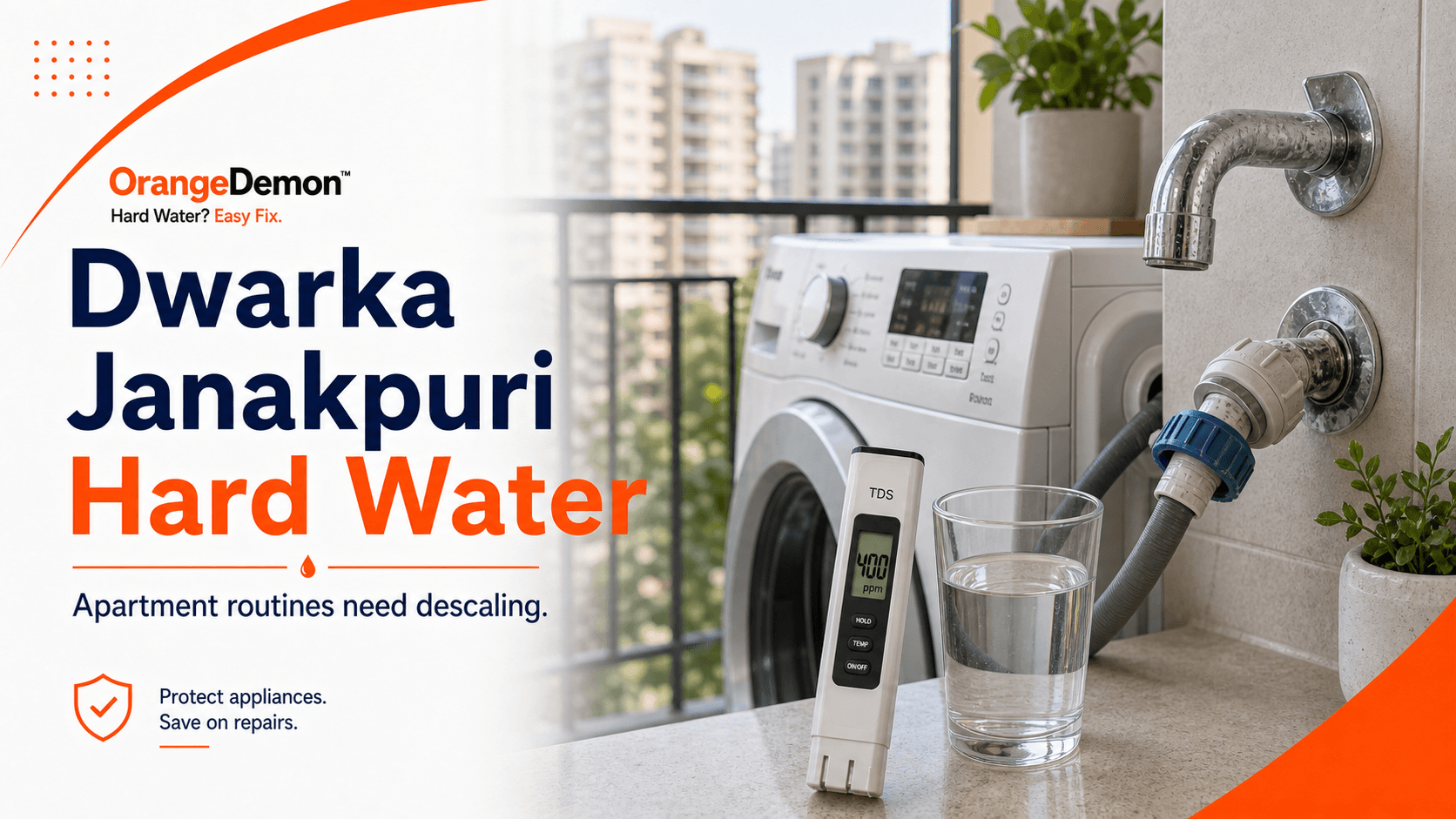
Dwarka and Janakpuri create a very specific Delhi hard-water search pattern.
Residents are usually not asking whether West Delhi has a water problem in the abstract. (New to TDS? See what TDS and hard water mean.) They are asking why a relatively well-planned, middle-to-upper-income apartment belt still ends up with:
- washing machines that smell or leave residue
- geysers that feel slower than they should
- kettles that film over quickly
- showerheads and bathroom fittings that keep building white deposits
That mismatch is the real story.
Treated water is not the same as appliance-friendly water
One of the biggest misconceptions in Delhi is that if water is treated, it should also be easy on appliances.
That is not how hard water works.
Delhi treatment improves biological safety, but it does not remove the dissolved calcium and magnesium responsible for scale. In areas like Dwarka and Janakpuri, residents often live with a blend of municipal supply, local storage conditions, and periodic groundwater influence that is good enough for everyday use but still hard enough to coat heating surfaces and washer internals over time.
So the water can look acceptable in a glass and still be a long-term maintenance problem.
Why West Delhi residents notice the problem indoors first
Dwarka and Janakpuri are apartment-heavy, appliance-heavy, and routine- driven.
That matters because hard water becomes more visible when the same appliances are doing the same tasks every day:
- a washing machine running frequent family loads
- a geyser heating water morning and evening
- an electric kettle boiling repeatedly
- bathroom fittings expected to stay clean-looking with normal upkeep
In this kind of household pattern, even medium-to-high TDS becomes expensive if nobody is treating scale as a maintenance category.
Washing machines are often the first real cost
In Dwarka and Janakpuri homes, washing machines usually expose the problem before residents think of it as "water chemistry."
The clues are familiar:
- clothes feel rougher than expected
- the drum develops a film or mineral smell
- drum-clean cycles do not fully solve the issue
- detergent performance seems inconsistent
What is happening underneath is straightforward: minerals are combining with detergent residue and repeatedly baking onto the machine during hot or warm cycles. A normal cleaner can freshen the machine, but it will not dissolve a hardened mineral layer the way a purpose-made descaler will.
That is why some Delhi households end up blaming the machine, the detergent, or the brand when the maintenance gap is really the issue.
Geysers and kettles show the water problem faster
If the washer is the cost signal, the geyser and kettle are the speed signal.
Heating makes hard-water deposits easier to notice because the minerals precipitate directly onto the surface doing the work. In practical terms, that means:
- kettles start showing white film and floating particles sooner
- geysers lose efficiency gradually
- hot-water recovery can feel slower over time
- a building that seems "fine" overall can still be quietly damaging heating appliances
For many West Delhi residents, this is the moment hard water stops being a theoretical problem and becomes a habit problem.
Why apartment residents usually respond too late
In Dwarka and Janakpuri, the water issue is rarely dramatic enough to force action immediately.
That is exactly why it gets ignored.
When the scale is not destroying something overnight, people postpone maintenance. They wipe the glass, rinse the kettle, run another drum- clean setting, and move on. Then six months later, the same home is dealing with heavier residue and an appliance that is already behind on care.
The better model is to treat descaling like filter replacement or AC servicing: a small repeating task that prevents a larger repair cycle.
What a better West Delhi routine looks like
For homes in Dwarka and Janakpuri, the smartest routine is usually:
- reset the washing machine with a proper descale cycle
- descale the kettle if heating deposits are already visible
- check geyser performance and shift to a repeat schedule before efficiency drops further
This is where the product split matters. DescaleX Bio is for kettles. DescaleX is for coffee machines and dishwashers. WashDX is for washing machines, geysers, and showerheads. The right routine is not a one-off rescue purchase. It is appliance-specific maintenance before neglect becomes expensive.
Which pack makes the most sense here
For many West Delhi households, a one-off clean is enough to prove the point but not enough to solve the whole pattern.
A more realistic starting point is often:
- WashDX for the washing machine or geyser
- DescaleX Bio for the kettle, or WashDX for the showerhead-scale problem
- a follow-up cycle booked before the deposits fully return
That is why a repeatable appliance-care routine usually converts better than trying to position descaling as a dramatic emergency purchase.
The real West Delhi hard-water question
The right question is not:
"Do Dwarka and Janakpuri have hard water"
The right question is:
"Is the water hard enough to quietly shorten appliance efficiency if I do nothing"
In most homes, the answer is yes.
And once you frame the issue that way, the solution becomes practical: descale early, descale on schedule, and stop waiting for the appliance itself to become the reminder.
Need a simple West Delhi appliance routine? Start with DescaleX or go straight to the right descaler if you want enough for a washing machine reset plus follow-up maintenance.