
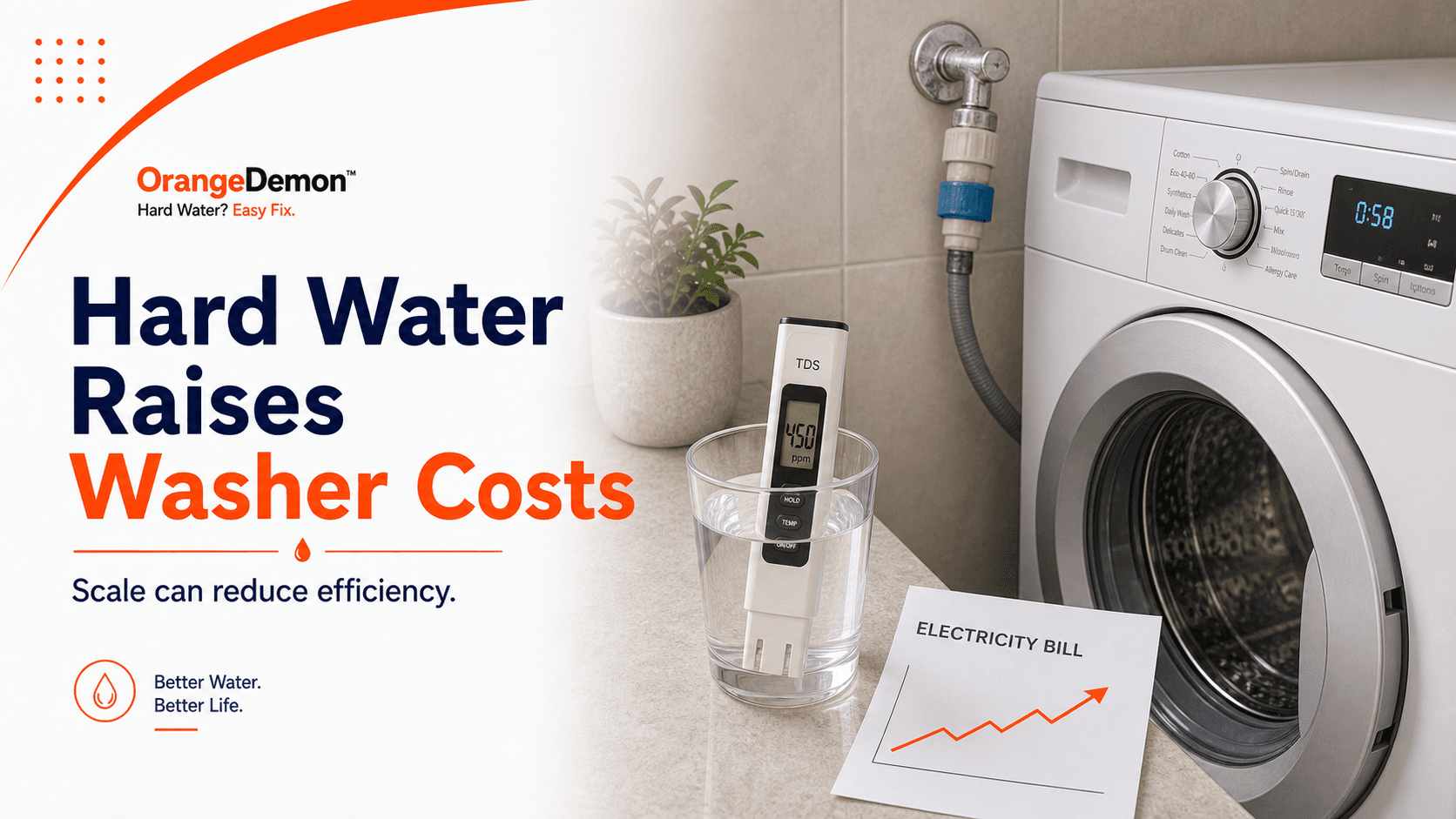
Your washing machine's heating element is probably coated in scale right now. You can't see it. You won't hear it. But you're paying for it every single month - in a longer wash cycle, a hotter drum struggling to reach temperature, and a compressor working harder than it was designed to.
This isn't a scare tactic. It's physics. And in India, where borewell TDS regularly runs between 400 and 900 ppm, it's happening in the majority of urban homes.
Why Scale and Electricity Are the Same Problem
A washing machine heats water by running current through a metal heating element. That element is designed to transfer heat into water efficiently - with nothing between the metal and the water.
Scale changes that equation completely.
Calcium carbonate - the white mineral that forms when hard water is heated - has a thermal conductivity roughly 50 times lower than steel. When scale coats your heating element, it functions like insulation. The element still draws the same electricity. But instead of heating the water, much of that energy heats the scale itself, which absorbs it without transferring it efficiently.
The machine compensates by running the element longer.
In practical terms: a 3mm layer of scale forces a heating element to consume approximately 25% more energy to reach the same water temperature. In a machine used five times a week in a 600 TDS area, that scale reaches 3mm in roughly 18 months of normal use.
For a 5.5kg front-loader rated at 2kW, that's an additional 0.5 kWh per cycle. At Rs.8/unit - a mid-range residential tariff across most Indian states - that's Rs.4 per wash. Five washes a week: Rs.20. Over a year: Rs.1,040 in additional electricity from scale alone. In 700+ TDS areas where scale builds faster, the figure is higher.
The Second Cost: Your Machine's Lifespan
Heating elements are not the only casualty.
Drum bearings corrode faster when mineral-rich water is repeatedly heated and evaporated inside a sealed drum. The residue is abrasive. Over hundreds of cycles, it accelerates wear on seals and bearings.
Door seals collect scale at the contact line between rubber and drum. As scale hardens, it creates micro-abrasions. Seals that should last 8 - 10 years show cracking at 5 - 6 years in high-TDS homes.
The heating element itself can fail prematurely if scale causes localised hot spots. A replacement element for a standard Indian front-loader runs Rs.1,500 - Rs.3,500. A new machine is Rs.25,000 - Rs.60,000.
Scale is not maintenance deferred. It is damage accumulating.
The Indian Context: Why This Problem Is Worse Here
European washing machine guides recommend descaling "every 3 months." That guidance was written for water systems with TDS of 150 - 300 ppm.
Delhi's average TDS: 450 - 600 ppm. Jaipur: 600 - 800 ppm. Ahmedabad: 500 - 750 ppm. Gurugram boreholes: frequently 700 - 900 ppm.
Indian machines are operating in conditions European maintenance schedules never anticipated. The 3-month guideline becomes monthly - or bi-monthly in the hardest water zones.
Most Indian households descale never.
How to Tell if Scale Has Already Built Up
Boiling time increases. If your machine takes noticeably longer to reach wash temperature than it did when new, scale is likely the reason.
White residue inside the drum. Wipe the drum wall with a dark cloth. White mineral dust indicates active scale deposition.
Clothes smell musty after washing. Scale provides a porous surface where bacteria and detergent residue accumulate.
Louder spin cycle. Scale on drum bearings is abrasive. Increased noise during spin can indicate early bearing wear.
The Right Way to Descale a Washing Machine
- Remove all clothes from the drum.
- Pour WashDX directly into the drum, not the detergent tray: one 50g sachet for front load, two for top load.
- Run the longest empty cycle with normal tap water. No hot setting needed.
- Let the cycle finish, then run one rinse cycle to clear the drum.
- After the cycle, wipe the drum interior and door seal with a damp cloth.
- For machines older than 5 years in 600+ TDS zones: use 2 WashDX sachets on the first clean, then 1 sachet monthly for maintenance.
How Often to Descale - by TDS Level
| TDS Range | Classification | Recommended Frequency |
|---|---|---|
| Below 200 ppm | Soft | Every 6 months |
| 200 - 400 ppm | Moderately hard | Every 3 months |
| 400 - 600 ppm | Hard | Monthly |
| 600 - 800 ppm | Very hard | Monthly - 2 sachets on first use |
| 800+ ppm | Extremely hard | Monthly - consider filter + descaler |
Hard water doesn't announce itself. It works quietly, slowly, and expensively. Monthly descaling is not a premium habit. In Indian hard water conditions, it's the minimum for running a machine at the efficiency you paid for.
OrangeDemon makes specialist descalers for Indian hard water conditions. WashDX is the heavy-duty route for washing machines, geysers, and other machine-side descaling jobs.