
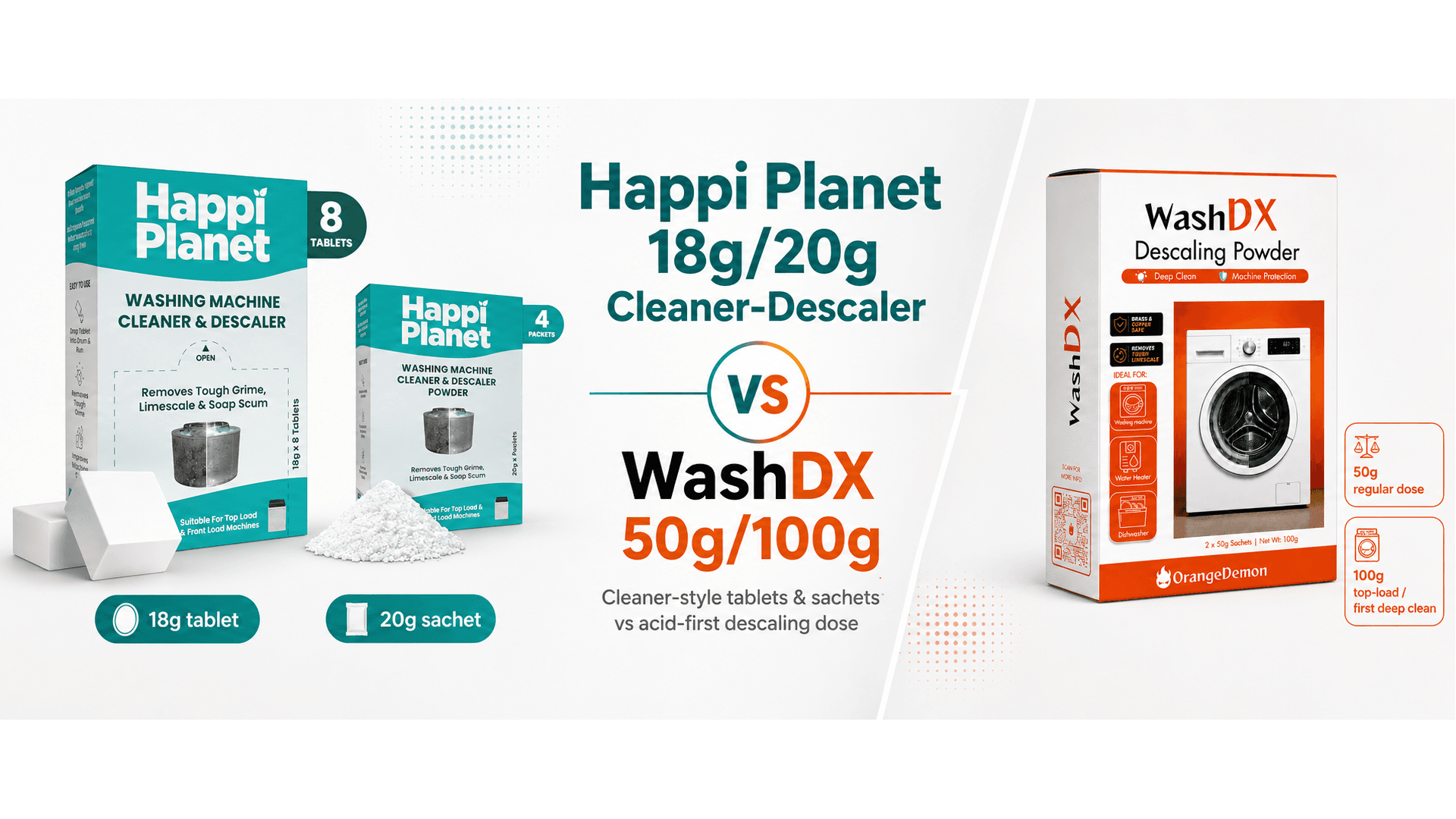
If you are comparing Happi Planet vs WashDX, you have probably seen the Happi Planet washing-machine cleaner tablet first.
That tablet format is easy to understand: drop one tablet into the drum, run a cycle, repeat monthly. Happi Planet also has a powder sachet version. Both are small-unit cleaner-descaler formats.
So the real comparison is:
Happi Planet's popular cleaner-descaler range uses small-unit doses: about 18g per tablet or 20g per powder sachet. OrangeDemon WashDX uses a 50g acid-first descaling dose, and recommends 100g for top-load, semi-automatic, first deep-clean, or high-water Indian washing machines.
Quick answer
Choose by problem, not by pack count.
| Your washing-machine problem | Better-fit route |
|---|---|
| Monthly freshness, mild odour, light soap scum, easy cleaning habit | Happi Planet style cleaner-descaler tablet/powder can fit |
| Chalky white residue, stiff towels, scale signs, slow hot cycles, smell returning after cleaner use | A scale-focused washing-machine descaler is the better route |
| Front-load machine, routine hard-water maintenance | 50g WashDX |
| Top-load, semi-automatic, borewell water, first deep clean, or visible scale | 100g WashDX |
The real difference is free acid reserve, dose size, dilution, hardness load and mineral-holding support.
Open the washing-machine descaler guide or buy WashDX 100g for top-load and first deep clean.
Fair comparison note
This is a public-source and chemistry-based comparison, not a lab test of a Happi Planet batch.
Happi Planet is a known home-care brand. Many buyers may like its tablet format because it is simple: one tablet, one month, easy repeat use. This article is not dismissing that use case. It asks a narrower question:
When the buyer's real problem is hard-water limescale inside an Indian washing machine, can an 18g/20g cleaner-style unit provide enough available descaling reserve in a high-water cycle?
For Happi Planet details, this article uses the brand's public product pages and visible pack/listing information as seen on June 16, 2026. For WashDX, it uses OrangeDemon's disclosed formula and dosing logic. Pack details can change, so always read the current label before use.
Why compare the tablet and powder together?
Because most buyers are not thinking in SKU codes.
They are thinking:
- "I saw Happi Planet washing-machine cleaner tablets."
- "I saw a Happi Planet powder sachet."
- "Both say cleaner and descaler."
- "My washing machine has hard-water residue. Which one should I use?"
That is the right question. The tablet and powder can both make sense for light cleaning and freshness. The issue starts when the problem is not light residue but hard-water limescale.
Tablet dose math: 144g / 8 tablets
Current visible pack information for the tablet version shows 144g (8 tablets).
That means:
144g / 8 tablets = 18g per tablet
The Happi Planet powder listing is easier:
80g / 4 sachets = 20g per sachet
Now compare that with WashDX:
| Product / use case | Per-use unit |
|---|---|
| Happi Planet tablet | 18g tablet |
| Happi Planet powder sachet | 20g sachet |
| WashDX regular dose | 50g sachet |
| WashDX top-load / first deep-clean dose | 100g, or 2 x 50g sachets |
This is not "more powder is always better." It is about matching dose to Indian hard-water and high-water washing-machine cycles.
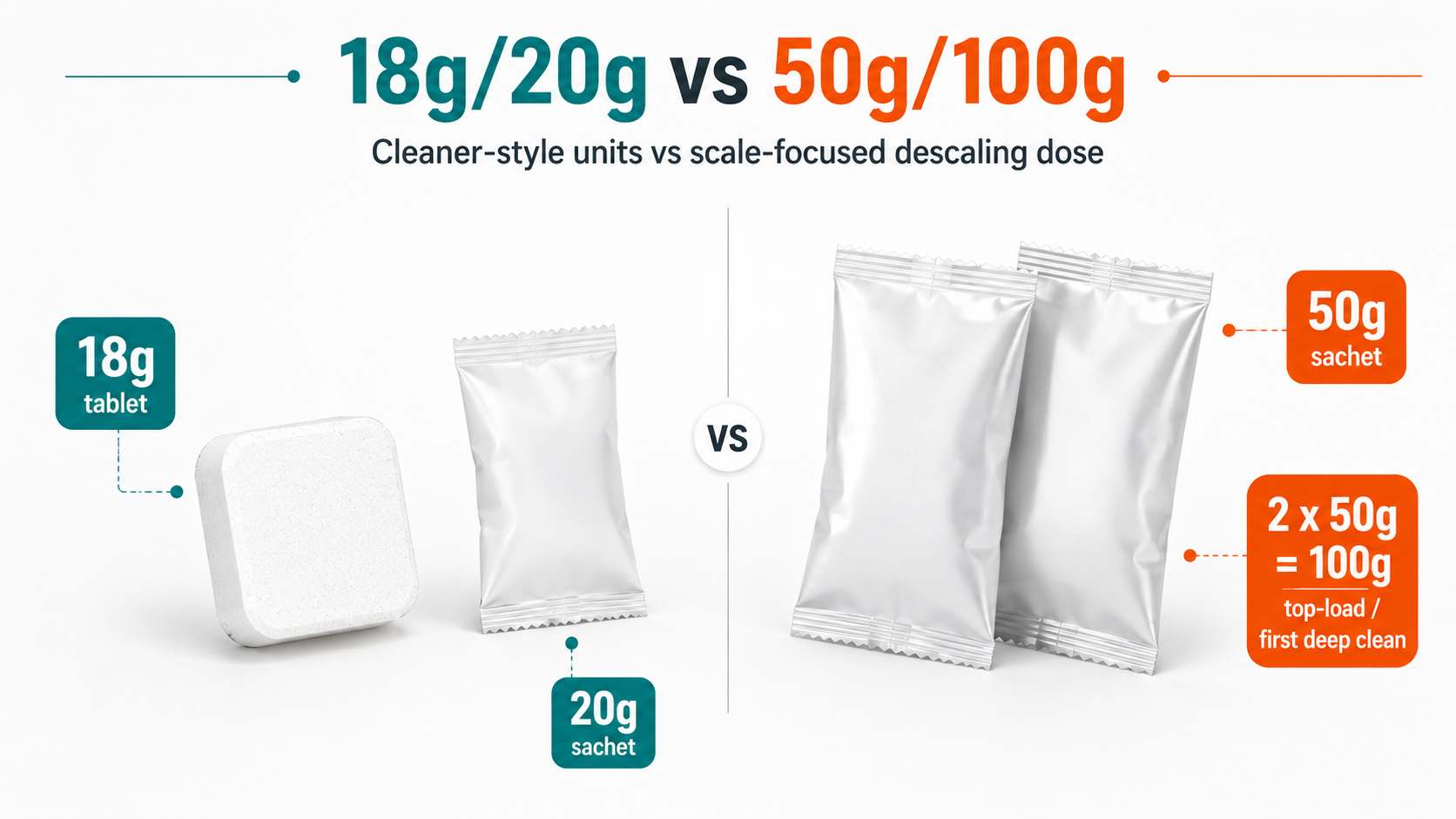
The dose gap is the simplest way to understand the comparison: small cleaner-style units versus a larger scale-focused descaling dose.
Why tablets feel convenient to buyers
Happi Planet's tablet format is easy to understand.
| Buyer cue | Why it feels useful |
|---|---|
| 8 tablets feels like 8 months | The buyer sees a long maintenance routine in one pack |
| One tablet per month sounds easy | The habit is simple and repeatable |
| Tablet looks premium | Tablets feel controlled and convenient |
| Any visible action feels reassuring | A visible reaction can make cleaning feel more concrete |
| The product feels familiar | Buyers may have already seen the tablet format before comparing chemistry |
That is a real advantage.
But chemistry asks a different question:
Can an 18g cleaner-style tablet provide enough free acid reserve for hard-water limescale in a high-water top-load machine?
That is where WashDX has a clearer technical case for scale-heavy use.
What the public product pages say
Happi Planet's official tablet page describes the product as a washing-machine cleaner and descaler. It says to remove one tablet, drop it in the drum, run a full wash cycle, and wipe leftover residue. The page communicates baking soda, natural citric acid and IFRA certified fragrance; its FAQ also mentions citric acid, tartaric acid and food-grade binders.
Happi Planet's official powder page describes an 80g pack made of 4 x 20g sachets, with a similar cleaner-descaler description and a one-sachet empty-cycle routine.
WashDX is OrangeDemon's washing-machine and heavy-appliance descaler. The WashDX formula is disclosed as an acid-first system with citric acid, sulfamic acid, fumaric acid, sodium gluconate, Disodium EDTA and BTA.
| Point | Happi Planet tablet / powder | OrangeDemon WashDX |
|---|---|---|
| Public format | 8 tablets or 4 x 20g powder sachets | 2 x 50g sachets, 100g total |
| Per-use unit | About 18g tablet or 20g sachet | 50g or 100g by machine and water load |
| Product direction | Cleaner-descaler | Descaling-first |
| Public ingredient direction | Baking soda + citric acid + fragrance; FAQ also mentions tartaric acid and binders | Citric acid + sulfamic acid + fumaric acid + chelation support |
| Buyer strength | Convenience, monthly habit, simple tablet use | Dose reserve, top-load logic, hard-water limescale focus |
| Best-fit problem | Freshness, odour, soap scum, light residue | Hard-water scale, heater-side residue, top-load dilution, first deep clean |
Why India changes the descaling calculation
Indian washing-machine descaling is not a small-appliance problem.
Many homes use borewell, tanker or mixed society supply. The water may be high in dissolved minerals. More importantly for scale, it may be high in hardness as CaCO3, which means calcium and magnesium are present in a form that can build mineral deposits.
The U.S. Geological Survey classifies water above 180 mg/L as CaCO3 as very hard. BIS drinking-water specification uses 200 mg/L as the acceptable total-hardness limit and 600 mg/L as the permissible limit in the absence of an alternate source. These references are not washing-machine manuals, but they explain why 200, 400 and 600 mg/L are useful scale-load numbers for Indian-home thinking.
Now add the second Indian reality: many homes use top-load or semi-automatic washing machines.
Front-load machines generally use less water than top-load agitator machines. ENERGY STAR says certified front-load washers use about 50% less energy and water than a top-load agitator washer. In practical descaling terms, this matters because a tablet or sachet is not working dry. It is diluted into the cycle water.
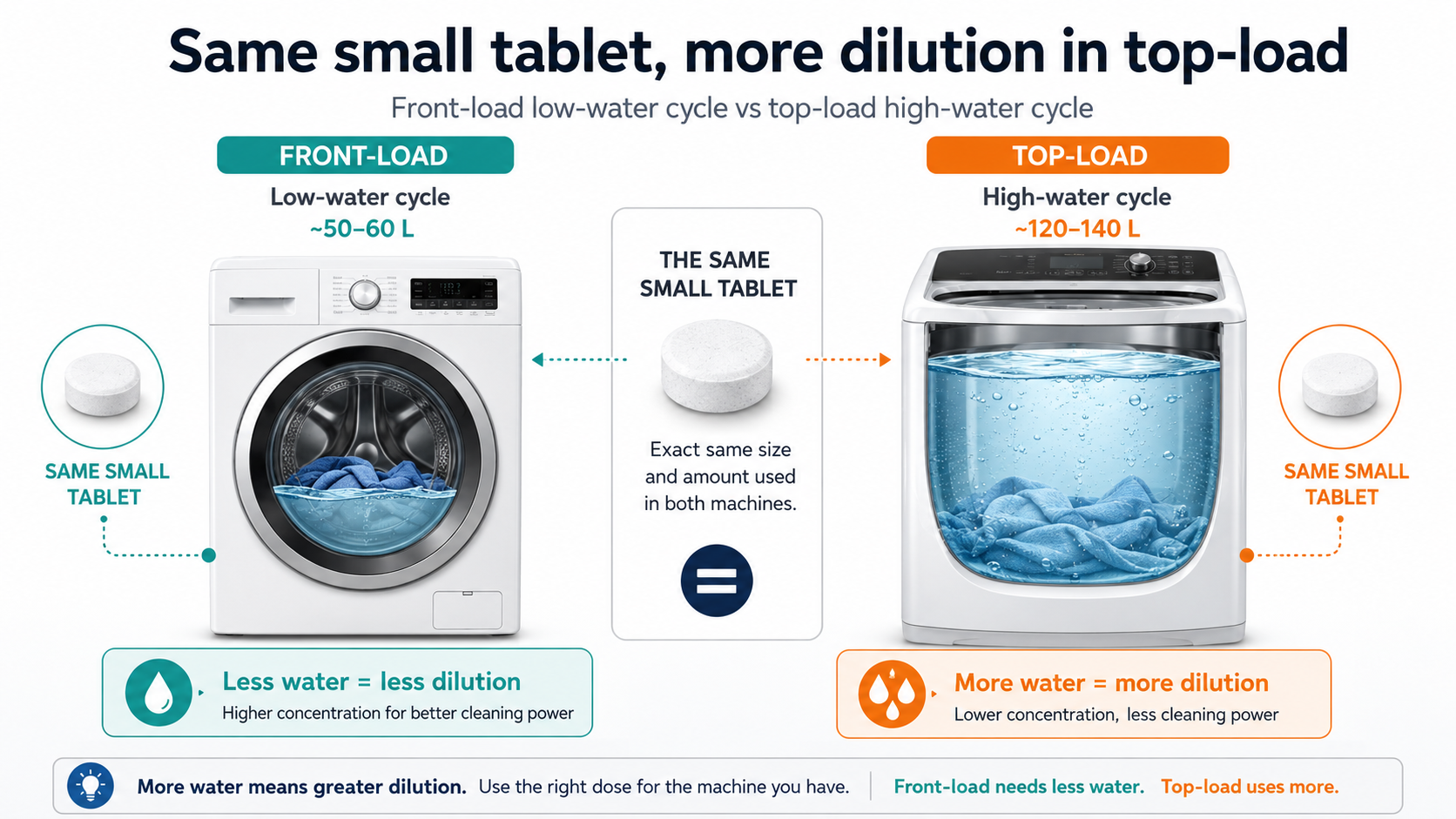
The same small tablet is more diluted in a high-water top-load cycle than in a lower-water front-load cycle.
Cleaner tablets vs descaling powder: not the same job
This is where buyers often lose money.
| Product type | Main job | What it is good at | What it may not solve |
|---|---|---|---|
| Washing-machine cleaner tablet | Odour, detergent film, body soil, light grime | Freshness and visible residue | Old mineral scale |
| Descaling powder | Calcium, magnesium and heater-side deposits | Hard-water scale, chalky film, slow heating | Fragrance or mould claims by itself |
| Cleaner-descaler | A middle route | Routine maintenance and mixed light residue | Severe hard-water scale if dose or free acid is low |
Visible tablet action is not the same thing as descaling strength. If an acid reacts with bicarbonate inside a cleaner tablet, the reaction may look active, but some of the acid can be spent before it reaches mineral scale.
For hard-water descaling, the useful question is:
How much available acid remains after dilution, after internal acid-base reactions, and after contact with hard water?
That is why dose size and formula direction matter.
Why an 18g tablet can become light in a top-load machine
An 18g tablet is not automatically too light. It depends on the job. In a lower-water machine, with light residue, and with monthly use, it can help the machine feel cleaner.
But in a high-water top-load or semi-automatic cycle, the same 18g is spread across much more water.
| Scenario | Approximate cycle-water logic | What happens to an 18g/20g unit |
|---|---|---|
| Lower-water front-load maintenance | Less dilution | May be acceptable for freshness or light residue |
| Top-load full-drum cycle | Much more dilution | Dose concentration drops sharply |
| Semi-automatic tub | High water and manual fill variability | Dose can become unpredictable |
| First descaling after years of hard water | Existing scale plus fresh hardness load | Small dose is often stretched too far |
This is why OrangeDemon does not treat all washing machines as the same job. A routine front-load maintenance cycle can use 50g WashDX. A top-load, semi-automatic, very hard-water home, or first reset is better treated as a 100g WashDX job.
Hardness load inside one washing-machine cycle
Hardness load can be expressed as grams of CaCO3 equivalent:
hardness mg/L x litres of water / 1000 = grams CaCO3 equivalent
That does not mean every gram is already stuck to the drum. It means the descaler is working inside that mineral environment while also trying to dissolve existing deposits.
| Machine water use | 200 mg/L hardness | 400 mg/L hardness | 600 mg/L hardness |
|---|---|---|---|
| 60L front-load type cycle | 12g CaCO3 eq. | 24g CaCO3 eq. | 36g CaCO3 eq. |
| 120L top-load or semi-auto type cycle | 24g CaCO3 eq. | 48g CaCO3 eq. | 72g CaCO3 eq. |
| 140L high-water top-load cycle | 28g CaCO3 eq. | 56g CaCO3 eq. | 84g CaCO3 eq. |
Now the 18g/20g versus 50g/100g difference starts looking less like marketing and more like chemistry.
In very hard water, the descaler needs enough reserve to handle:
- fresh hardness in the cycle water
- existing scale on heater and drum zones
- detergent-mineral residue
- contact-time losses
- dilution in high-water machines
- incomplete heating in some wash programs
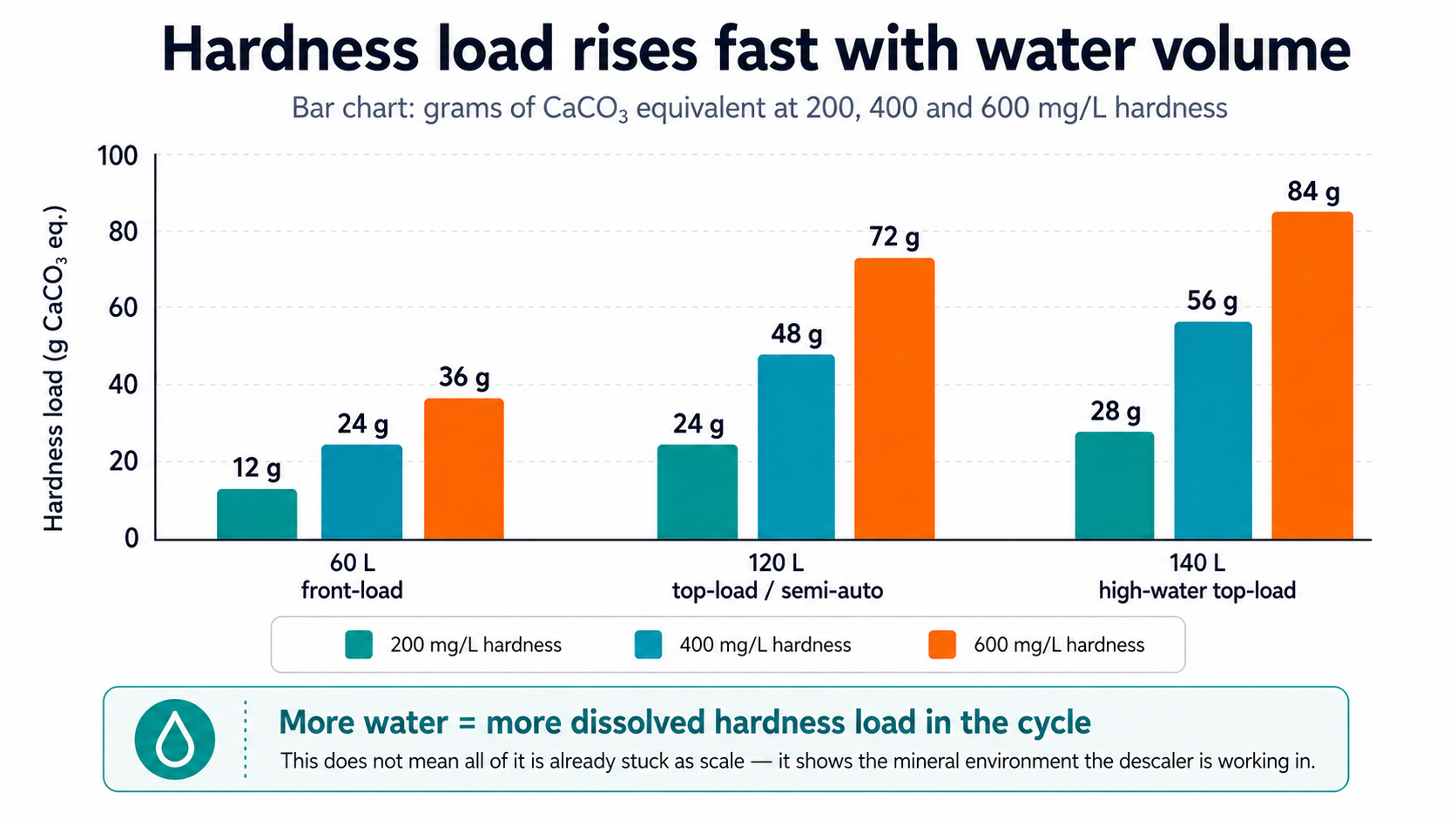
Higher water volume means the descaler is working inside a larger dissolved hardness load before it even tackles old deposits.
What acid actually does to limescale
Most appliance limescale is calcium and magnesium mineral buildup. The common reference is calcium carbonate, written as CaCO3.
In simple language:
calcium carbonate + acid -> dissolved calcium + carbon dioxide + water
The acid has to be available in solution, at useful concentration, for enough time. Heat, agitation and chelation help. This is why the best washing-machine descaler is not judged only by fragrance, foam or visible reaction.
Theoretical CaCO3 capacity of common descaling acids
Different acids have different theoretical neutralisation capacity.
| Acid | Approx. CaCO3 neutralisation capacity per 1g acid | Practical note |
|---|---|---|
| Citric acid anhydrous | ~0.78g CaCO3 | Common appliance descaling acid; also complexes calcium |
| Sulfamic acid | ~0.52g CaCO3 | Useful for hard or layered mineral deposits |
| Fumaric acid | ~0.86g CaCO3 | High theoretical capacity, lower cold solubility; hot cycles help |
| Tartaric acid | ~0.67g CaCO3 | Support acid with mineral complexing behaviour |
This table is theoretical. Real performance depends on solubility, temperature, formulation, water volume, contact time, pH and how much acid is consumed before it reaches scale.
Why bicarbonate changes the descaling discussion
Happi Planet's tablet page communicates baking soda as an ingredient. Baking soda is sodium bicarbonate.
Bicarbonate can be useful in cleaning products. It can help with odour and general cleaning feel. But for descaling, bicarbonate is chemically different from acid. It is alkaline. When acid and bicarbonate meet, they react.
That reaction can release gas when acid and bicarbonate meet:
acid + bicarbonate -> salt + carbon dioxide + water
A visible reaction can look satisfying. But from a descaling perspective, the important point is that some acid can be neutralised before it reaches scale.
So when a product is described as a cleaner-descaler and lists baking soda plus acids, it may be suitable for a freshness-style job. But for a hard-water scale job, we should be careful before assuming the full 18g or 20g is available descaling acid.
The 18g/20g ceiling problem
Even if the entire tablet or sachet were made of pure citric acid, the theoretical CaCO3 capacity would be:
| Hypothetical unit | Theoretical CaCO3 capacity |
|---|---|
| 18g pure citric acid | ~14.1g CaCO3 |
| 20g pure citric acid | ~15.6g CaCO3 |
| 18g pure tartaric acid | ~12.1g CaCO3 |
| 20g pure tartaric acid | ~13.4g CaCO3 |
That is the ceiling, not the claim.
The public Happi Planet pages do not disclose acid percentages for the tablet or powder. They communicate baking soda, citric acid, fragrance, and in the FAQ, tartaric acid and binders. Therefore the actual free-acid capacity cannot be calculated from the public pages.
The safe statement is:
An 18g tablet or 20g cleaner-descaler sachet has a much lower maximum possible acid reserve than a 50g or 100g acid-first descaling dose, and its actual reserve depends on undisclosed formulation percentages.
That is the main issue for Indian hard-water washers.
WashDX formula: acid-first and scale-focused
WashDX is built for a different job. The formula is disclosed as:
| WashDX ingredient | Percentage | Why it matters |
|---|---|---|
| Citric acid | 60.0% | Primary appliance descaling acid |
| Sulfamic acid | 14.0% | Helps harder, layered scale |
| Fumaric acid | 13.0% | Adds hot-cycle acid reserve |
| Sodium gluconate | 10.0% | Helps hold dissolved calcium and magnesium in solution |
| Disodium EDTA | 2.8% | Chelation support, useful where borewell metals complicate deposits |
| BTA | 0.2% | Metal-care support in the formula |
This is a descaling-first formula with chelation support. The product is designed around mineral scale rather than only odour, fragrance, or general drum freshness.
That is why the dose logic is different:
| WashDX dose | Best-fit washing-machine job |
|---|---|
| 50g | Front-load routine maintenance or lower-water descaling cycle |
| 100g | Top-load, semi-automatic, high-water cycle, very hard water, first deep clean |
WashDX theoretical acid reserve
Using the disclosed acid percentages:
| WashDX dose | Citric acid capacity | Sulfamic acid capacity | Fumaric acid capacity | Approx. total theoretical CaCO3 capacity |
|---|---|---|---|---|
| 50g | ~23.4g | ~3.6g | ~5.6g | ~32.6g |
| 100g | ~46.8g | ~7.2g | ~11.2g | ~65.3g |
This is not a promise that every washing machine contains exactly that much removable scale. It is a way to compare descaling reserve under the same chemistry assumptions.
Compared with the theoretical ceiling of an 18g/20g pure-acid unit, WashDX brings more reserve to the cycle. Compared with an 18g/20g cleaner-descaler that includes baking soda and binders, the reserve gap is likely wider.
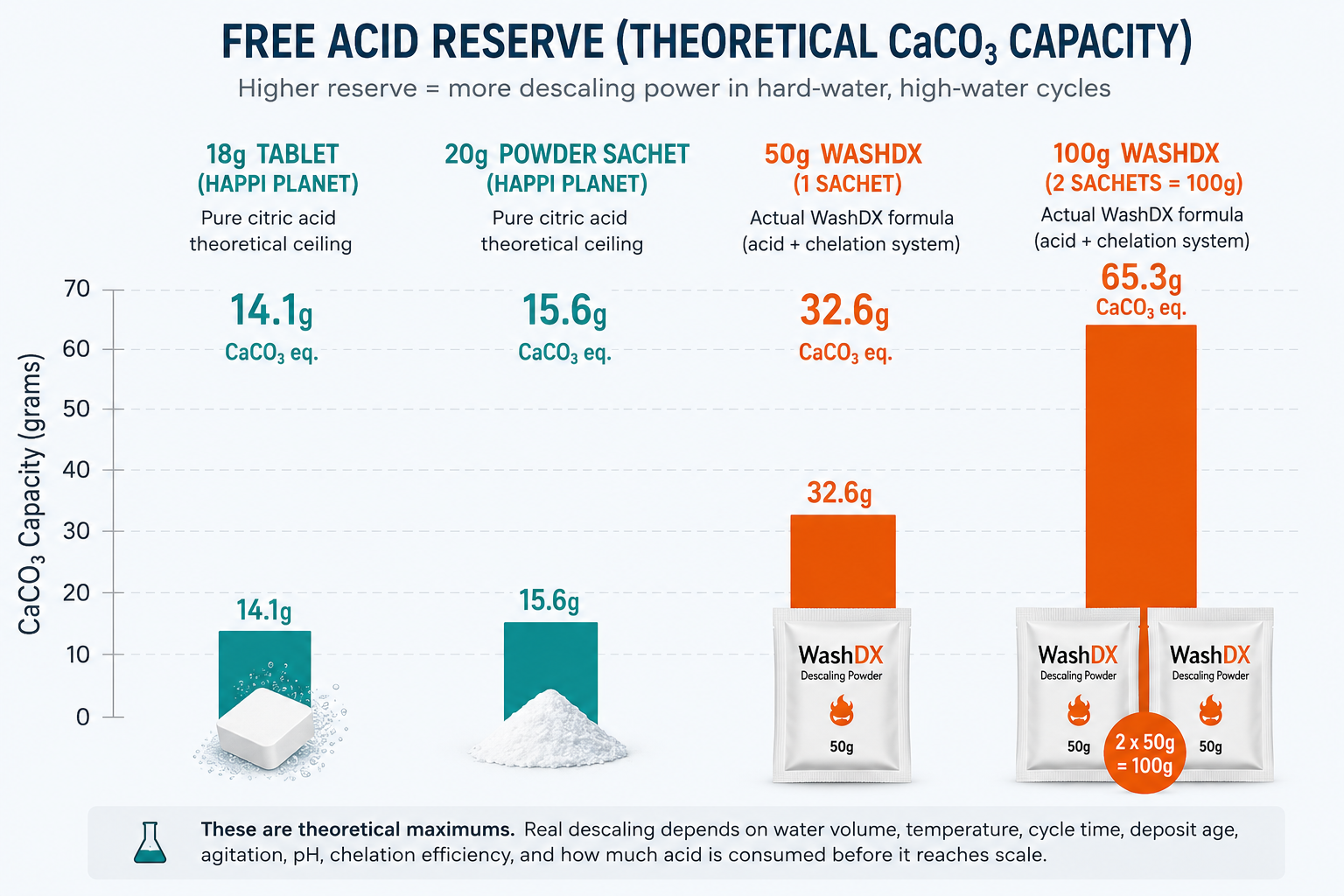
The 18g and 20g columns are pure-acid ceilings, not real product claims; WashDX columns use the disclosed formula math.
What this means in real washing machines
Here is the practical interpretation:
| Situation | What to choose |
|---|---|
| Monthly freshness in a low-symptom machine | A cleaner-descaler tablet or sachet can be fine |
| Light smell and detergent residue, no chalky film | Cleaner route first, then observe |
| Smell returns after cleaning | Move to descaling; scale may be trapping residue |
| Chalky residue, stiff towels, white marks near tray or drum | Use WashDX |
| Front-load, recent maintenance, moderate hard water | 50g WashDX |
| Top-load or semi-auto | 100g WashDX |
| Borewell water, 400-600+ ppm TDS, first descaling | 100g WashDX |
The key buyer lesson: do not choose only by freshness or cleaner cues when the symptom is scale.
How to test your own machine before deciding
Do this simple check before buying:
- Look at the detergent drawer, drum edge, rubber gasket and lint filter area.
- Rub a damp dark cloth over the residue.
- If it feels greasy, slimy or smells musty, the problem is cleaner-type residue.
- If it feels chalky, gritty, white-grey or returns quickly after cleaning, the problem is descaler-type residue.
- Check your local TDS or use the OrangeDemon TDS checker.
If both problems exist, remove scale first. Scale can hold detergent residue, body soil and smell-causing buildup.
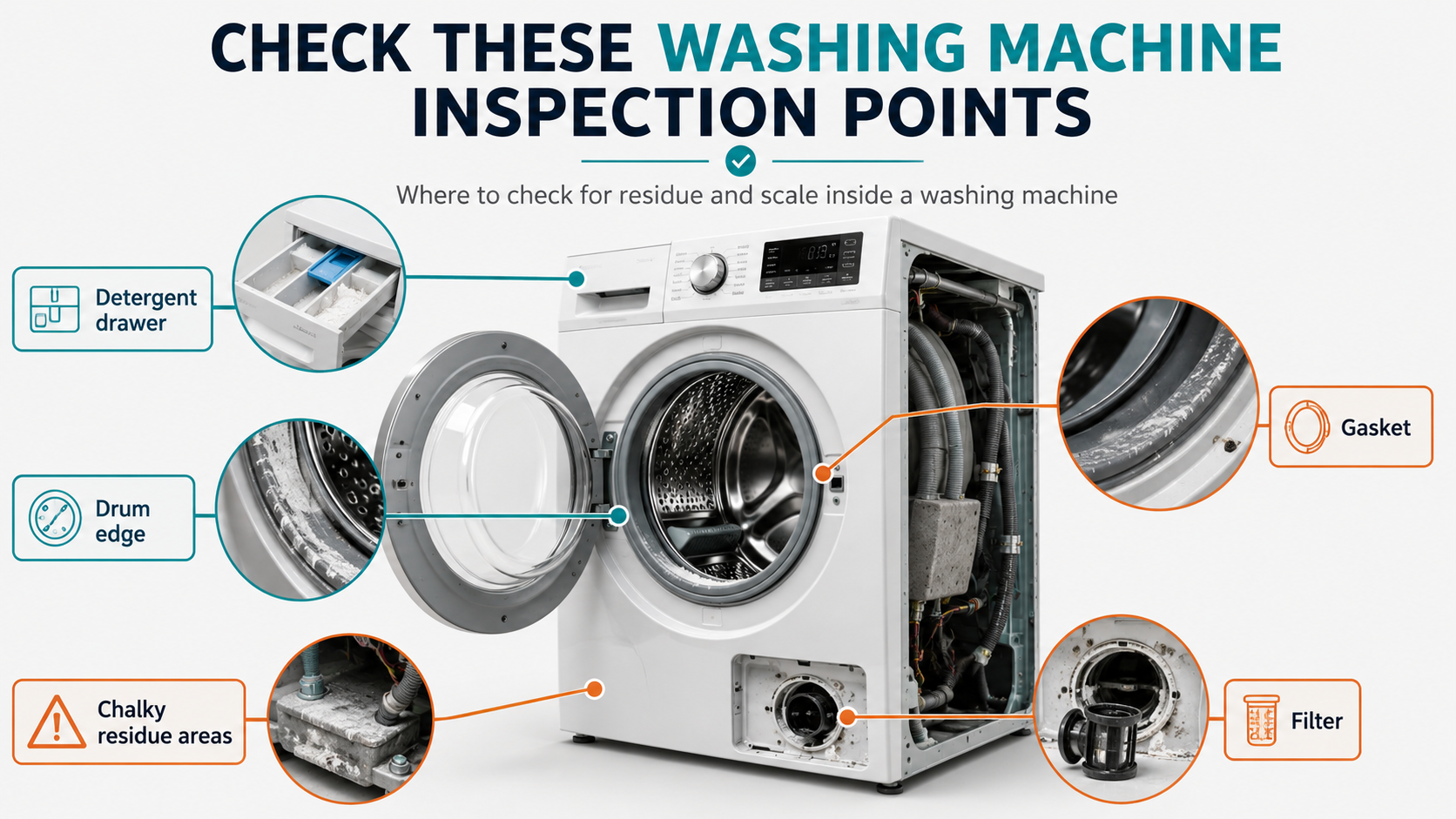
If residue is chalky, gritty, white-grey, or returns quickly after cleaning, treat it as a descaling problem rather than only a freshness problem.
50g or 100g WashDX?
Use this as the practical rule:
| Machine / condition | WashDX dose |
|---|---|
| Front-load, maintenance use | 50g |
| Front-load, first deep clean in very hard water | 100g |
| Top-load automatic | 100g |
| Semi-automatic | 100g |
| Borewell or tanker water with visible scale | 100g |
| TDS above 400 ppm and symptoms are obvious | 100g |
| After a recent successful descaling cycle | 50g maintenance later |
If you are unsure and the machine is top-load, start with the 100g logic. The extra water volume is the deciding factor.
How to use WashDX in a washing machine
- Empty the washing machine completely.
- Add WashDX directly into the drum.
- Use 50g for routine front-load maintenance.
- Use 100g for top-load, semi-automatic, first deep clean or very hard water.
- Run the hottest available empty cycle.
- Run one plain rinse cycle immediately after.
- Wipe the drum, gasket, tray and visible residue areas.
Do not mix WashDX with bleach, detergent or alkaline cleaners. Do not use it on clothes. Do not use it for kettles, baby bottles or food-contact appliances; use DescaleX Bio for those jobs.
Where Happi Planet still makes sense
A fair comparison should say where the other product can fit.
Happi Planet's cleaner-descaler tablet or powder may make sense when:
- the machine mainly needs freshness
- the buyer wants a simple monthly cleaning habit
- the visible issue is odour, soap scum or detergent residue
- there is no strong chalky residue
- the water is not very hard
- the machine is lower-water and maintained often
- convenience matters more than heavy scale reset
That is a real use case. It is just not the same as a heavy hard-water descaling use case.
Where WashDX is the better-fit product
WashDX is the stronger fit when:
- the machine is top-load or semi-automatic
- the first descaling is overdue
- the water is borewell, tanker or high-TDS
- there is white, grey or chalky residue
- laundry feels stiff even after detergent changes
- smell returns after using a drum cleaner
- the buyer wants an appliance-scale descaler, not a freshness cleaner
In OrangeDemon's range, WashDX is the heavy machine-side scale product: washing machines, geysers, showerheads, tanks, boilers and immersion rods. For coffee machines and dishwashers use DescaleX. For kettles and bottle warmers use DescaleX Bio.
Buyer verdict
If your question is "which product is easier for monthly freshness?", Happi Planet's tablet format has a clear consumer advantage.
If your question is "which product makes more sense for Indian hard-water limescale in a washing machine?", WashDX is the better-fit choice because it uses a larger acid-first dose, clearer front-load/top-load dosing, and chelation support for dissolved minerals.
The short buyer answer:
Use cleaner tablets for light cleaning. Use WashDX when the problem is hard-water scale.
Open the washing-machine descaler guide or buy WashDX 100g.
Related guides
- Best washing machine descaler India
- Washing machine cleaner vs descaler
- How much descaling powder to use
- What is TDS in hard water?
Sources and method notes
- Happi Planet official tablet product page, accessed June 16, 2026: Washing Machine Cleaner & Descaler | 8 Tablets
- Happi Planet official powder product page, accessed June 16, 2026: Washing Machine Cleaner & Descaler Powder
- BigBasket listing used only for visible 144g / 8-tablet pack-size math, accessed June 16, 2026: Happi Planet Washing Machine Cleaner & Descaler, 144g
- ENERGY STAR clothes washer guidance, accessed June 16, 2026: Clothes Washers
- U.S. Geological Survey hardness background, accessed June 16, 2026: Hardness of Water
- BIS drinking-water specification context, accessed June 16, 2026: IS 10500:2012 PDF
- OrangeDemon WashDX formula and use-case information: WashDX
The CaCO3 capacity tables are theoretical stoichiometric estimates using formula molecular weights. Real-world descaling varies with water volume, temperature, cycle length, solubility, age of deposits, agitation, pH, chelation and how much acid is consumed before reaching scale.