

Quick answer: front-load or top-load for hard water
Top-load washing machines are usually more forgiving in hard-water homes, but they are not immune. Front-loaders often show hard-water problems earlier because heat, gaskets, and longer cycles trap mineral and detergent residue. If your local TDS is above 400 ppm, choose the machine you will maintain consistently and use WashDX on schedule.
| Buyer question | Direct answer |
|---|---|
| Which handles hard water better? | Top-load is often more forgiving; front-load needs stricter routine |
| Which needs descaling more urgently? | Front-load, especially with hot cycles |
| Can top-load skip descaling? | No. Scale still builds on drum and water paths |
| Best maintenance route | WashDX empty maintenance cycle plus plain rinse |
Most people compare front-load and top-load washing machines on three things:
- wash quality
- water use
- price
In Indian hard-water cities, there is a fourth question that matters just as much:
Which one suffers less from scale
The honest answer is not "top-load good, front-load bad." Both machine types deal with hard water. They just deal with it in different places.
The first thing to understand
Hard water is not mainly a brand problem. It is a mineral-load problem.
If your water sits in the 350-700 ppm TDS range, calcium and magnesium are moving through the machine on every cycle. Those minerals deposit on surfaces over time, especially wherever heat, detergent residue, and evaporation are involved.
That is consistent with the U.S. Geological Survey's hardness explanation: calcium and magnesium are the core minerals behind hard-water scale (USGS hardness guide). In India, TDS, hardness, calcium, and magnesium are separate water-quality values, so use TDS as the warning signal and appliance symptoms as the maintenance trigger (BIS IS 10500:2012 PDF).
That means both front-loaders and top-loaders need maintenance.
Why front-loaders feel more vulnerable
Front-loaders usually get blamed first in hard-water homes, and there is a reason for that.
They are more likely to have:
- hot wash usage
- a heating element that can scale
- a door gasket that traps moisture and residue
- longer cycle times that make performance drops more noticeable
In other words, a front-loader often gives hard water more places to become a problem.
Front-loader trouble spots
Heating element. If the machine heats water, scale can coat the element the same way it coats a kettle. That lowers heat transfer efficiency and can make hot cycles slower and more expensive.
Drum and back-of-drum residue. The visible drum may only show light deposits, but hidden buildup is often worse than what you can see.
Door seal and detergent residue. Front-loaders are more likely to hold moisture around the gasket. In hard water, detergent, lint, and minerals combine into the familiar grey-white grime people mistake for "just smell."
Why top-loaders are not immune
A lot of households assume top-loaders are safe from hard-water damage. That is too optimistic.
Top-loaders are often a little more forgiving, especially if they do not rely much on internal heating, but they still face:
- drum deposits
- inlet and outlet scaling
- residue around the tub ring
- mineral-heavy buildup in regularly wet internal parts
So yes, many top-loaders are less punishing to own in very hard water. But "less vulnerable" is not the same thing as "safe."
The practical difference
Here is the simplest way to think about it.
| Issue | Front-load | Top-load |
|---|---|---|
| Heating element scale risk | Higher | Lower in many models |
| Smell and residue risk | Higher | Moderate |
| Visible drum deposits | Common | Common |
| Performance drop from hard water | Shows earlier | Shows later |
| Need for routine descaling | Strong | Still real |
The top-loader usually buys you a little more tolerance. The front-loader usually rewards you more if you maintain it properly.
Which one is the better buy in a hard-water city
If your area is above 450 ppm TDS, the better question is not:
"Which machine avoids hard water"
It is:
"Which machine am I actually willing to maintain"
Choose a front-loader if you want:
- better wash performance
- lower water use
- stronger fabric care
Choose a top-loader if you want:
- simpler ownership
- lower anxiety about gasket grime
- a machine that is a bit more forgiving when maintenance slips
But do not choose either one assuming you can ignore descaling.
What maintenance should look like
For front-loaders
- descale monthly in 400+ ppm areas
- use hotter maintenance cycles consistently
- wipe the door seal after wash days
- leave the door open after use so moisture can escape
For top-loaders
- descale every 1-3 months depending on TDS and usage
- do not let mineral residue collect under the lid and tub ring
- run maintenance cycles before deposits become visible and stubborn
When WashDX matters more
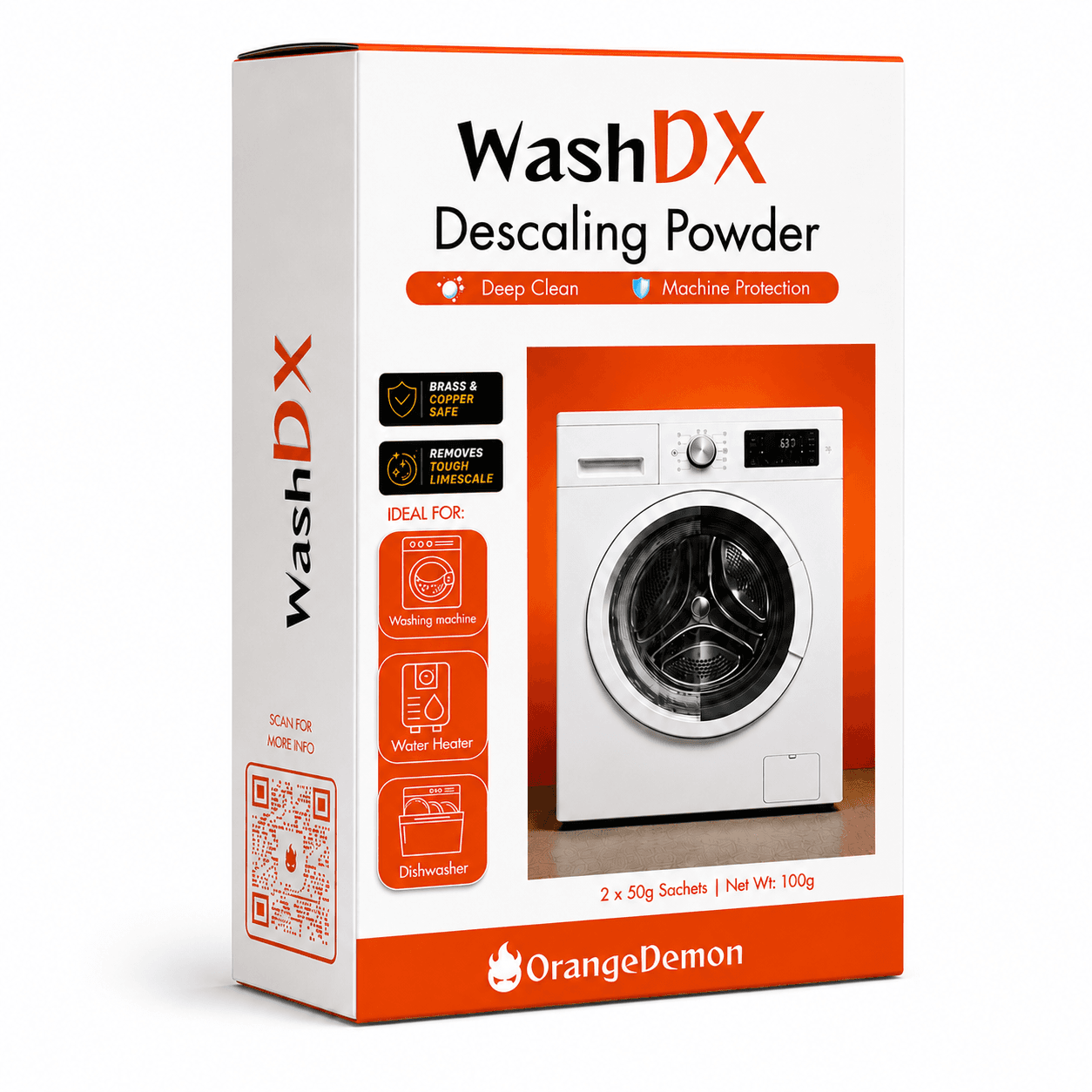
WashDX is usually more urgent for front-loaders because the heater + residue combination makes hard-water damage show up sooner.
But it still makes practical sense for top-loaders because the problem is not only the heater. Scale and mineral residue still build inside the machine, and once buildup gets established, cleaning becomes slower and less complete.
For most households, the right rule is:
- one sachet for regular maintenance
- two sachets for an older machine's first serious clean in harder water
The mistake people make
They buy the machine based on showroom logic, then live with the water they actually have.
That is backwards.
If you live in Delhi NCR, Jaipur, Gurugram, Noida, Hyderabad, or any other city where scale shows up quickly, water quality should influence your appliance routine from day one.
Read next: The Best Appliance Descaling Schedule by TDS in India
Front-load or top-load, hard water still wins if maintenance never happens. WashDX is the machine-side formula for both. View WashDX.