
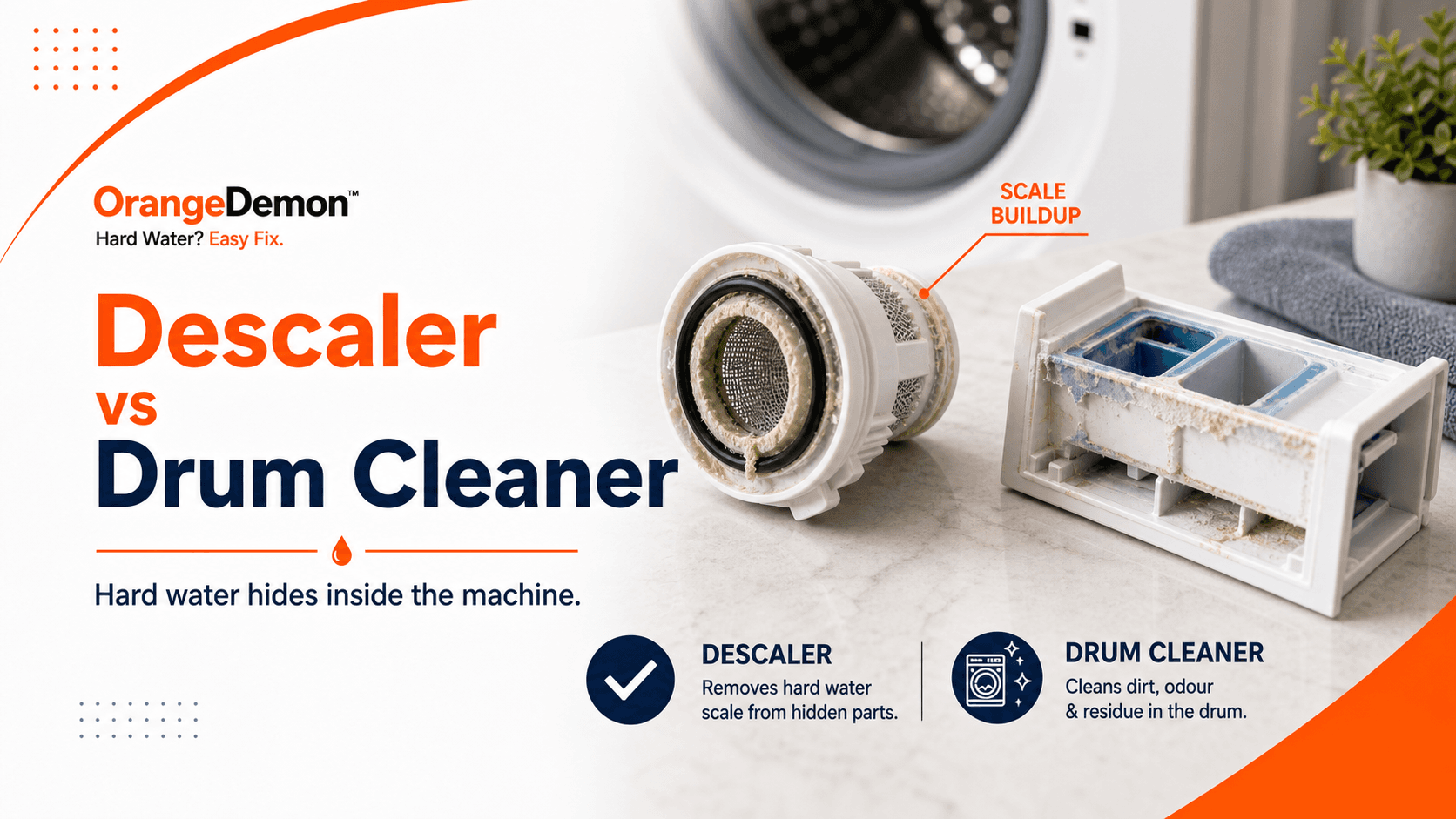
Quick answer: descaler vs drum cleaner
A washing-machine drum cleaner handles odour, detergent residue, lint, body oil, and mould. A washing-machine descaler handles mineral scale from hard water. If the machine smells again after a drum-clean cycle, clothes feel stiff, or chalky residue is visible, use a descaler route such as WashDX.
| Symptom | More likely problem | Better product type |
|---|---|---|
| Smell, sludge, dirty gasket | Organic buildup | Drum cleaner |
| White or grey deposits, stiff laundry | Hard-water scale | Washing-machine descaler |
| Smell returns after cleaning | Scale trapping residue | Descaler, then cleaning routine |
| High-TDS or borewell home | Repeat mineral load | Scheduled descaling |
The big confusion: cleaner and descaler are not the same
Most people search for a "washing machine cleaner" when the machine smells bad, looks dull, or gives poor wash results. But there are two different problems inside a washing machine.
One is organic buildup: detergent residue, fabric softener, lint, body oil, and mould. This is what many drum-clean tablets target.
The second is mineral scale: calcium, magnesium, rust-integrated deposits, and hard-water buildup around internal parts. This needs an acid-based descaler.
If your problem is hard-water scale, a normal drum cleaner may not solve it.
Why hard water affects washing machines
A washing machine repeatedly fills, heats, drains, and spins water. In hard-water homes, minerals slowly deposit on internal surfaces. Scale can collect around the drum, heater, pipes, and areas you cannot see.
This is common in Indian homes using borewell, tanker, or high-TDS municipal water. The issue becomes worse when detergent residue and mineral deposits combine.
The source logic is simple: hardness is mainly calcium and magnesium, and those minerals create scale in heated or evaporating water paths (USGS hardness guide). A TDS reading helps flag the risk, but washer symptoms decide whether you need cleaning, descaling, or both.
Signs your washing machine may need descaling
You may need a descaler if you notice:
- White or grey mineral deposits around drum holes
- Rough deposits near the heater area
- Clothes feel stiff even after washing
- Detergent does not perform well
- Machine takes longer to heat water
- Drum cleaner improves smell but not scale
- You live in a hard-water or borewell-water area
A descaler will not replace mould cleaning. But if mineral scale is the problem, it is the right tool.
Why WashDX is different
WashDX is OrangeDemon's heavy-duty appliance and plumbing descaler. It is built for washing machines, geysers, boilers, water tanks, immersion rods, and RO pre-filter housings.
Unlike many drum-clean sachets that focus on surfactants or alkaline cleaning, WashDX is acid-based and targets mineral scale. It has no surfactant, which means no foam and no drainage risk when used correctly.
The formula includes citric acid, sulfamic acid, fumaric acid, sodium gluconate, EDTA, and BTA. Sulfamic acid helps with hard scale and rust-integrated deposits. Sodium gluconate and EDTA support chelation. BTA helps protect aluminium during acid contact.
How to use WashDX in a washing machine
- Empty the drum completely. No clothes. No detergent.
- Tear open one 50 g sachet.
- Pour directly into the empty drum.
- Run the hottest cycle available, ideally 60 deg C or above.
- Keep the cycle to a maximum of 60 minutes.
- Immediately follow with one plain cold rinse cycle.
- Wipe the door seal with a damp cloth.
Do not use WashDX within 24 hours of a bleach cycle. Do not mix it with detergent or any other cleaner. Never run it with clothes inside.
How often should you descale a washing machine?
- Soft water: every 4-6 months
- Moderate hard water: every 2-3 months
- Hard water: every 6-8 weeks
- Very hard or borewell water: every 4-6 weeks
For the first clean in a very hard-water home, you may need a stronger maintenance cycle. After that, regular use helps prevent heavy buildup.
Can you use kettle descaler in a washing machine?
Do not use DescaleX Bio for washing machines. Bio is made for food-contact appliances like kettles and baby bottle warmers. Washing machines need a heavy-duty formula. Use WashDX.
Do not use WashDX in kettles or baby appliances. It is stronger and meant for appliance/plumbing scale, not food-contact use.
Final word
A washing machine drum cleaner and a washing machine descaler solve different problems. If you are dealing with smell and organic residue, a drum cleaner may help. If you are dealing with hard-water mineral scale, you need an acid-based descaler. For Indian hard-water washing machines, OrangeDemon WashDX is the correct product.
If the problem is mineral scale, move from drum cleaner to WashDX.