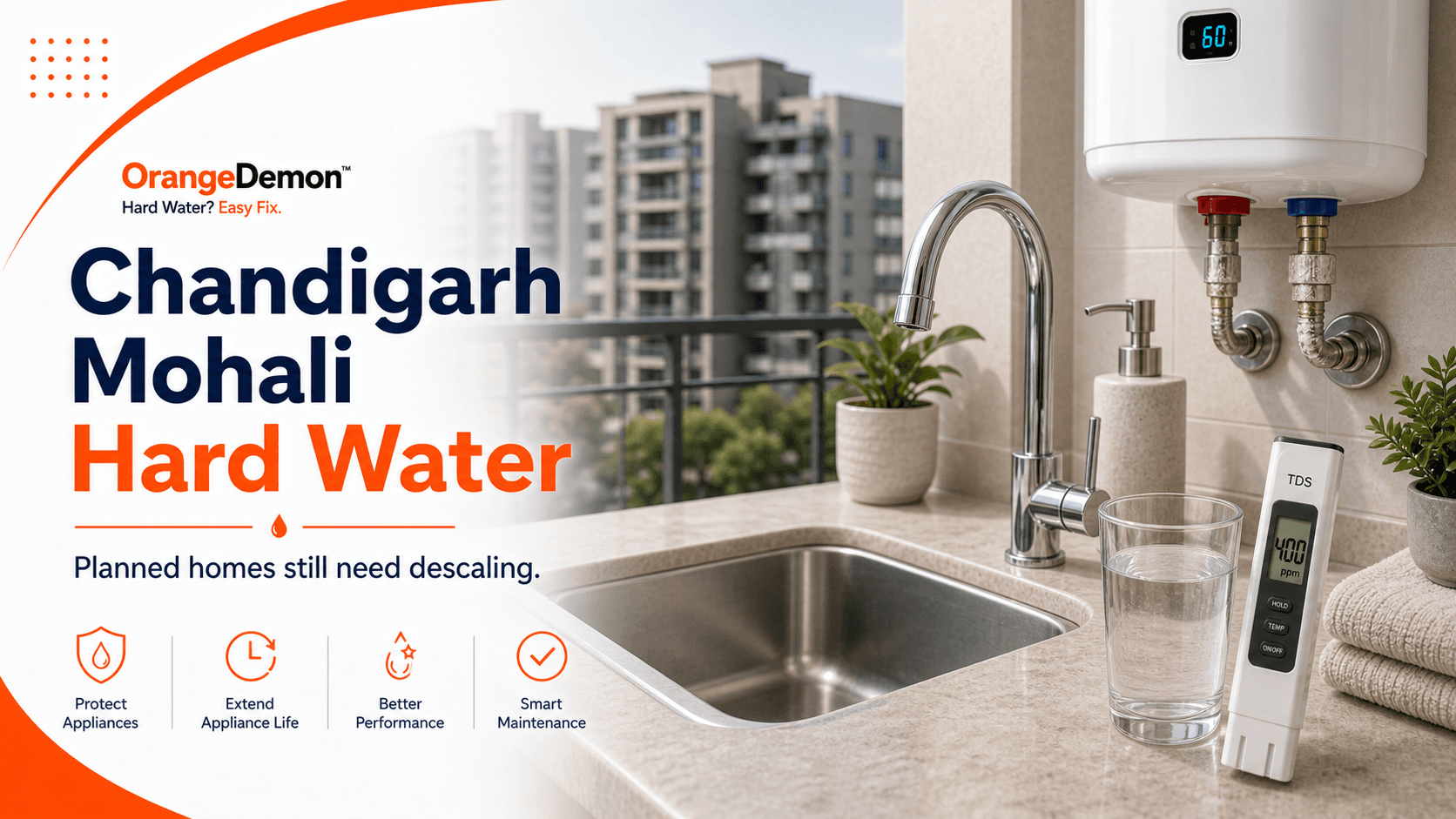
How hard water shows up in Panchkula homes.
Panchkula's approved city baseline is 390 ppm TDS for pincode 134109. Use that number as an appliance-maintenance reference, not as a total-hardness reading or a result for every sector and tap. The right question is whether the water entering the kettle, washing machine, geyser, or showerhead is leaving a recurring mineral film, residue, slow heating, or loss of flow.
The District Administration's HSVP water-bill service confirms a public water-service route, but it does not publish a neighbourhood-level municipal, borewell, or tanker mix. A 2019 groundwater study in south-eastern Panchkula sampled eight locations and reported a 100–250 mg/L hardness range; it gives useful variation context for Sector 25, 26, and 28 and Ramgarh, but it is neither a current citywide TDS report nor a result for municipal water, tankers, or every home. Confirm your building's source and test the appliance inlet before setting a cleaning schedule.
Panchkula households usually feel hard water first in washing machines, laundry feel, and repeat drum-cleaning frustration. At 390 ppm, the practical issue is not one bad wash - it is mineral residue building through daily cycles until the machine, fabric feel, and detergent performance all drift.
Panchkula sits in Panchkula district, and this page uses pincode 134109 as its local baseline. Individual buildings can test higher or lower depending on borewell share, overhead tank cleaning, season, storage time, and plumbing condition, so treat the city number as a strong household reference point rather than a lab certificate for every tap.
HOW TO USE THIS PAGE
For Panchkula, use this page as a prevention guide. The goal is to keep moderate mineral load from turning into avoidable washer, kettle, and geyser inefficiency over time.
- -Drum residue, repeat smells after normal clean cycles, or laundry that feels stiff.
- -Longer hot cycles and more visible scale on the machine rim, tray, or door seal.
- -White spotting in bathrooms showing the same mineral load hitting the washer.
PANCHKULA STUDY-AREA AND APPLIANCE CHECKS
Sector 25 source checksSector 26 utility-tap checksSector 28-A, 28-B, and 28-C study areaRamgarh groundwater-study areaHSVP-billed connectionsKettle, washer, geyser, and shower inlets
These are the kinds of local pockets where residents usually notice hard-water symptoms first: more tank storage, mixed supply, frequent hot-water use, and higher day-to-day appliance load.
BEST NEXT STEP
Match the product to the appliance showing scale: WashDX for a washing machine, geyser, showerhead, or immersion rod; DescaleX Bio for a kettle or bottle warmer; and DescaleX for a coffee machine or dishwasher. The city baseline and the 2019 groundwater study are reasons to test, not reasons to assume a fixed source mix or repeat interval.