
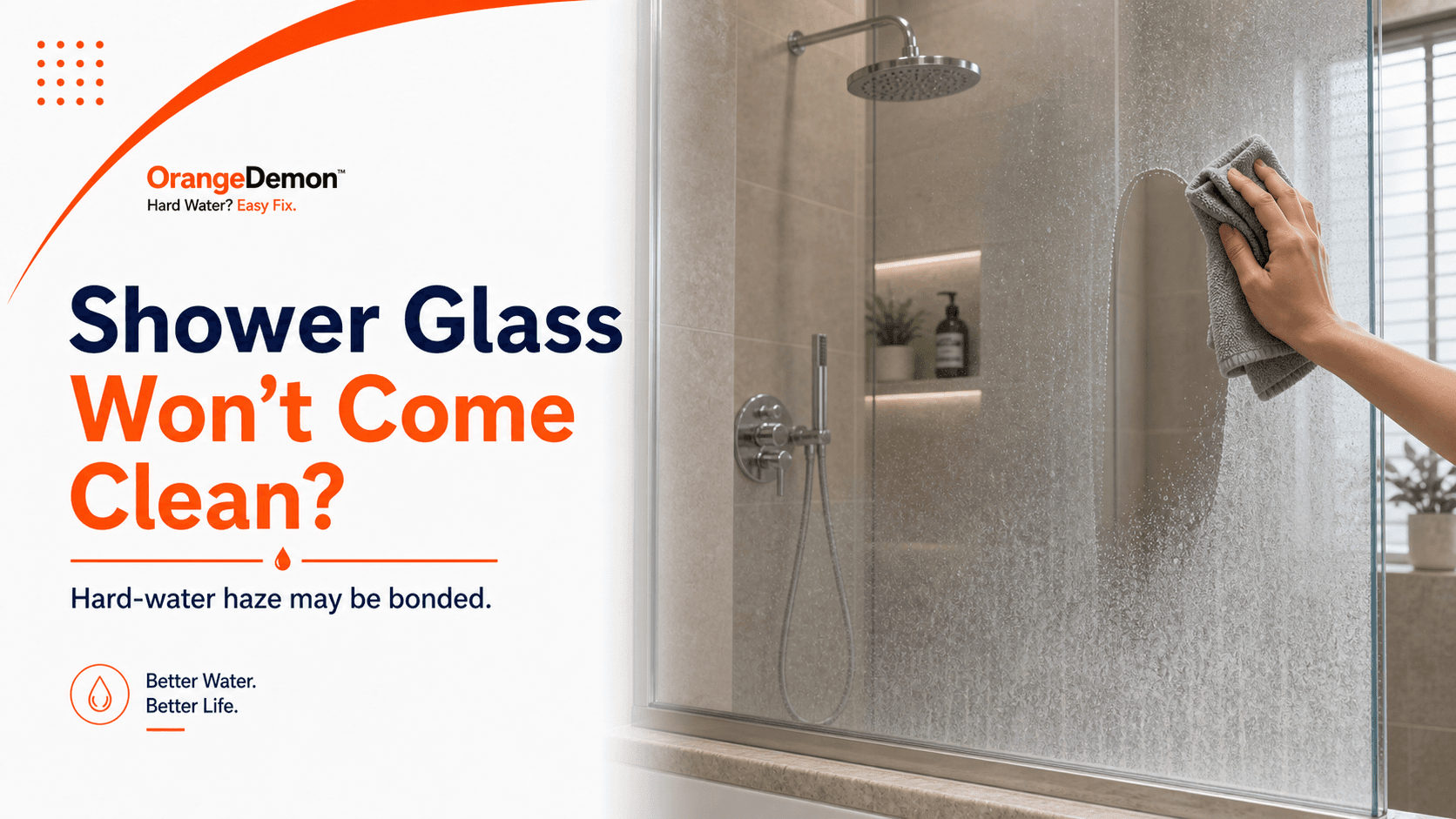
Quick answer: why shower glass will not come clean
Shower glass that stays cloudy after cleaning is usually covered in mineral scale, not ordinary dirt. In Indian hard-water bathrooms, choose a surface-safe limescale route for glass and tiles; Fighter is OrangeDemon's preview route for this job.
Open the Fighter shower-glass route.
The thing you've been cleaning isn't what you think
You've scrubbed it. You've used glass cleaner, vinegar, lemon juice, toothpaste - things the internet told you would work. And for a day, maybe two, the glass looks better. Then the white film comes back.
Here's what no one tells you: that film isn't dirt.
It's minerals. And ordinary cleaners were never built to remove minerals.
What hard water actually is
Water picks up dissolved minerals as it moves through rock and soil. In India, water travels through geological formations rich in calcium carbonate, magnesium, and various iron compounds. By the time it reaches your shower, it carries these minerals in dissolved form.
When that water hits your shower glass and evaporates, the minerals don't evaporate with it. They stay behind, bonded to the glass surface. That white, chalky, sometimes yellow-tinged residue - that's calcium and magnesium you're looking at.
This is called limescale or calcium carbonate scale. And it behaves completely differently from dirt, grease, or soap.
Best next page
| If your issue is | Best next page | Product route |
|---|---|---|
| Shower glass stays cloudy after cleaning | Fighter preview route | Fighter when available |
| Showerhead flow is weak or holes are blocked | WashDX product page | WashDX |
| Your city has high TDS and the stains return fast | TDS 400, 600, and 800 guide | Product by surface/appliance |
Short answer for buyers: shower glass film is mineral scale, not ordinary dirt. Use a surface-safe limescale route for glass and fittings, and use WashDX for removable showerheads with blocked flow.
Why ordinary cleaners fail
Standard bathroom cleaners are formulated to remove organic matter: body oils, soap, grime, mould. They use detergents and mild surfactants that break down organic compounds.
Calcium carbonate is not an organic compound. It's a mineral salt. Detergents don't break it down - they clean around it. That's why you can scrub a hard-water-stained glass for twenty minutes with standard cleaner and see almost no improvement in the actual scale. The surface looks cleaner because you've removed the top layer of soap scum, but the mineral deposits underneath are untouched.
The chemistry that removes minerals is fundamentally different from the chemistry that removes dirt. Minerals require acid. Specifically, they require acid that can penetrate the deposit and break the molecular bond between the mineral and the glass surface.
The TDS problem
TDS stands for Total Dissolved Solids - essentially a measure of how many minerals are suspended in your water. In most of Europe and North America, drinking water TDS runs between 50-200 ppm. In India, depending on your city and water source:
| City | Typical TDS |
|---|---|
| Delhi | 400-600 ppm |
| Jaipur | 500-700 ppm |
| Jodhpur | 600-900 ppm |
| Ahmedabad | 400-600 ppm |
| Mumbai | 150-300 ppm |
At 400+ TDS, hard water marks form within days of cleaning. At 600+ TDS - typical of borewell water in Rajasthan and Gujarat - they form within hours of use.
Most imported cleaning products were tested on 150 ppm water. They are simply not engineered for what Indian water does to surfaces.
What actually works
The solution is an acid-based formula capable of dissolving calcium and magnesium deposits - not masking them, not cleaning around them. Dissolving them.
Specifically, a combination acid system works better than a single acid. Different acid types attack different mineral compounds at different bond strengths. A triple-acid formula - combining methanesulfonic acid, lactic acid, and gluconic acid - can break through even severe scale that single-acid products can't touch.
The other requirement is contact time. An acid formula that drips off vertical glass immediately doesn't work well. The formula needs to cling to the glass surface for at least 60 seconds to allow the acid to penetrate and work through the mineral layers.
This is why cling-gel format matters. Not aesthetic - functional. The foam holds the acid against the glass instead of letting it run into the drain.
The honest answer
If your shower glass won't come clean, you're not failing at cleaning. You're using a product designed for a different problem.
The glass isn't dirty. The water is.
OrangeDemon Fighter is the preview route for this specific problem: hard-water mineral deposits on shower glass, in Indian conditions, with Indian TDS levels. Check what's in your water or open the Fighter preview.