
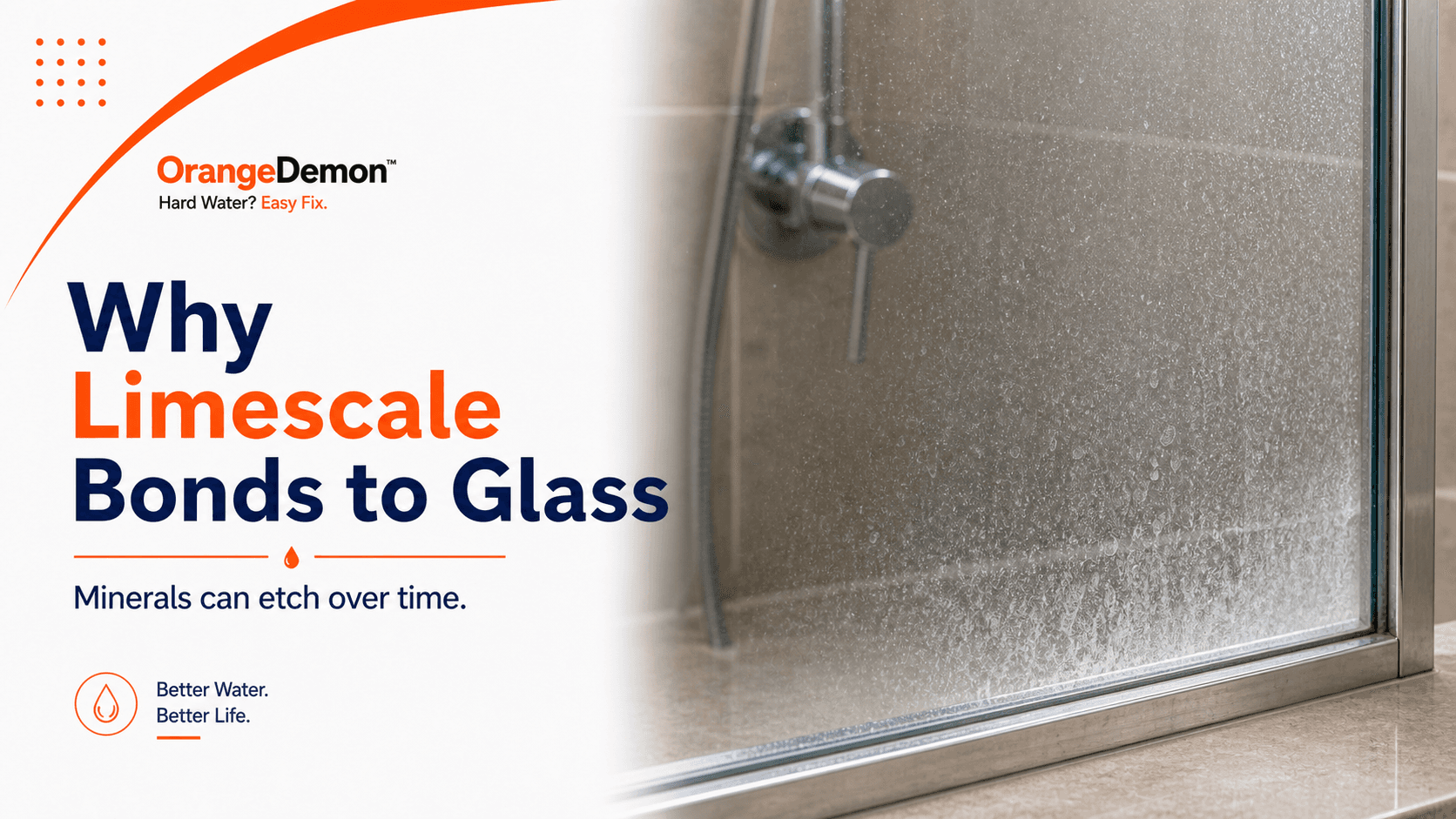
Most people approach hard water stains as a surface deposit - something sitting on the glass that needs to be wiped off with sufficient force or a better cleaning product. This mental model is wrong, and it's why most cleaning attempts fail or only partially succeed. Limescale doesn't sit on glass. It bonds to it.
How Calcium Carbonate Sticks to Glass
Glass is primarily silicon dioxide (SiO2) with various metal oxides. The surface of glass, particularly when wet, has silanol groups (Si-OH) on it - hydroxyl groups that can form weak chemical bonds with calcium ions in hard water. When hard water evaporates on glass, calcium ions don't just stay on the surface mechanically - they form a weak but real chemical bond with the glass surface via these silanol groups.
Subsequent layers of mineral deposits bond to previous ones. Over weeks and months, you build up a crystalline structure of interlocking calcium carbonate crystals that has genuine adhesion to the glass surface. This is structurally more like a coating bonded to the glass than loose dust that can be wiped away.
Why Scrubbing Doesn't Work
Mechanical force can physically break calcium carbonate crystals away from the surface, which is why hard scrubbing partially removes limescale. But several problems arise: abrasive materials (sponges, metal scourers) scratch glass and chrome surfaces, creating micro-scratches that provide even more surface area for future mineral bonding. And scrubbing without first dissolving the scale often breaks crystals rather than fully removing them, leaving microscopic mineral remnants that serve as nucleation sites for faster future scale buildup.
The Acid Dissolution Mechanism
Acid works differently. When an acid contacts calcium carbonate, hydrogen ions react directly with the carbonate group: CaCO3 + 2H+ -> Ca2+ + H2O + CO2. The calcium carbonate is converted to soluble calcium ions (which rinse away in water), water, and carbon dioxide gas (which you can sometimes hear fizzing). The crystal structure is chemically dismantled from within, not mechanically broken from the outside.
Critically, because acid dissolves the mineral from all contact surfaces simultaneously, there's no scratching, no surface damage, and no mineral residue left as a foundation for new scale. The glass surface is restored to its pre-scale state. This is why acid cleaning followed by proper rinsing produces a genuinely transparent, smooth glass surface, while scrubbing with abrasive cleaners produces a scratched glass surface that still has scale residue and builds up again faster.
Old vs. New Scale: Why Time Matters
Fresh mineral deposits - from the past week or two - are relatively loosely crystallised and dissolve quickly with acid. Old scale - built up over months or years - has gone through multiple recrystallisation cycles. The calcium carbonate crystals are larger, more ordered, and more densely packed. Acid still dissolves it, but may require longer contact time and, for very old scale, multiple treatment sessions.
This is the practical argument for regular acid treatment: fresh scale dissolved weekly requires 60 seconds of acid contact. Six-month-old scale may need 5--10 minutes and multiple applications. The cost of consistent weekly maintenance is always lower than the cost of attempting restoration after neglect.
Fighter is OrangeDemon's planned bathroom hard-water cleaner for shower glass and visible mineral stains. Join the launch list for availability updates and any launch-only offer.
Seen results with Fighter Share a before/after on Instagram @orangedemon.in or tag us on Twitter/X @OrangeDemonIn.
Follow OrangeDemon: Instagram / YouTube / Twitter / X