
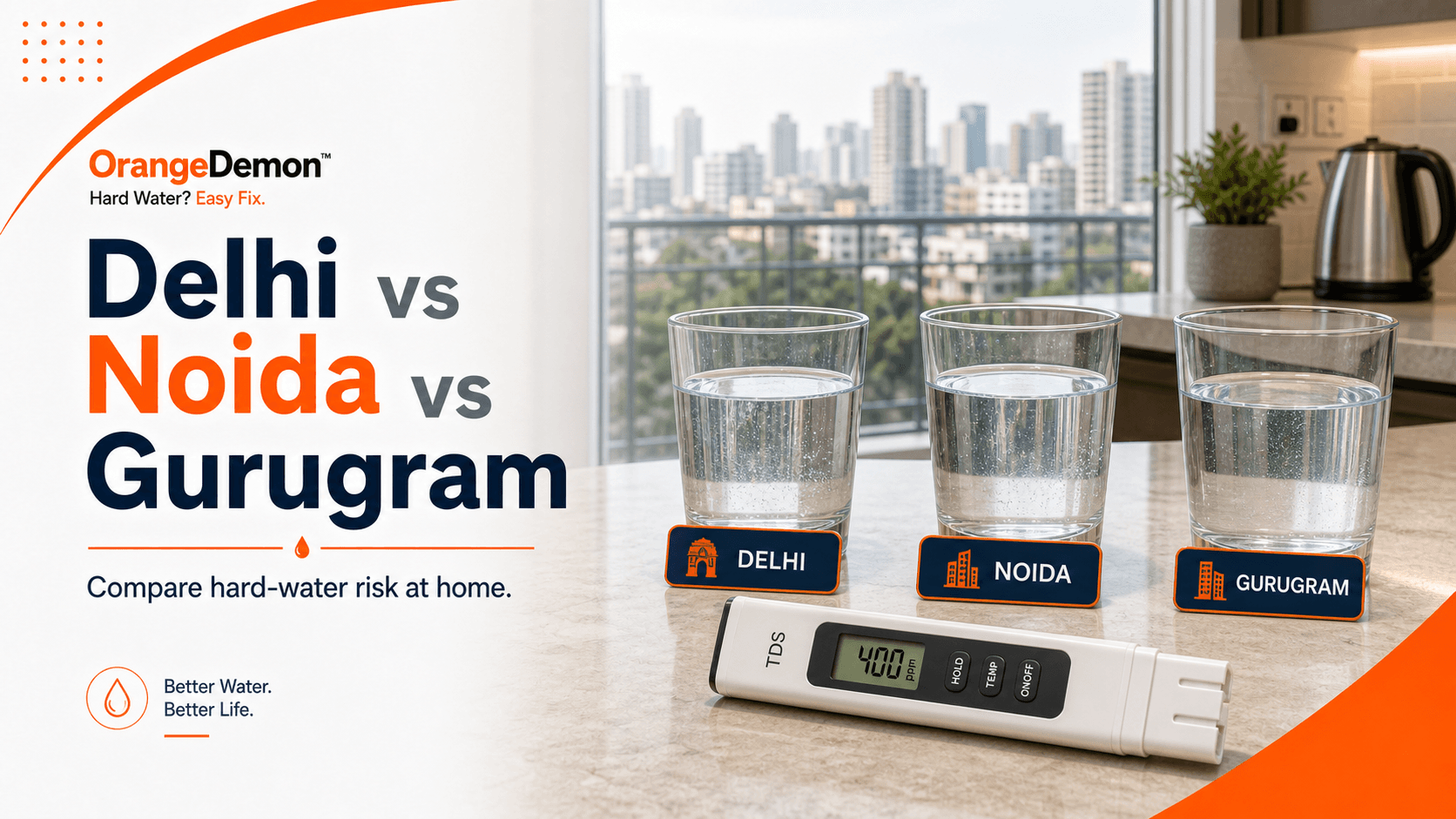
If you live anywhere in NCR, you have heard some version of this conversation:
"Delhi water is better." "Noida is terrible." "Gurugram is worst if your society uses borewell water."
Everyone has an opinion. Fewer people have a useful framework.
The better way to compare Delhi, Noida, and Gurugram is not to treat them as three perfectly uniform water systems. They are not. Each city contains local variation, mixed supply conditions, and building-level differences that matter a lot once the water reaches your home.
Still, if you are trying to understand which city is harsher on bathrooms and appliances, the comparison is worth doing.
The quick comparison
Based on OrangeDemon's city dataset, the indicative averages are:
- Delhi: 520 ppm
- Noida: 520 ppm
- Gurugram: 506 ppm
On paper, Delhi and Noida are roughly tied, with Gurugram slightly lower.
But that is only the start of the story.
Why the averages do not settle the question
A city average is a useful starting point, but you do not live in averages — you live with your building's actual supply.
One apartment may receive relatively better municipal water. Another may depend on blended or borewell-heavy supply and behave much more harshly despite being in the same city. So the real ranking depends on how water is sourced, stored, and delivered where you live.
That said, each city has a different hard-water profile.
Delhi: the broadest variation
Delhi is complicated because it contains everything from relatively better served urban zones to localities where storage, aging distribution, or supplementary groundwater change the in-home experience.
This makes Delhi less predictable than people assume.
Many residents think of Delhi water as the benchmark that is "supposed" to be better than the satellite cities. In some pockets that is true. But Delhi also has enough locality-level variation that residents still see classic hard-water symptoms:
- shower glass haze
- white marks on fittings
- faster scale in kettles
- appliance maintenance that comes sooner than expected
For the city-level page, see Hard Water in Delhi.
Noida: the high-TDS expectation problem
Noida has one of the strongest hard-water reputations in NCR, and for good reason.
Even with city-level improvements in supply infrastructure, many residents still report water that behaves like hard water in day-to-day use. And people reasonably want to understand why they are still seeing high TDS, scale, and appliance problems when the broader supply story sounds more optimistic.
Noida's hard-water identity is driven by:
- locality variation
- society-level source mixing
- continued groundwater dependence in practical use
- a noticeable mismatch between infrastructure narrative and in-home reality
If the question is "which city most often feels hard-water-heavy to the resident", Noida is a strong contender.
For the local view, see Hard Water in Noida.
Gurugram: the premium apartment paradox
Gurugram's special problem is not just hardness. It is hardness inside expensive homes.
The city's premium apartment stock makes hard water more visible and more expensive to live with. Imported fittings, glass-heavy bathrooms, and appliance-rich kitchens show mineral deposits quickly. If a society is relying on hard groundwater or blended supply, the result is obvious:
- glass loses clarity
- chrome crusts up
- showerheads and heating appliances scale faster
Gurugram residents often experience hard water as a property-protection issue. It is not just annoying; it feels misaligned with the value of the home.
For city context, see Hard Water in Gurugram.
So which city is actually harder
If we speak strictly by the average figures in the dataset, Delhi and Noida edge out Gurugram.
If we speak by everyday user perception, the answer becomes more nuanced:
- Noida often feels like the most consistently complained-about high-TDS city
- Gurugram often feels like the most visibly frustrating hard-water city in premium apartments
- Delhi is the broadest and most uneven, with stronger locality-to-locality differences
So the honest answer is:
Noida and Delhi look slightly harsher on average, but Gurugram can feel equally bad or worse depending on the society and source mix.
What matters more than the city name
For a homeowner or resident, the most important variables are:
- your tap-water TDS, not the city's reputation
- whether your building uses groundwater, blended supply, or cleaner municipal supply
- how quickly visible scale returns after cleaning
- whether appliances are already showing mineral buildup symptoms
These signals matter more than the city's reputation.
If your shower glass hazes in a week, your kettle scales repeatedly, and your geyser or washing machine needs more maintenance than expected, the water is already telling you what category you are in.
What to actually do about it
The comparison matters because your question is usually not purely informational.
If you are comparing Delhi, Noida, and Gurugram, you are usually trying to answer a practical question:
"Is my home normal, or is my water unusually harsh"
Once you know that, the response is the same in all three cities:
- work out the likely cause (building source plus your tap TDS)
- see what scale does to your surfaces and appliances
- set a simple maintenance routine
- use the right descaler for the appliance side
That is where DescaleX becomes relevant across all three cities.
Final takeaway
Delhi, Noida, and Gurugram all have legitimate hard-water problems, but they express them differently.
Delhi is broad and variable. Noida has one of the strongest high-TDS reputations in real household use. Gurugram turns hard water into a luxury-home maintenance problem.
If you want the useful answer, stop asking which city has the worst reputation and start asking what your own water is doing to your glass, fittings, and appliances.
Then maintain accordingly.
See the hard-water guides for Delhi, Noida, and Gurugram. If scale is already showing up in your machines, shop DescaleX.