
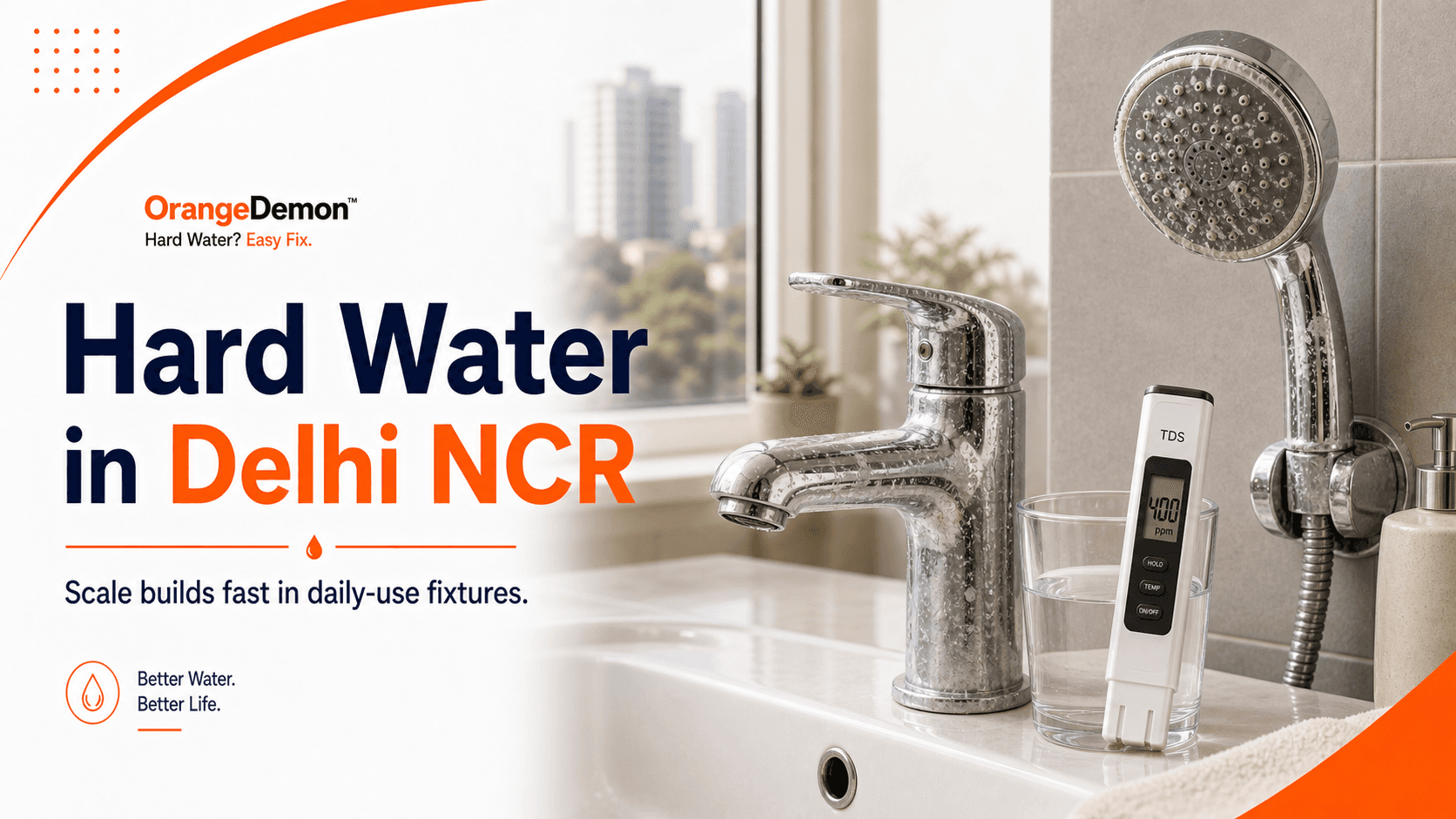
Quick answer: why Delhi NCR has hard water
Delhi NCR hard-water problems come from a mix of groundwater dependence, mineral-rich alluvial geology, storage tanks, old distribution paths, and fast apartment growth around Gurugram, Noida, Faridabad, and Ghaziabad. For buyers, the useful question is not whether NCR is hard in theory. It is which appliance is already showing scale and how often the routine should repeat. (New to TDS? See what TDS and hard water mean.)
| NCR area pattern | Likely issue | Maintenance route |
|---|---|---|
| Delhi apartment and builder-floor belts | Storage plus mixed-source variation | Test TDS and watch washer/kettle symptoms |
| Gurugram, Noida, Faridabad, Ghaziabad | Borewell and high-TDS apartment exposure | Repeat appliance descaling |
| Shower glass and chrome scale | Visible mineral deposits | Descale and dry-wipe routine |
| Washer, geyser, kettle all affected | Whole-home hard-water load | Starter Combo |
If you live in Delhi, Gurgaon, Noida, Faridabad, or Ghaziabad, you've almost certainly noticed the problem. Glass shower doors fog over within days. Chrome taps develop a white crust that won't come off with regular cleaning. Tiles around the base of the shower look stained even after scrubbing. This isn't bad hygiene. It's geology and groundwater mismanagement.
Delhi's Water Quality: The Numbers
Delhi's groundwater TDS typically ranges between 500 and 1200 mg/L depending on the locality, source, and season. The Delhi Jal Board's piped water supply - drawing from the Yamuna and Ganga canal systems
- generally delivers water at 300--600 mg/L TDS to the distribution network. However, that number rises significantly by the time it reaches homes through aging distribution pipes, rooftop tanks, and overhead storage.
In areas that rely on borewell water - which includes large parts of South Delhi, the new Dwarka sectors, much of Gurgaon's residential zones, and most of Noida - TDS regularly tests at 600--1000 mg/L. Gurgaon has been classified as 'over-exploited' by the CGWB, meaning groundwater extraction exceeds annual recharge. As the water table drops, the remaining water sits longer in mineral-rich sediment and picks up more dissolved calcium and magnesium.
Source context before acting
Delhi Jal Board publishes daily drinking-water quality updates, which is useful for supply-side monitoring but still does not tell you what every apartment receives at the tap after storage and internal plumbing (Delhi Jal Board daily drinking-water quality). Delhi's water policy also discusses groundwater quality variation and CGWB electrical-conductivity mapping, which is relevant to high-mineral water patterns (Delhi water policy PDF).
The buyer move is therefore practical: check your tap TDS, then choose by symptom. Use WashDX for washing-machine and geyser scale, DescaleX Bio for kettles, and the Starter Combo when the same water is hitting more than one appliance.
Why NCR Is Particularly Affected
The Indo-Gangetic Plain, on which Delhi NCR sits, is underlain by deep alluvial sediment - ancient river deposits of limestone, sand, and clay from the Himalayan erosion. This geology is naturally mineral-rich. Groundwater moving through it picks up calcium carbonate and magnesium sulphate before it's ever pumped. It's not contamination in the traditional sense - it's the baseline chemistry of the water source.
Add to this the rapid urbanisation of the past 25 years. New residential developments in Gurugram, Greater Noida, and Faridabad were built faster than municipal water infrastructure could be extended. Builders installed borewells as the primary or backup water supply. Those borewells tap into the same over-exploited aquifer, delivering 600--900 mg/L water to bathrooms that cost Rs.1--5 crore to furnish.
What This Means for Your Bathroom
At 600--800 mg/L TDS, which is typical for much of NCR borewell supply, hard water scale becomes visible on shower glass within 5--7 days. Chrome tap bases develop a white mineral ring within days of installation if not treated. Glass enclosures in premium bathrooms lose their clarity within weeks.
Ordinary cleaning products - Harpic, Colin, even 'bathroom cleaners' that claim to remove stains - are formulated to remove organic dirt and soap scum at alkaline or neutral pH. They do not dissolve calcium carbonate or magnesium sulphate. The white haze returns because you're cleaning the surface layer without addressing the mineral bonded to the glass underneath.
The Effective Maintenance Approach for NCR Water
At 600+ mg/L, weekly acid treatment is the only approach that keeps glass clear. The routine is simple: spray an acid-based cleaner, wait 60 seconds for the acid to react with and dissolve the mineral layer, then wipe or rinse. Regular squeegee use after showers slows accumulation between acid treatments but does not replace them at this TDS level.
For appliances: check your geyser manufacturer's manual for descaling frequency. At 700+ mg/L, annual descaling is the minimum recommendation. Washing machines benefit from monthly hot wash cycles with a descaling agent. Showerheads can be soaked in acid solution overnight every 3 months to clear clogged nozzles.
Delhi NCR FAQ for hard-water buyers
Is Delhi water hard even if it is treated?
Yes, treated supply can still carry hardness minerals. Treatment and biological safety are not the same as softening. That is why a Delhi home can receive treated water and still show scale on kettles, washers, geysers, and shower fittings.
Which NCR appliance usually shows hard water first?
Kettles and showerheads show visible scale fastest. Washing machines and geysers often cost more because the scale is hidden until smell, slow heating, stiff laundry, or service issues appear.
Which OrangeDemon route fits Delhi NCR?
For one affected appliance, choose the specific route: WashDX, DescaleX Bio, or DescaleX. For typical NCR multi-appliance scale, start with the Starter Combo.
TapStrike Intense is OrangeDemon's heavy-duty spray for limescale, hard-water marks and soap scum on taps, sinks, washbasins and glazed tiles. See TapStrike Intense.
Seen results with OrangeDemon? Share a before/after on Instagram @orangedemon.in or tag us on Twitter/X @OrangeDemonIn.
Follow OrangeDemon: Instagram / YouTube / Twitter / X