
People in Noida often hear a version of the same reassurance: Ganga water has been brought in, supply has improved, the hard-water problem should be getting better.
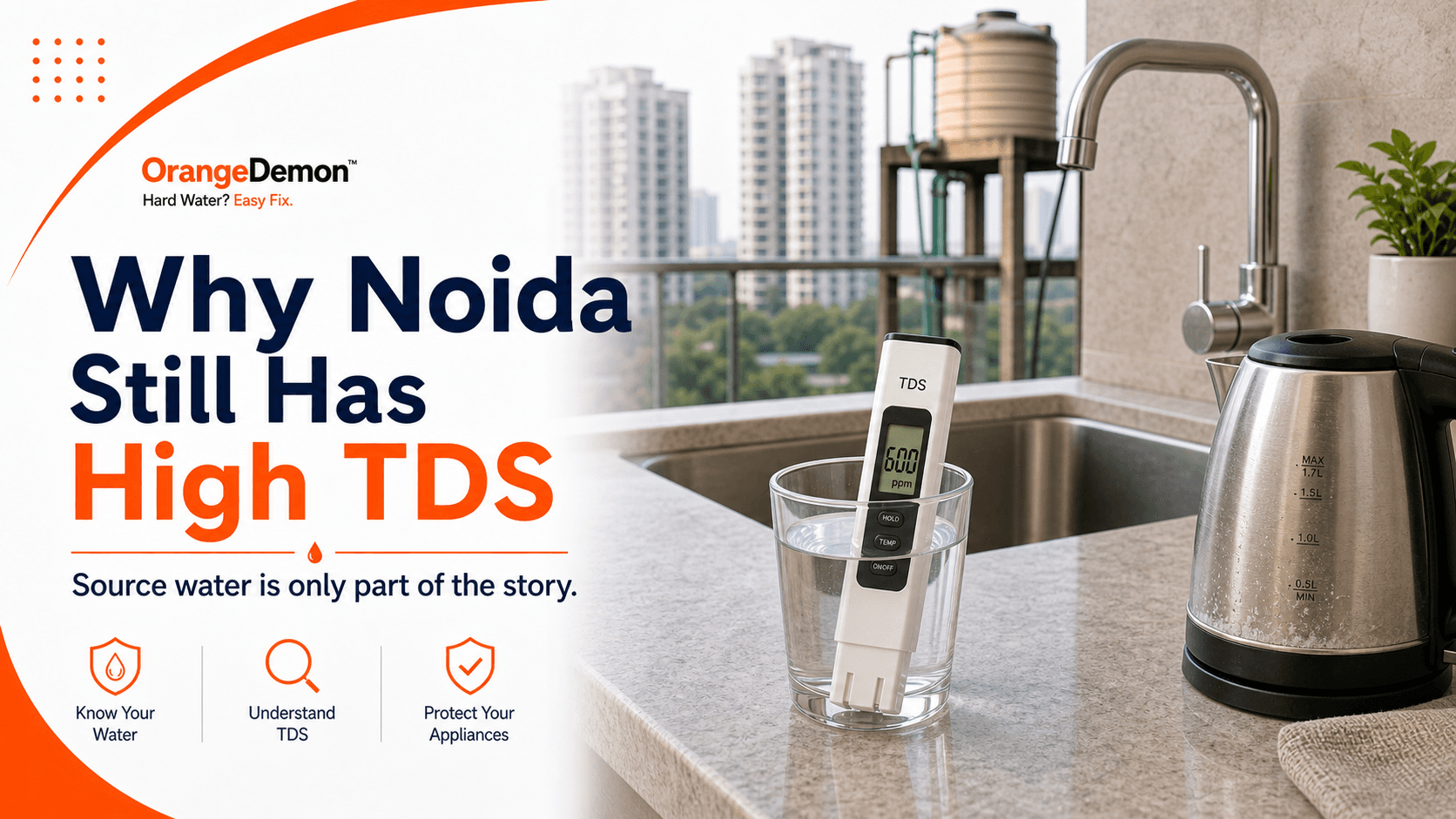
Then they test the water in their apartment and still see numbers in the 450-700+ TDS range.
That mismatch is exactly why this topic ranks and why it confuses so many residents. The headline infrastructure story and the in-home reality are not always the same thing.
Quick answer: why Noida still has high TDS
Ganga water entering the wider Noida supply story does not mean every home receives low-TDS water at the tap all the time.
What reaches your kitchen, bathroom, washing machine, and geyser depends on:
- how much of the local supply is actually surface water vs groundwater
- whether your sector or society blends multiple sources
- storage in underground tanks and overhead tanks
- seasonal shifts, shortages, and maintenance disruptions
- how your building manages borewell backup
That is why two societies a few kilometres apart can report very different appliance problems.
Evidence check: city supply is still mixed
Noida's infrastructure documents describe supply from tube wells, Ranney wells, and Ganga water, with Ganga water used to dilute high-mineral groundwater rather than replace every source at every tap (Noida Authority NGT status report PDF). The BIS drinking-water specification separates TDS, total hardness, calcium, magnesium, and alkalinity, which is why a city-level improvement still has to be checked at the apartment tap (BIS IS 10500:2012 PDF).
| Noida resident claim | What it can still mean at home | Buyer action |
|---|---|---|
| "Our area gets Ganga water" | Surface water may still be blended or interrupted | Test tap TDS |
| "Society water is treated" | Treatment may not remove hardness minerals | Watch appliance symptoms |
| "Only the geyser is slow" | Heating surfaces expose scale first | Use WashDX or service route |
| "Kettle, washer, and shower all scale" | Whole-home hard-water routine needed | Choose by appliance |
The city-level story and the apartment-level story are different
At the city level, Noida has worked to increase access to treated surface water. That matters. It can reduce dependence on harder groundwater and improve baseline supply quality in parts of the city.
But search behavior in Noida tells us residents are still dealing with high TDS at the point of use, and the local news cycle keeps returning to the same issue: inconsistent supply quality, high TDS complaints, and frustration that the infrastructure narrative has not fully translated into better in-home water.
That gap is the important one for OrangeDemon.
You do not descale a geyser based on policy announcements. You descale it based on what is actually moving through the appliance.
Why TDS can still stay high in Noida homes
1. Groundwater does not disappear overnight
Even when a city improves surface-water access, groundwater often remains part of the operational mix. In many sectors and private societies, borewell supply still plays a direct or backup role. Noida and nearby areas have long depended on mineral-heavy groundwater, and that underlying chemistry does not vanish just because a new source has been introduced into the broader system.
2. Societies often manage their own water reality
This is where the consumer experience becomes hyper-local.
A resident may say, "Our city has Ganga water now," but the building may still be:
- blending municipal supply with borewell water
- switching sources depending on shortages
- storing water in tanks where quality varies over the week
- distributing water unevenly between towers or blocks
So the city brand and the building reality can diverge sharply.
3. Greater supply coverage is not the same as consistently low TDS
Infrastructure upgrades can improve access without guaranteeing soft water. If the local network still includes mixed sources, aging storage, or groundwater fallback, the water reaching the apartment may still be hard enough to damage glass, taps, showerheads, kettles, and heating elements.
4. People notice appliance symptoms before they understand the water
This is why product-led content works so well in Noida.
Most residents do not start by searching for hydrogeology. They search because:
- the geyser heats slowly
- the showerhead pressure has dropped
- the washing machine smells off
- the kettle scales up too fast
- the bathroom glass is cloudy again
Those are not separate problems. They are often the household symptoms of the same mineral load.
What high TDS in Noida usually looks like inside the home
In practical terms, homes with roughly 500+ TDS water often report:
- white crust around taps and drain lines
- fast haze build-up on shower glass
- rough-feeling bathroom fittings
- repeated scale in kettles and coffee machines
- reduced geyser efficiency over time
- washing machines that smell or need more frequent maintenance
Knowing your local number is only the start. What matters is connecting that TDS to the repair, cleaning, and replacement costs Noida residents already feel.
If you want the city-specific breakdown, see Hard Water in Noida.
What this means for your home
The useful question is not whether Noida is "supposed" to have better water now. It is simpler and more practical:
"My water is still hard enough to damage things. What do I do about it?"
The answer has three parts:
- diagnose your local hard-water level clearly
- know which appliances and surfaces are most affected
- use a maintenance routine that removes mineral scale before it builds up
That is where an appliance-specific descaling routine fits.
Protect the appliances that take the hit
If your apartment is still receiving high-TDS water, you need to protect the machines and fixtures that actually take the hit.
Use the product route by appliance:
| Affected Noida appliance | OrangeDemon route |
|---|---|
| Washing machine, geyser, immersion rod | WashDX |
| Kettle or food-contact heating appliance | DescaleX Bio |
| Dishwasher or coffee machine | DescaleX |
| Showerhead flow blockage | WashDX |
| Multiple appliances in the same flat | Choose by appliance |
It is not trying to re-engineer municipal water infrastructure. It helps you deal with the part of the problem that shows up in your home today.
The better framing for Noida residents
The wrong question is:
"Has Noida solved its water problem yet"
The more useful question is:
"What is the TDS at my tap, and what is that doing to the things I use every day"
That framing makes decisions clearer:
- if TDS is high, descale on a schedule
- if shower glass hazes quickly, treat it as a water issue, not just a cleaning issue
- if a society claims supply quality has improved, still verify your own water
Noida residents do not need optimism. They need a realistic maintenance plan.
Final takeaway
Ganga water in the system is real. So are Noida's continuing high-TDS complaints.
Those two facts can coexist because city-scale water sourcing and apartment-level water quality are not the same thing. Mixed sources, borewell dependence, storage practices, and locality-level variation all help explain why so many Noida homes still behave like hard-water homes.
If your appliances are scaling, trust the evidence in front of you.
Start with your actual TDS — check your city's level and see what your TDS number means for appliances. Then build the maintenance routine around that.
For city-level context, read Hard Water in Noida. For the appliance side, choose the specific route for each scaling machine: WashDX, DescaleX Bio, or DescaleX.