
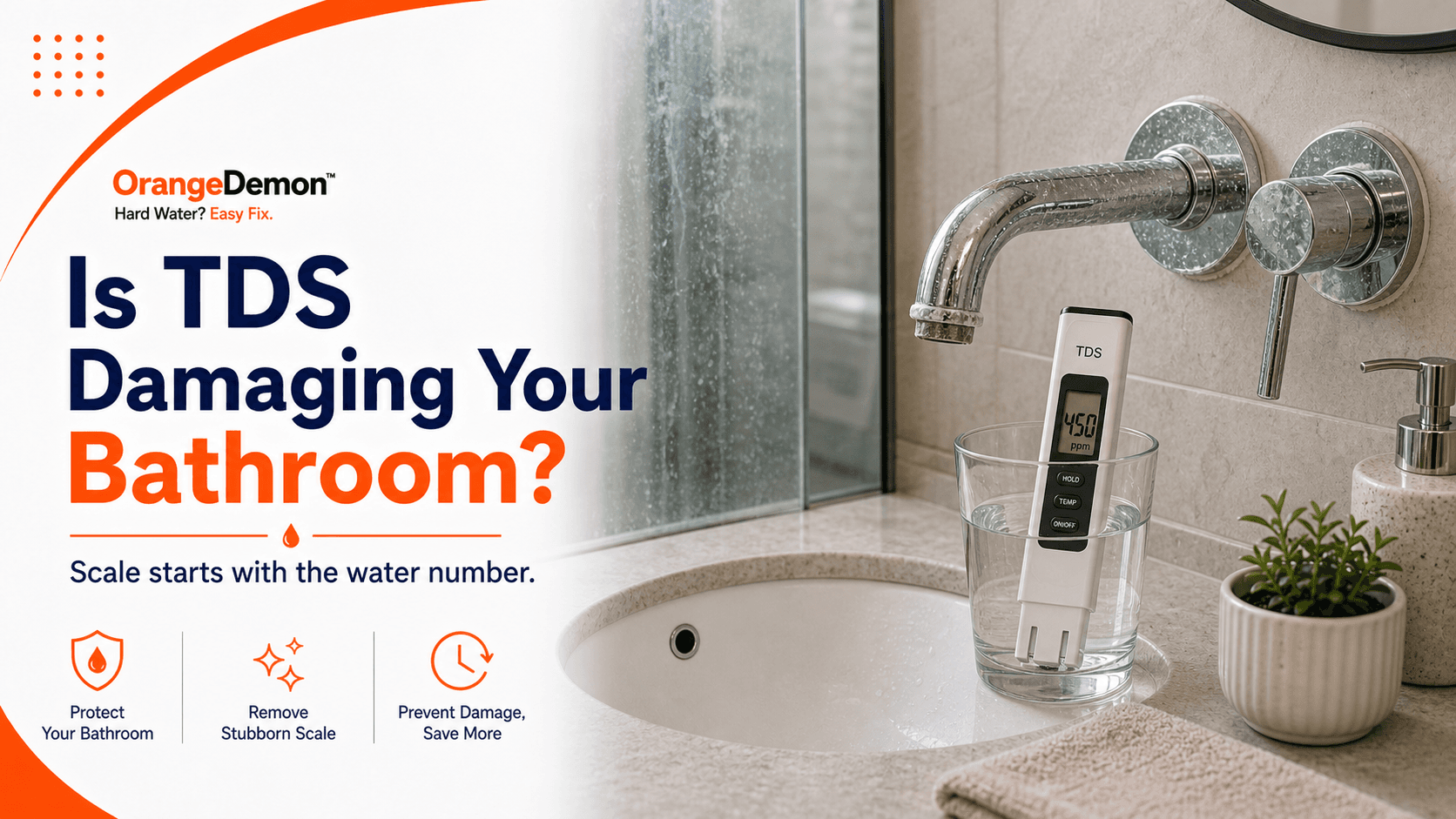
You've probably seen the abbreviation TDS on your water purifier display or heard your plumber mention it. Most people assume it's only relevant for drinking water. It isn't. TDS is also the reason your shower glass looks milky white a week after you scrub it clean.
What TDS Actually Means
TDS stands for Total Dissolved Solids. It's a measurement - in milligrams per litre (mg/L) or parts per million (ppm) - of everything dissolved in your water that isn't H2O itself. That includes calcium, magnesium, sodium, potassium, bicarbonates, sulphates, and chlorides, among other minerals.
The Bureau of Indian Standards (BIS), under IS 10500:2012, sets the acceptable limit for TDS in drinking water at 500 mg/L. Water above that threshold tends to taste salty or metallic and is not considered palatable. The WHO recommends below 300 mg/L for ideal taste.
But here's what those standards don't tell you: even water at 300--500 mg/L leaves mineral deposits on hard surfaces. Every litre of water that touches your glass, tiles, or chrome and then evaporates leaves behind those dissolved solids. Do that 10 times a day over 30 days and you have a thick calcium crust that no soap or regular cleaner was ever designed to remove.
Why India's Water Is Unusually High in TDS
India has some of the highest residential TDS levels in the world, particularly in the north, northwest, and parts of the south. This is primarily a geological fact, not a pollution problem. India sits on ancient sedimentary rock formations - limestone, chalk, and gypsum - that are naturally rich in calcium and magnesium. As groundwater moves through these formations, it dissolves minerals and becomes hard.
Overextraction makes it worse. According to the Central Ground Water Board's 2024 Annual Report, states including Punjab, Rajasthan, Haryana, and Delhi are classified as 'over-exploited' - meaning extraction exceeds annual recharge. When aquifer levels drop, the remaining water sits in contact with mineral-rich rock longer, absorbing more dissolved solids before it's pumped up.
Borewell water in most Indian cities routinely tests at 400--1000 mg/L. Delhi borewells average 500--800 mg/L. Jodhpur and Jaisalmer in Rajasthan can exceed 1500 mg/L. Even in cities with municipal supply, that supply often blends borewell water with surface water, and many apartments rely on borewells as backup, especially in newer developments.
What High TDS Does to Your Bathroom
When high-TDS water hits your shower glass and evaporates, it leaves a thin mineral film. Calcium carbonate (CaCO3) and magnesium sulphate (MgSO4) are the primary culprits. These compounds are essentially the same materials that form stalactites in caves - they bond chemically to glass and other surfaces rather than sitting loosely on top.
The first few deposits are invisible. By week three, you see a faint haze. By month two, it's a white-grey crust that scatters light and makes glass look perpetually dirty. Soap scum - fatty acids from soap reacting with calcium and magnesium - layers on top, creating a film that ordinary alkaline cleaners can dissolve but cannot penetrate.
Regular bathroom cleaners are formulated around surfactants and alkaline compounds. They're excellent at removing organic dirt - skin cells, soap residue, grime. They have no meaningful effect on inorganic mineral scale because the calcium and magnesium compounds are not soluble in alkaline or neutral pH environments. You need an acid.
The TDS Scale and What It Means for Your Glass
Below 200 mg/L: Soft water. Minimal scale. Found in parts of coastal India and the northeast. Light maintenance keeps glass clear.
200--400 mg/L: Moderate hardness. Monthly cleaning with an acid-based product keeps surfaces clear. Most metro municipal supply sits here.
400--600 mg/L: Hard water. Heavy scale forms within weeks if untreated. Much of NCR, Hyderabad, Bengaluru borewell supply falls here.
600--900 mg/L: Very hard. Scale visible within days on glass. Rajasthan, parts of Gujarat and Haryana frequently test here.
Above 900 mg/L: Extreme. Found in areas with saline groundwater. Not just a bathroom problem - can clog pipes and reduce appliance life dramatically.
The Practical Implication
Knowing your TDS level tells you how aggressive your cleaning routine needs to be. A TDS meter costs Rs.300--Rs.500 online. Dip it into a glass of your tap water and you'll have your number in seconds. If you're above 400 mg/L, a standard cleaning routine will never keep up. You need a cleaner with actual acid chemistry - not stronger scrubbing, not more soap, not vinegar.
TapStrike Intense is OrangeDemon's heavy-duty spray for limescale, hard-water marks and soap scum on taps, sinks, washbasins and glazed tiles. See TapStrike Intense.
Seen results with OrangeDemon? Share a before/after on Instagram @orangedemon.in or tag us on Twitter/X @OrangeDemonIn.
Follow OrangeDemon: Instagram / YouTube / Twitter / X