
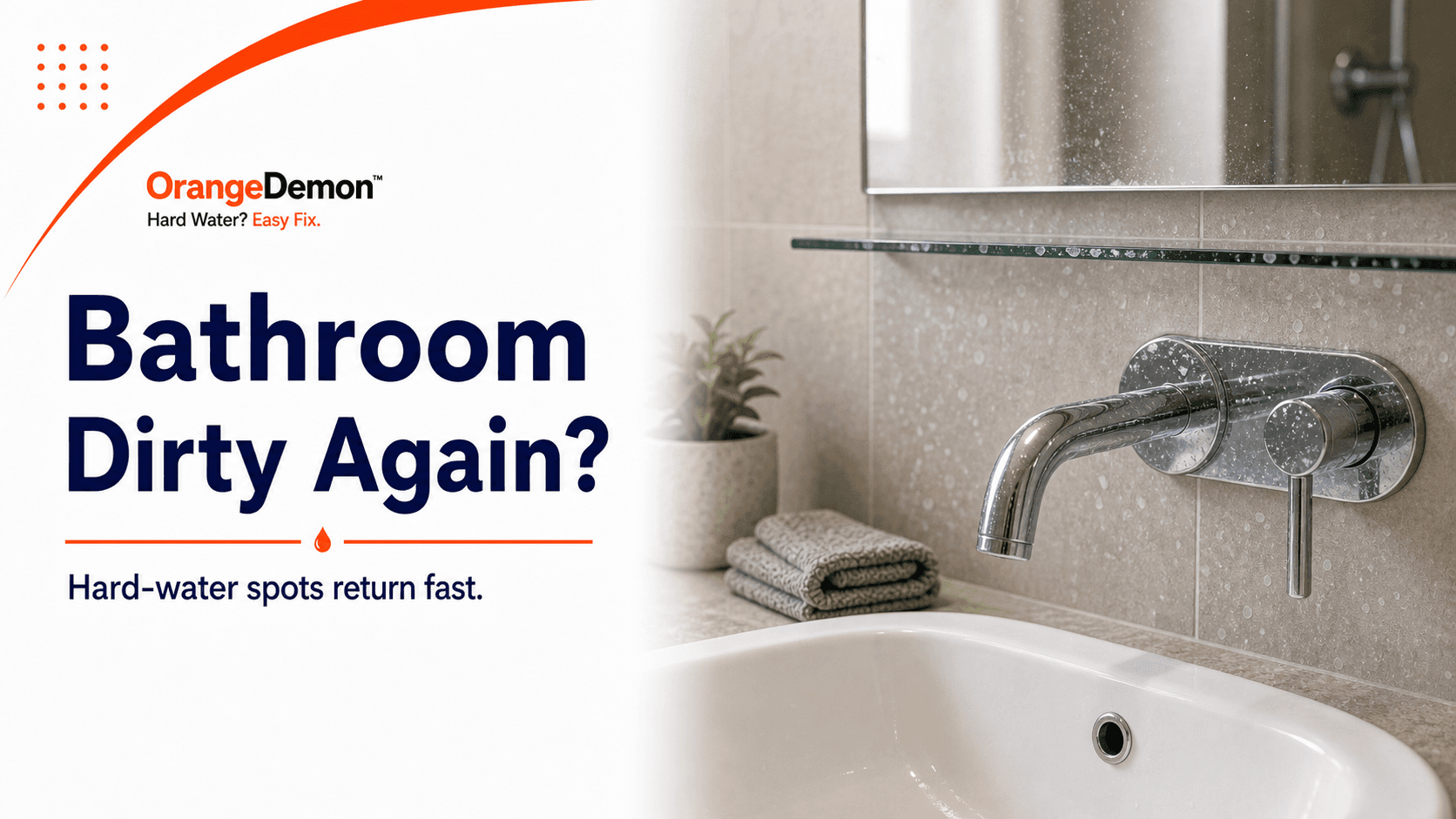
There is almost nothing more demoralising in home maintenance than thoroughly cleaning a bathroom - scrubbing every surface, polishing the glass, descaling the taps - only to find it looking dingy again two days later. Before you blame the cleaning product or your cleaning technique, understand what's actually happening.
You're Cleaning the Wrong Layer
Standard bathroom cleaners are excellent at removing what they were designed to remove: organic deposits. Soap scum, body oil, skin cells, bacteria, mildew - all of this dissolves effectively in the alkaline or neutral pH solutions that make up most bathroom spray products. When you use one of these products and scrub, you're genuinely cleaning the bathroom.
But underneath the organic layer is a mineral layer - calcium carbonate and magnesium sulphate bonded to the glass and tile surface from your water. A standard cleaner at neutral or alkaline pH does not dissolve this layer. It cleans around it and on top of it. The bathroom looks clean when you finish. Two days later, the soap scum and grime have re-deposited on the porous mineral surface and it looks like it was never cleaned.
The only way to address this cycle is to periodically remove the mineral base layer with an acid-based cleaner. Once the mineral surface is gone, organic deposits have less to grip and the bathroom stays cleaner between washes.
Water Evaporation Is Continuous
Even after cleaning, your water doesn't stop being hard. Every shower deposits a fresh layer of minerals. Every water droplet that dries on glass leaves behind its dissolved mineral content. In a household of two or three people, your shower glass might be hit with water hundreds of times between weekly cleans. Each event adds a microscopic layer.
The first few days after an acid clean, the glass is clear and water beads and runs off easily. As the week progresses, mineral deposits begin accumulating again. By day 10--14 at 500+ mg/L TDS, you're back to the hazy look. This isn't your cleaner failing - it's physics.
Soap Scum Builds on Mineral Scale
Here's the compounding factor: soap scum - the white or grey film formed when fatty acids in soap react with calcium in hard water - bonds much more strongly to mineral-roughened surfaces than to clean glass. A glass surface freshly treated with acid is smooth and hydrophobic; water and soap residue slide off more easily. An untreated glass surface covered in calcium deposits is microscopically rough and hydrophilic; soap scum and organic residue grip the surface and accumulate faster.
This is why a bathroom cleaned with only a standard product looks dirty faster than one cleaned with an acid-based descaler as the first step. The acid removes the mineral roughness; subsequent standard cleaning is more effective and lasts longer.
The Right Cleaning Protocol
Step one: Apply an acid-based descaler to all hard surfaces - glass, tiles, chrome, and porcelain. Allow 60--90 seconds of contact time for the acid to react with mineral scale. Wipe or rinse. Step two: Apply your regular bathroom cleaner to address soap scum, organic residue, and bacteria. Rinse thoroughly. The result is a genuinely clean bathroom from which the mineral base layer has been removed. This two-step approach, done weekly in hard water areas, breaks the two-day cycle.
TapStrike Intense is OrangeDemon's heavy-duty spray for limescale, hard-water marks and soap scum on taps, sinks, washbasins and glazed tiles. See TapStrike Intense.
Seen results with OrangeDemon? Share a before/after on Instagram @orangedemon.in or tag us on Twitter/X @OrangeDemonIn.
Follow OrangeDemon: Instagram / YouTube / Twitter / X