
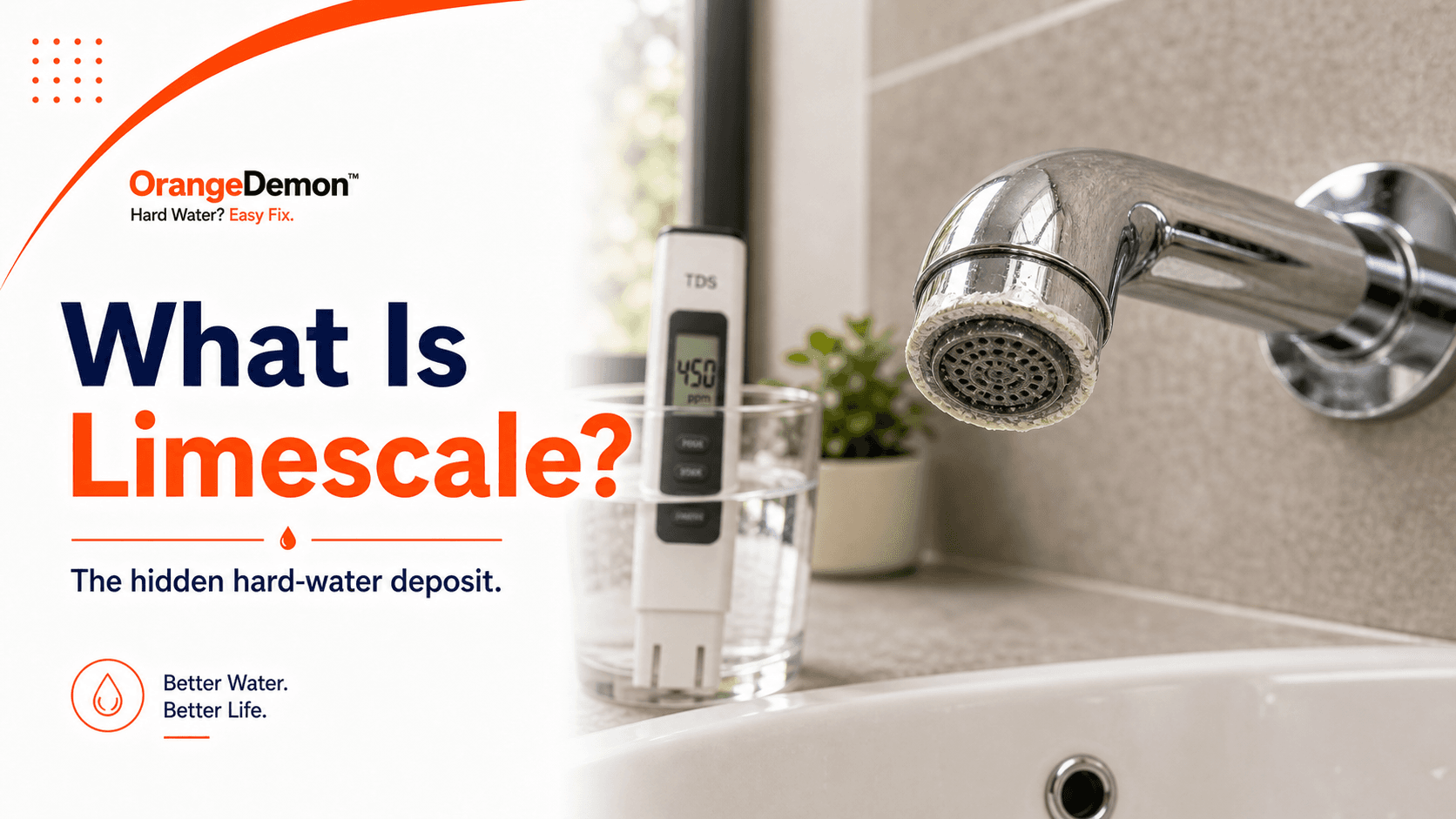
What is limescale?
Limescale is the chalky white-grey deposit you see on the inside of a kettle after a few months of use. On a chrome tap, it is the cloudy ring near the spout. On a geyser element, it is a hard insulating crust. On a washing machine drum, it is the rough mineral layer that catches detergent residue.
All of it is the same chemistry. When hard water is heated or evaporates, the dissolved calcium and magnesium it carries separate out and bond to whatever surface they touch. Over weeks and months, those mineral deposits stack up into a hard layer.
That layer is limescale. It is not dirt. It is not grease. It is a different kind of problem and it needs a different kind of cleaner.
Why limescale is not just "dirt"
A normal cleaner is built for organic mess: soap scum, food residue, body oil, dust. Detergents, surfactants, bathroom sprays - all designed for that.
Limescale is inorganic. It is a mineral, chemically bonded to your surface. Soap will not dissolve it. Scrubbing eventually scratches the surface but rarely removes the bonded layer underneath. The only thing that reliably breaks limescale down is acid - chemistry that can pull calcium and magnesium back into solution.
That is why hard-water homes need a descaler in addition to their normal cleaning routine. The two products do different jobs.
Why Indian hard water makes the problem worse
European designs assume water TDS of 150 to 250 ppm. Most Indian homes run 400 to 700 ppm or higher, especially where borewell water is involved. That is two to four times the mineral load these appliances were engineered for. If you are not sure where your water sits, start with what TDS and hard water mean.
The result is faster, denser, more layered scale. A kettle that should descale once every six months in Europe needs descaling every four to six weeks in many Indian cities. A geyser that lasts ten years in soft water can fail in four years on borewell. A washing machine that holds its drum balance for a decade in Delhi may need spider-arm replacement in five.
Common signs of limescale in appliances
- Kettle: white ring at the waterline, flakes in boiled water, cloudy glass — how to descale a kettle
- Geyser: slower heating, higher electricity bill, knocking sounds during heating
- Washing machine: rough drum surface, white residue on door seal, rinse cycle that does not feel fully clean
- Dishwasher: white film on glasses, cloudy interior, salt indicator firing more often
- Showerhead: weaker pressure, sideways spray, blocked nozzles
- Coffee machine: slower flow, weaker shots, error lights about descaling
If any of these look familiar, the issue is mineral buildup, not the appliance failing.
Why descaling matters
Limescale is an insulator. On a heating element, that insulating layer means the element has to push harder to transfer the same heat. Energy bills go up. The element runs hotter than designed and fails sooner.
On moving parts - washing machine drums, dishwasher spray arms, coffee pump heads - scale increases friction and creates micro-imbalances that lead to bearing failures over time.
Descaling is preventive maintenance. It is not about making the appliance look better. It is about keeping it efficient and extending its useful life.
Why vinegar or plain citric acid may not be enough
Vinegar works on light, fresh scale. For occasional kettle maintenance in soft water, it is fine.
But Indian hard water often produces dense, layered scale. Vinegar only attacks the surface. It also leaves a strong smell, takes longer to act, and is not designed for mixed-metal appliance internals.
Plain citric acid is similar. It is good for the calcium portion of scale but does nothing for iron deposits common in borewell water, and offers no protection for brass, copper, or aluminium parts that touch the descaling solution.
A purpose-built descaler combines multiple acids, chelants to hold dissolved minerals in solution so they actually rinse away, and corrosion inhibitors where appliance metals matter.
Which OrangeDemon product should you use?
Kettles and baby appliances
Use DescaleX Bio. It is fully food-grade - only E-number certified acids - with no EDTA, no BTA. Safe for kettles, baby bottle warmers, drip filter coffee, and any food-contact appliance after rinsing.
Coffee machines, dishwashers and showerheads
Use DescaleX. The standard triple-acid formula with EDTA chelation and BTA brass protection. Designed for any appliance with mixed-metal internals - espresso machines especially.
Washing machines, geysers, tanks and immersion rods
Use WashDX. Heavy-duty, hot-cycle optimised. Sulfamic + citric + fumaric acid with BTA aluminium protection. The right product for any appliance running hot water through metal that does not see drinking water.
Maintenance schedule for Indian homes
| Appliance | Frequency at 400+ TDS |
|---|---|
| Kettle | Every 4-6 weeks |
| Coffee machine | Every 4-6 weeks |
| Dishwasher | Every 4-6 weeks |
| Showerhead | Every 4-6 weeks |
| Washing machine | Every 2-3 months |
| Geyser | Every 3-4 months |
| Immersion rod | Every 4-6 weeks |
| Water tank | Every 6 months |
Adjust faster in borewell or very hard water. Slower in softer supply.
Final word
Limescale is the single most under-recognised problem in Indian appliance maintenance. Most homes are throwing money at appliance repairs and replacements that descaling would have prevented. Build the routine, pick the right product per appliance, and the appliances last twice as long.
Suggested CTA: Start your hard-water maintenance routine with the right OrangeDemon descaler.