
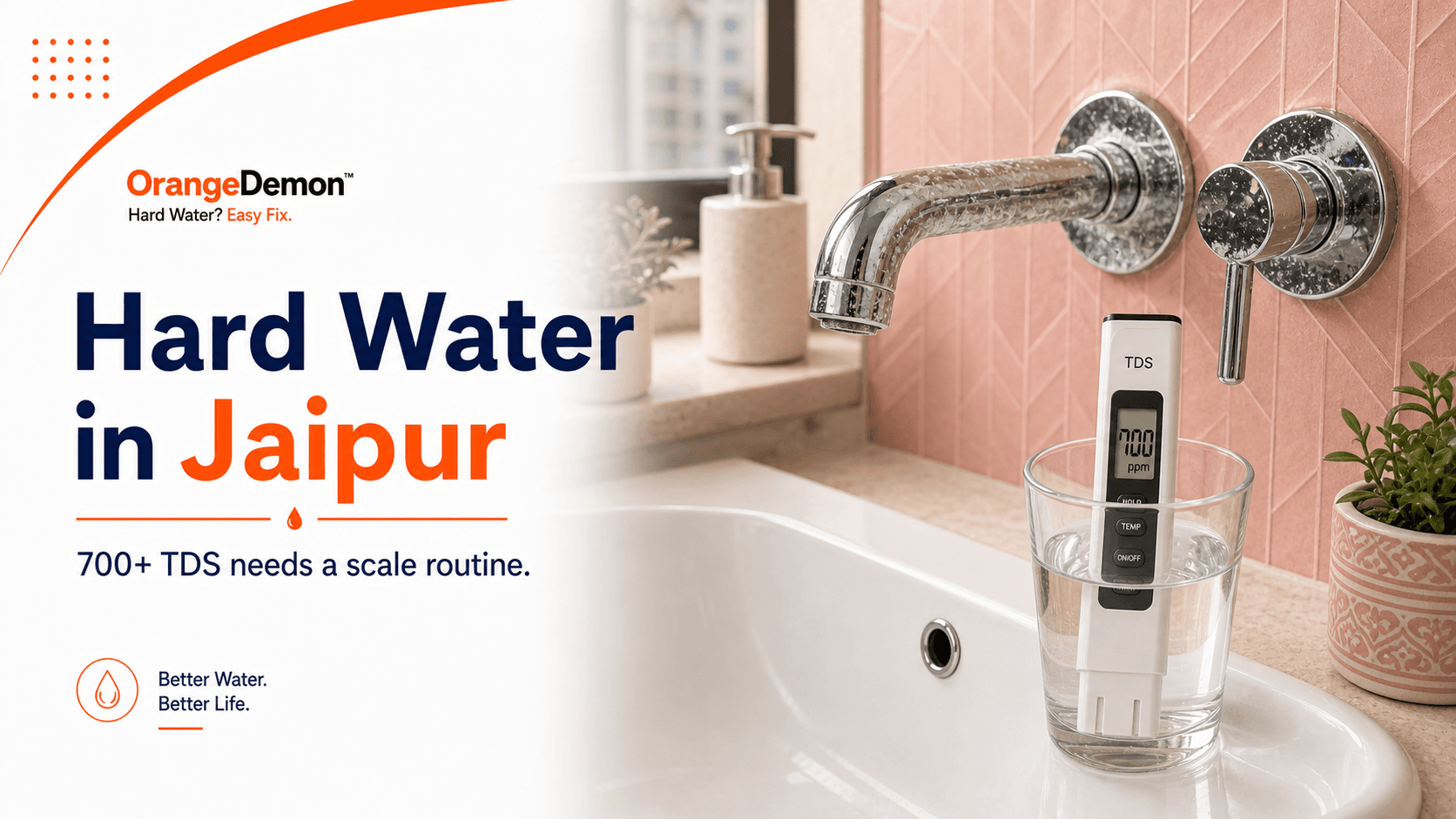
Jaipur is one of India's most photographed cities, but its water is among its least flattering attributes. Groundwater in Jaipur and surrounding Rajasthan districts regularly tests at 700--1500 mg/L TDS
- in some areas significantly higher. For residents, this means bathroom glass that clouds over within days and chrome that develops mineral rings almost immediately after installation. (New to TDS? See what TDS and hard water mean.)
Why Rajasthan Has India's Hardest Water
Rajasthan sits on ancient sedimentary and metamorphic rock formations
- the Aravalli Range and the Thar Desert's underlying geology - that are unusually mineral-rich. The state receives low and erratic rainfall (200--400 mm annually in most areas, as little as 100 mm in the desert west), meaning groundwater recharge is slow and the water that does percolate into aquifers spends a long time in contact with calcium and magnesium-rich rock before it's extracted.
The Central Ground Water Board's 2024 Annual Groundwater Quality Report flags Rajasthan as one of the most affected states, with Barmer, Nagaur, and Jaipur showing elevated electrical conductivity and fluoride contamination. Jaipur district's municipal supply draws from the Bisalpur dam on the Banas river, which is moderately hard at 300--500 mg/L. But most peripheral areas and newer residential developments depend on borewell water that commonly tests at 700--1200 mg/L.
What This Means in Practice
At 700+ mg/L, hard water staining is not an inconvenience - it's an aggressive ongoing maintenance challenge. Glass shower enclosures develop visible white scale within 3--5 days of cleaning. Tap bases accumulate white mineral rings within days of installation. Showerhead nozzles begin clogging within months.
The geological fluoride problem in parts of Jaipur adds another dimension. While fluoride doesn't contribute to bathroom scale (it's present in too small quantities), it's a reminder that Jaipur's groundwater is not simply 'hard' in the single-mineral sense - it's a complex mineral soup that interacts with surfaces in multiple ways.
The Recommended Approach for Jaipur Residents
Weekly acid treatment is not optional at 700+ mg/L - it's the minimum effective frequency. More frequently is better. The protocol: spray acid cleaner on glass and chrome, wait 90 seconds, wipe, rinse. For showerheads, monthly soak in dilute acid solution. For geysers, check for annual descaling. For taps with mineral buildup at the base, wrap a cloth soaked in acid cleaner and leave for 10 minutes - the acid penetrates the crust more effectively than spraying alone.
For drinking water, a reverse osmosis purifier is strongly recommended at Jaipur's TDS levels. For bathroom use, consistent acid descaling is the practical solution short of a whole-house water softener.
TapStrike Intense is OrangeDemon's heavy-duty spray for limescale, hard-water marks and soap scum on taps, sinks, washbasins and glazed tiles. See TapStrike Intense.
Seen results with OrangeDemon? Share a before/after on Instagram @orangedemon.in or tag us on Twitter/X @OrangeDemonIn.
Follow OrangeDemon: Instagram / YouTube / Twitter / X