
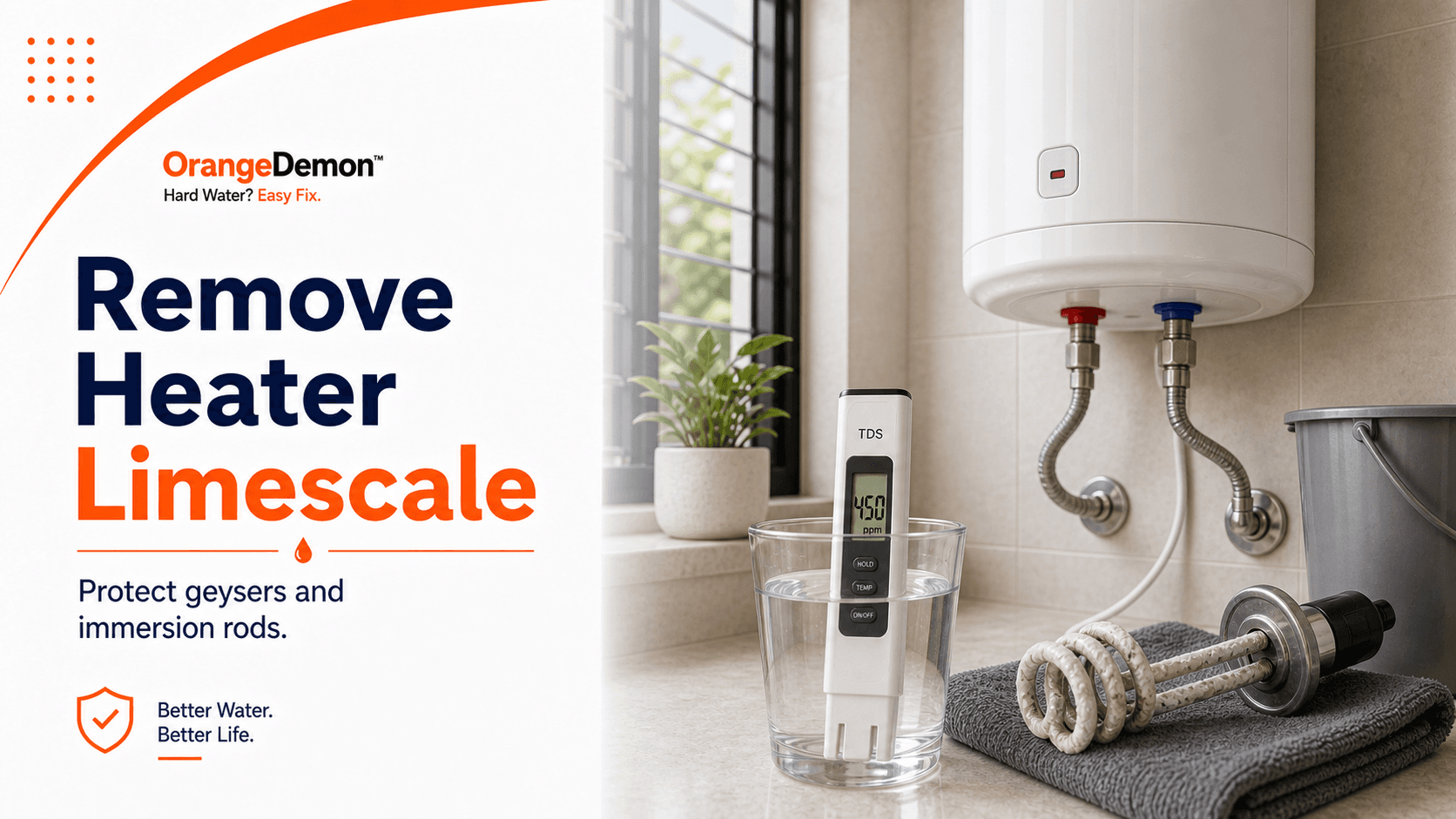
Quick answer: how to descale a geyser
To descale a geyser, switch it off and let it cool, drain the tank, then soak the inside with a WashDX solution for about an hour — never heat the solution inside the tank — drain, and flush three times before heating again. For an immersion rod, unplug it, let it cool, and soak the scaled part for an hour. Full step-by-step is below.
For the product itself, WashDX is the OrangeDemon geyser descaler for this job — built for washing machines, geysers, boilers, tanks, and immersion rods.
Why geysers and immersion rods get heavy scale
Geysers, water heaters, boilers, and immersion rods are some of the worst-hit appliances in hard-water homes. They repeatedly heat mineral-rich water. The hotter the surface, the faster minerals settle on it.
Inside a geyser, scale can collect on the heating element and inner tank surfaces. On an immersion rod, the deposit is visible as a rough white, grey, or brownish layer. In borewell-water areas, scale may mix with rust or iron stains, making it harder than normal kettle scale.
Why this matters
A scaled heating element transfers heat poorly. That means slower heating, more stress on the appliance, and more difficult cleaning later. If scale is ignored for too long, it becomes dense and layered.
For geysers and rods, plain citric acid may help with light scale, but heavy deposits often need a stronger formula.
If your main symptom is a geyser that takes much longer to heat than it used to, see why a geyser heats slowly in hard water.
Why WashDX is built for this job
WashDX is designed for heavy-duty appliance and plumbing descaling. It is suitable for washing machines, geysers, boilers, water tanks, immersion rods, and RO pre-filter housings.
Its formula includes citric acid for primary scale dissolution, sulfamic acid for hard scale and rust deposits, fumaric acid as a secondary hot-cycle scale acid, sodium gluconate and EDTA for chelation, and BTA for aluminium protection.
This makes it more appropriate for heavy mineral deposits than a food-contact kettle descaler.
How to descale an immersion rod
- Unplug the rod.
- Let it cool fully.
- Dissolve one WashDX sachet in a bucket of warm water.
- Submerge the scaled part of the rod fully.
- Soak for one hour.
- Rinse under running water.
- Wipe dry before next use.
Do not scrub aggressively with metal tools. Let chemistry soften the scale first.
If your immersion rod has a thick white or chalky crust and you want a focused walkthrough, see removing the white chalky layer from an immersion rod.
How to descale a geyser or water heater
- Switch off the geyser and let it cool completely.
- Drain the tank.
- Flush once with cold water.
- Dissolve one WashDX sachet in one litre of warm water.
- Pour the solution into the tank through the inlet.
- Top up with water to fill.
- Soak for one hour. Do not heat the solution.
- Drain fully.
- Flush three times with fresh water before heating again.
Never heat descaling solution inside a geyser. Heating acidic solution inside a closed or semi-closed system can create pressure and vapour risk.
How often should you descale a geyser?
- Soft water: every 4-6 months
- Moderate water: every 2-3 months
- Hard water: every 6-8 weeks
- Very hard/borewell water: every 4-6 weeks for exposed rods; geysers may need scheduled maintenance depending on use
A geyser used daily in a high-TDS home needs more attention than a guest-bathroom geyser used occasionally.
What not to do
Do not use bleach. Do not mix descaler with detergent or alkaline cleaners. Do not use a food-contact kettle descaler for heavy geyser scale. Do not descale a high-pressure system unless you understand the manufacturer's service requirements.
Final word
Geyser and immersion-rod scale is usually heavier than kettle scale. It often needs a stronger, appliance-focused descaler. For Indian hard-water homes, WashDX is the correct OrangeDemon choice for geysers, water heaters, boilers, water tanks, and immersion rods.
For geysers, water heaters, and rods, use WashDX.