
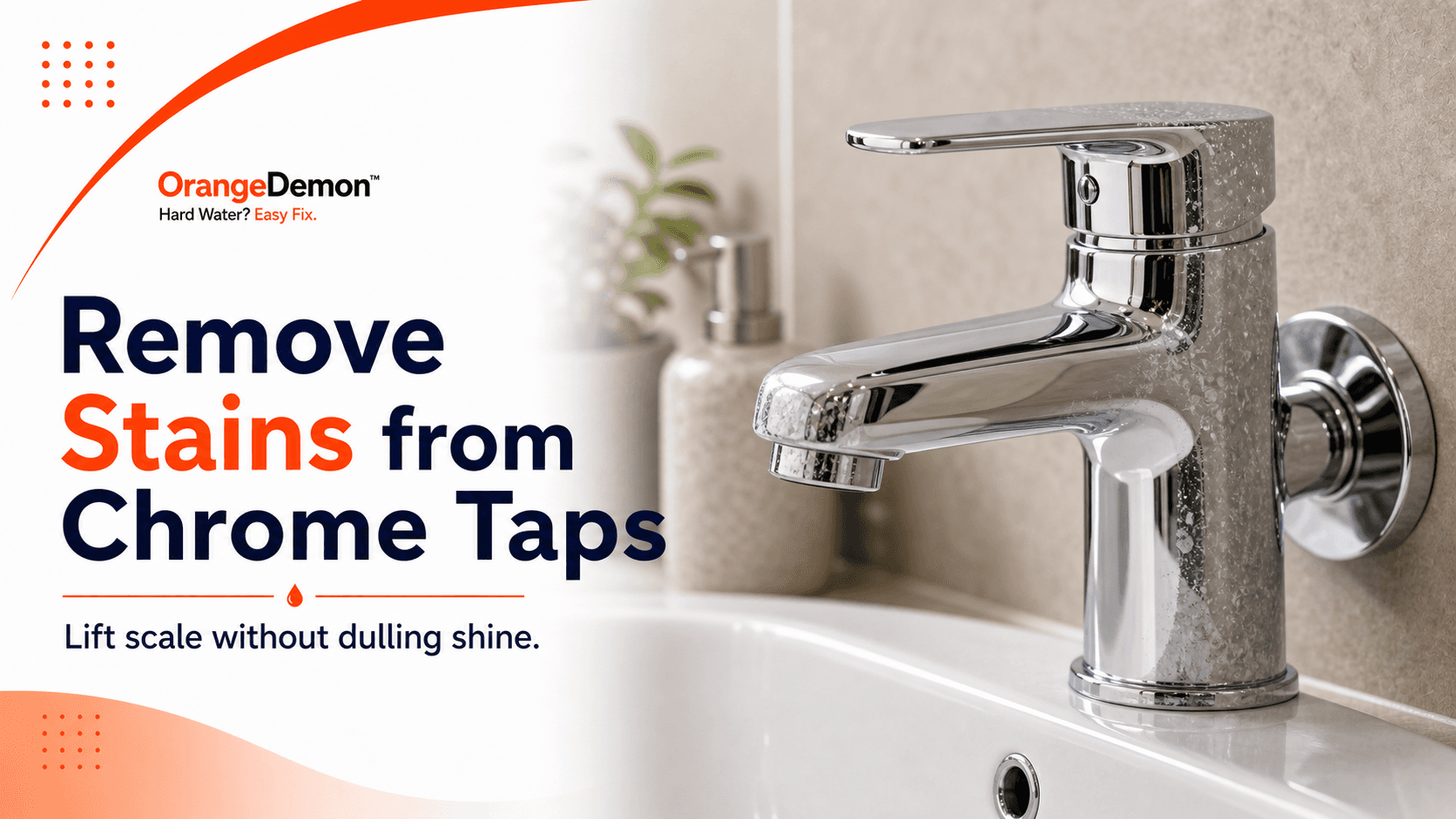
Quick answer: how to remove hard water stains from taps
Hard water stains on taps are mineral scale (mostly calcium carbonate), so they need a mild acid, not more scrubbing. The method that works on chrome and steel taps:
- Spray an acid limescale remover such as TapStrike Intense on the tap body, spout and the ring at the tap base.
- Wait 30-60 seconds. Do not let it dry on the tap.
- Wipe with a soft damp cloth. For thick crust at the base, scrub gently with a soft brush and leave it 1-3 minutes.
- Rinse and dry the tap with a dry cloth so new water spots do not form.
Shop TapStrike Intense, the hard water stain remover for taps.
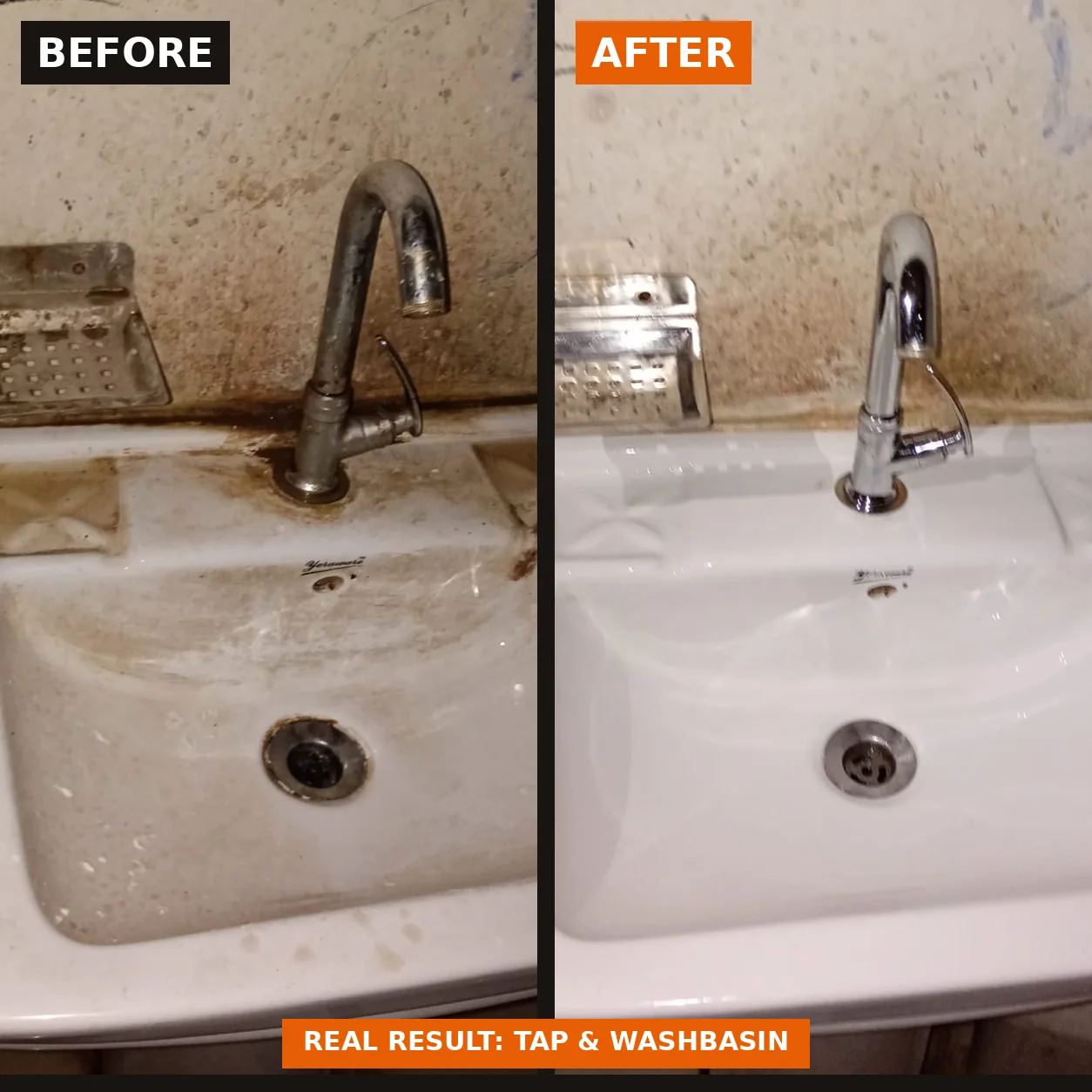
What the white stains on your taps actually are
Most Indian tap water carries 300-600 ppm TDS, and borewell water often runs much higher. Every time a drop of water dries on a tap, it leaves its dissolved calcium and magnesium behind. One drop is invisible. Thousands of drops, week after week, become:
- White spots and streaks on the spout and handle
- Cloudy, dull chrome that no longer reflects
- A hard white or yellow ring at the tap base, where water pools against the tile or basin
- A rusty-brown edge in older fittings, where scale traps iron from the water
Many people call these "salt stains". They are not dirt, which is why a regular bathroom cleaner or soap wipes the grime off the top and leaves the white layer behind. Within a few days the tap looks stained again.
Why chrome needs a careful method
Chrome plating on bathroom fittings is a very thin layer, typically well under a micron, over brass or zinc alloy. It resists corrosion and looks great when new, but it scratches easily. Steel wool, metal scrubbers, rough scouring pads and gritty cleaning powders all leave permanent fine scratches, and scratched chrome picks up scale even faster.
Left for months, the white ring at a tap base can also hide early pitting of the plating underneath. Regular removal is maintenance, not just looks.
Step by step: chrome taps
Step 1: Put away anything abrasive. Use only a soft cloth, a microfibre cloth or a non-scratch sponge. An old soft toothbrush is fine for the joint at the tap base.
Step 2: Spray and wait. Spray TapStrike Intense on the spout, handle and the ring at the base. For light marks, 30-60 seconds of contact is enough. The sulfamic-led acid dissolves the mineral layer, while BTA in the formula protects the chrome.
Step 3: Wipe, then deal with the crust. Wipe with a soft damp cloth. Light marks lift straight away. For thick crust at the tap base, spray again, scrub gently with a soft brush and leave it 1-3 minutes at most. If some scale remains, repeat the spray instead of scrubbing harder or leaving it on longer.
Step 4: Rinse and dry. Rinse with water and dry the tap completely with a dry cloth. Drying matters: water left on a freshly cleaned tap starts the next layer of spots.
Steel taps and kitchen sink taps
Stainless steel taps and kitchen sink mixers get the same white spots, often with added soap and food film. Use a lighter touch:
- Mist lightly, wait about 30 seconds, and wipe with a damp microfibre cloth.
- Wipe along the grain of brushed steel, not in circles.
- Buff dry for a streak-free finish.
- Do not spray on hot taps or right after running hot water.
Crust at the tap base and around the joint
The ring where the tap meets the basin or tile is the thickest scale in most bathrooms, because water pools there and dries slowly. Work in two rounds: spray, wait, wipe off the loosened top layer, then spray again and use a soft toothbrush in the joint. Rinse well so product does not sit in the gap.
If your tap flow is weak or spraying sideways, the aerator mesh inside the spout is scaled. That is scale inside the fitting, not on the surface. See the aerator section in our faucet hard water stain guide.
What not to do
- Do not use metal scrubbers or abrasive powder on chrome. The scratches are permanent.
- Do not use toilet acid or HCl-based cleaners on taps. They are far stronger than a tap needs and can damage plating and nearby surfaces.
- Do not leave any acid cleaner to dry on the tap. Short contact, wipe, rinse.
- Do not spray on marble, granite or natural stone vanity tops next to the tap. Acid etches stone. Cover the stone or spray onto a cloth instead.
- Unlacquered brass or copper taps: test a small hidden spot first.
How often to clean taps in hard-water areas
| Your water TDS | How often |
|---|---|
| Below 300 | Every 2 weeks |
| 300-600 | Once a week |
| Above 600 or borewell | Twice a week, plus wiping taps dry daily |
Not sure of your TDS? Check your TDS range or read what your TDS number means.
How to keep taps clean for longer
- Wipe taps dry after use. A small towel near the basin and 20 seconds a day slows scale more than any product.
- Clean before it builds up. A weekly 60-second spray is far easier than scrubbing a year of crust.
- Polish chrome occasionally. A thin layer of chrome polish or car wax makes water bead and run off instead of drying in place. Reapply every 1-2 months.
Best product route
| If the stain is on | Best next page | Product route |
|---|---|---|
| Tap base, chrome mixer, or spout | TapStrike Intense spray | TapStrike Intense |
| Steel taps and kitchen sink | TapStrike Intense spray | TapStrike Intense |
| Washbasin, sink, or glazed tiles | Bathroom tile stain guide | TapStrike Intense |
| Removable showerhead holes | WashDX showerhead flow guide | WashDX |
| Shower glass | Hard water bathroom stains | Fighter when available |
Short answer for buyers: taps need a surface-safe acid spray with short contact time. Do not scrub with abrasive powder, and do not use appliance descaler powder directly on chrome fittings, marble, natural stone or painted surfaces. Choosing a product? Read how to choose a tap cleaner for hard water.
TapStrike Intense is OrangeDemon's hard water stain remover and tap cleaner spray for tap bases, faucets, mixers, sinks and bathroom tiles. If it does not clear the marks when used as directed, website orders are covered by our money-back promise. See TapStrike Intense.
Seen results with TapStrike Intense? Share a before/after on Instagram @orangedemon.in or tag us on Twitter/X @OrangeDemonIn.
Follow OrangeDemon: Instagram / YouTube / Twitter / X