
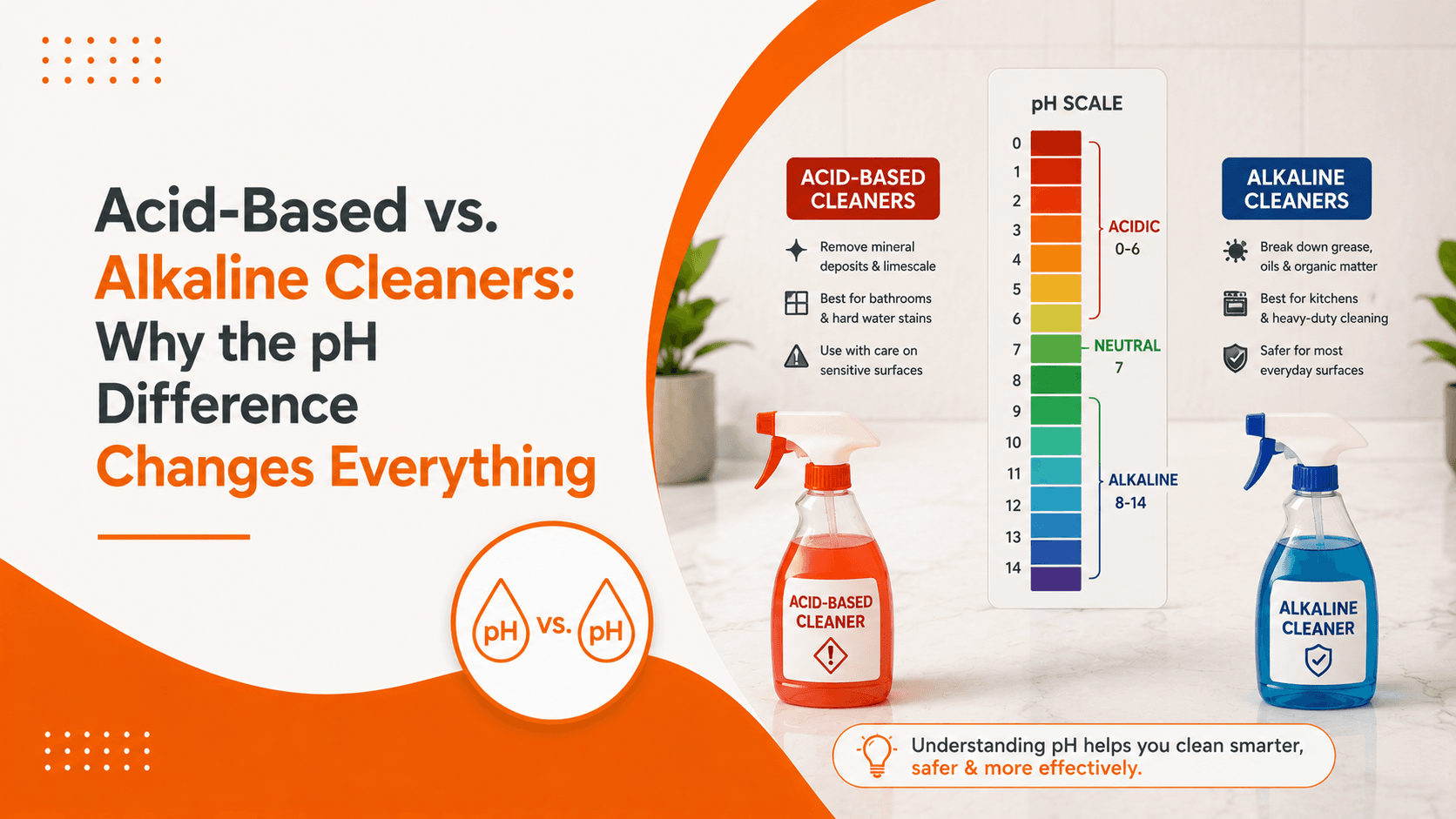
Quick answer: acid cleaner vs alkaline cleaner
Acid cleaners are the right chemistry for mineral scale such as calcium carbonate and limescale. Alkaline cleaners are better for organic soil, grease, soap scum, oils, and biological residue. If the stain is white, chalky, and hard-water related, using more alkaline bathroom cleaner usually will not fix the base mineral layer.
If you've ever wondered why using more bleach, a stronger bathroom spray, or scrubbing harder doesn't fix white hard water stains - this article explains why. The issue isn't cleaning strength. It's pH.
Source context before choosing chemistry
Hard-water scale is tied to calcium and magnesium minerals, the same mineral family the U.S. Geological Survey uses to explain water hardness (USGS hardness guide). BIS also treats TDS, hardness, calcium, magnesium, and alkalinity as separate water-quality parameters, which is why "strong cleaner" is not the same thing as "right cleaner" (BIS IS 10500:2012 PDF).
| Deposit type | Better chemistry | OrangeDemon route |
|---|---|---|
| White hard-water scale on taps, sinks, tiles | Acid-side limescale routine | TapStrike Intense |
| Showerhead mineral blockage | Appliance descaler soak | DescaleX |
| Washing-machine mineral residue | Machine-side descaler | WashDX |
| Grease or organic grime | Alkaline or neutral cleaner | Not a descaler job |
The pH Scale and Cleaning Chemistry
pH measures how acidic or alkaline a solution is, on a scale from 0 (most acidic) to 14 (most alkaline), with 7 being neutral. For cleaning purposes, pH determines what types of substances the cleaner can dissolve.
Alkaline cleaners (pH 8--14) are excellent at dissolving organic substances - fats, oils, proteins, soap scum, grease, and biological residue. This is why most household cleaners, detergents, and bleach products are alkaline. The alkalinity breaks down the chemical bonds in organic molecules.
Acid cleaners (pH 1--6) dissolve inorganic mineral compounds - calcium carbonate, magnesium sulphate, iron oxide, and other scale-forming minerals. The acid reacts with the mineral's chemical structure and converts it to soluble salts that rinse away.
Why Alkaline Cleaners Cannot Remove Hard Water Scale
Hard water scale is calcium carbonate (CaCO3). This compound is stable in alkaline and neutral environments - it does not dissolve, react, or break down when exposed to alkaline chemistry. You can apply undiluted bleach to hard water scale and leave it for an hour and the scale will be unchanged, because bleach is alkaline and calcium carbonate is alkaline-stable.
This is not a matter of product quality or concentration. No alkaline product, regardless of how 'strong' or 'concentrated' it is, will dissolve calcium carbonate. The chemistry categorically doesn't allow it. You'd need to change the fundamental nature of the product - make it acidic - for it to work on scale.
Why Acid Cleaners Are Effective
The reaction is straightforward: CaCO3 + 2HCl -> CaCl2 + H2O + CO2 (using hydrochloric acid as the example). The acid donates hydrogen ions that react with the carbonate group. The calcium is released into solution as a soluble calcium chloride salt and rinses away. Water and carbon dioxide are produced as byproducts.
The same reaction occurs with other acids at their own rates. Stronger acids (lower pH) react faster and dissolve denser scale. Weaker acids (higher pH, like citric acid) react more slowly and are limited against heavy deposits.
Using Both Strategically
The right approach for a complete bathroom clean is both, in the right order. Use an acid-based cleaner first to dissolve mineral scale from glass, tiles, and chrome. Then use an alkaline product (or neutral cleaner) to address soap scum, organic residue, and bacteria. The acid step prepares a clean mineral-free surface that the alkaline step can clean more thoroughly, producing a result that neither alone achieves.
TapStrike Intense is OrangeDemon's heavy-duty spray for limescale, hard-water marks and soap scum on taps, sinks, washbasins and glazed tiles. See TapStrike Intense.
Seen results with OrangeDemon? Share a before/after on Instagram @orangedemon.in or tag us on Twitter/X @OrangeDemonIn.
Follow OrangeDemon: Instagram / YouTube / Twitter / X