
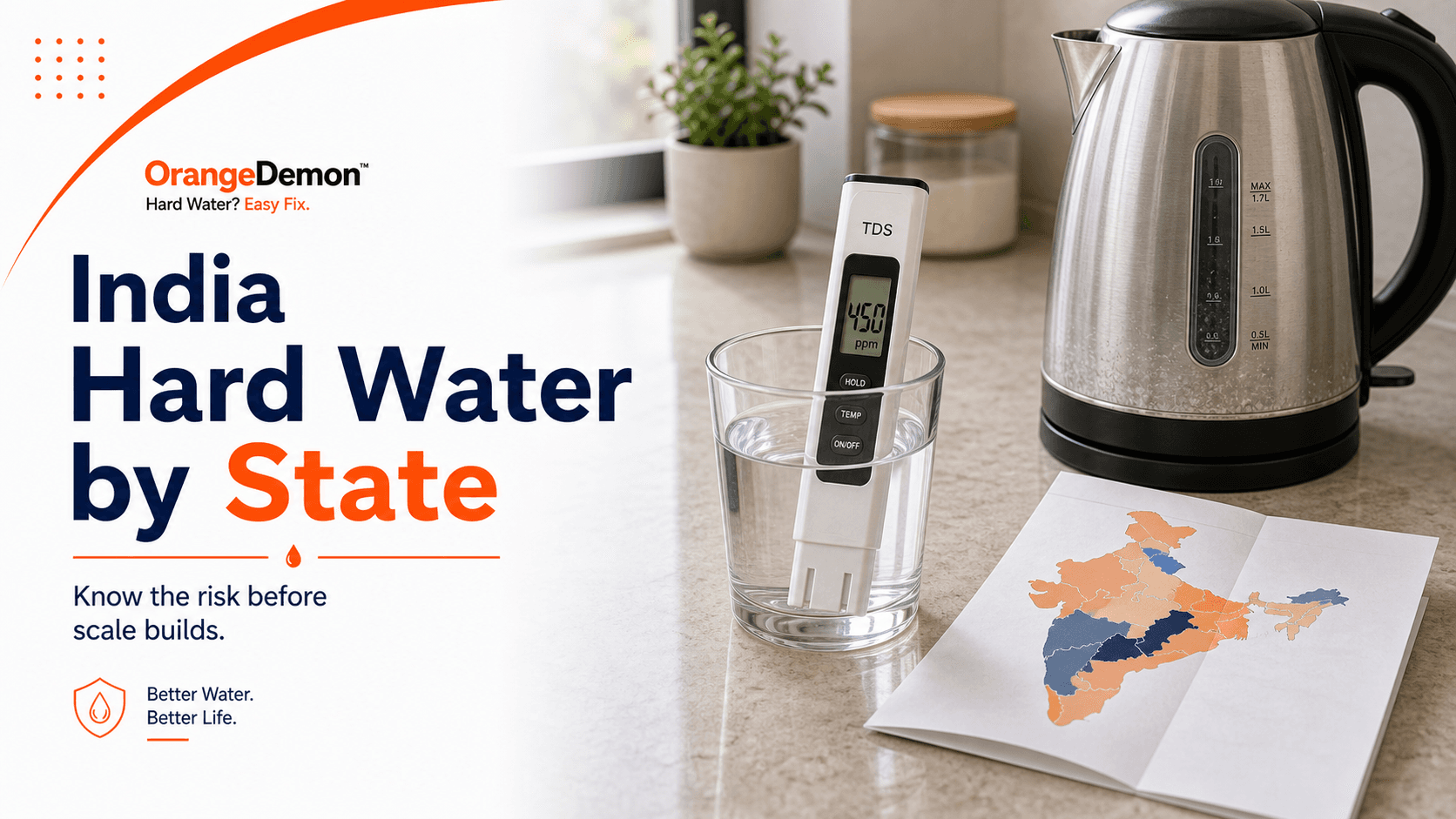
India's hard water problem is not uniform. Understanding the geographic distribution helps explain why bathroom maintenance challenges in Jaipur are so different from those in Shillong, and why the same cleaning product recommendation doesn't work equally well across the country. (New to TDS? See what TDS and hard water mean.)
Quick answer: where hard water is most serious in India
Hard-water maintenance is usually most urgent in Rajasthan, Haryana, Delhi NCR, parts of western Uttar Pradesh, groundwater-heavy Gujarat pockets, and borewell-dependent apartment belts in Bengaluru, Hyderabad, and Pune. Softer coastal and northeast regions still need prevention, but the repeat descaling schedule is usually lighter.
The Data Source
The Central Ground Water Board (CGWB), under the Ministry of Jal Shakti, released its Annual Groundwater Quality Report for 2024 in December 2024. The report is based on sampling from 15,259 monitoring locations across all states and union territories, assessed in both pre-monsoon and post-monsoon seasons. It is the most comprehensive national dataset on groundwater quality currently available.
Official source trail:
- PIB release on CGWB Annual Ground Water Quality Report 2024
- CGWB Ground Water Quality page
- BIS IS 10500:2012 drinking-water specification PDF
For household decisions, treat this state-level view as the authority layer and use Check your city's TDS for local action. State data can explain why Rajasthan, Haryana, NCR, parts of Gujarat, and interior Telangana behave differently, but your tap-level TDS and visible appliance symptoms still decide the descaling routine.
The Most Hard-Water Affected States
Rajasthan leads India in groundwater hardness. Barmer and Jodhpur in particular show rising electrical conductivity - the CGWB's 2024 report explicitly flags increasing salinisation in these areas. Over 25% of Rajasthan wells in affected districts exceed BIS fluoride limits; TDS commonly exceeds 1000--2000 mg/L in many zones.
Haryana and Punjab are classified as 'over-exploited' states - groundwater extraction exceeds annual recharge. Declining water table levels increase mineral concentration in remaining groundwater. Haryana's groundwater TDS commonly ranges from 700 to 1500 mg/L across many districts.
Delhi NCR draws from the Indo-Gangetic alluvial formation, with borewell TDS typically at 500--1000 mg/L. The CGWB 2024 report confirms Delhi as one of the over-exploited urban groundwater zones.
Gujarat shows rising electrical conductivity in Barmer and Jodhpur (bordering Rajasthan) and in coastal districts where sea-water intrusion raises salinity. Ahmedabad and Surat borewell water typically tests at 600--900 mg/L.
Andhra Pradesh and Telangana face dual groundwater quality issues - hard water in interior districts (400--800 mg/L) and fluoride contamination. The CGWB 2024 report shows 18.9% of AP samples and 16.5% of Telangana samples exceed BIS fluoride limits.
States With Relatively Soft Water
The CGWB 2024 report found that Arunachal Pradesh, Mizoram, Meghalaya, and Jammu & Kashmir had 100% of water samples meeting BIS standards. The northeast generally has India's softest water - annual rainfall is high, aquifer recharge is consistent, and the underlying geology is less mineral-rich than the Gangetic plains.
Kerala, parts of coastal Karnataka, and coastal Tamil Nadu have relatively soft water due to high rainfall and proximity to the coast. Mumbai's Tansa and Bhatsa reservoir system supplies relatively soft water (150--250 mg/L) to most of the city - significantly softer than Delhi or Bangalore's borewell supply.
Why This Matters for Bathroom Maintenance
A cleaning product or routine calibrated for 200 mg/L TDS water is not appropriate for 700 mg/L water. The mineral load is three to four times higher, scale deposits are proportionally denser, and acid contact time needs to be longer. If you live in Rajasthan, Haryana, or are on borewell water in NCR, Bengaluru, or Hyderabad, you need a cleaning approach specifically designed for high-TDS conditions - not a European-formulated product or a DIY solution designed for soft water.
State data to appliance action
| If your state or city is high-hardness | First page to use | Product direction |
|---|---|---|
| Rajasthan, Haryana, Delhi NCR, western UP | Check your city TDS | Washer/geyser routine first |
| Bengaluru, Hyderabad, Pune growth belts | City hard-water hub | Match by building source |
| Gujarat and coastal mixed-salinity belts | TDS 400, 600, and 800 guide | Repeat maintenance, not one rescue clean |
| Softer northeast/coastal pockets | Appliance descaling schedule | Preventive, lower-frequency descale |
TapStrike Intense is OrangeDemon's heavy-duty spray for limescale, hard-water marks and soap scum on taps, sinks, washbasins and glazed tiles. See TapStrike Intense.
Seen results with OrangeDemon? Share a before/after on Instagram @orangedemon.in or tag us on Twitter/X @OrangeDemonIn.
Follow OrangeDemon: Instagram / YouTube / Twitter / X