
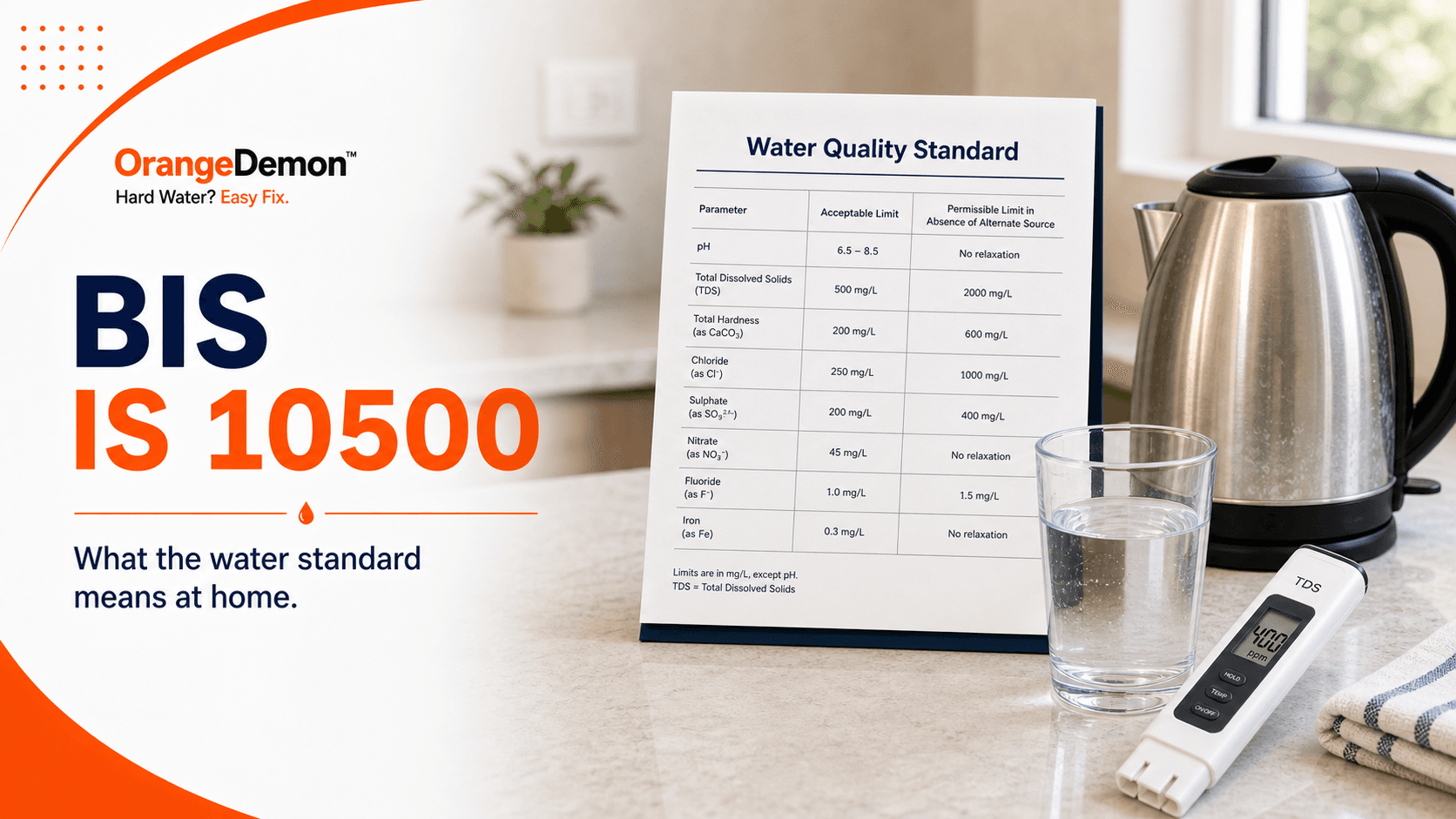
Quick answer: BIS IS 10500 TDS and hardness limits
As per BIS IS 10500:2012 (India's drinking-water standard), the acceptable TDS limit is 500 mg/L and the permissible limit is 2000 mg/L — allowed only when no alternative source is available. For total hardness, the acceptable limit is 200 mg/L and the permissible limit is 600 mg/L (as CaCO₃).
| Parameter | Acceptable limit | Permissible limit (no alternate source) |
|---|---|---|
| Total dissolved solids (TDS) | 500 mg/L | 2000 mg/L |
| Total hardness (as CaCO₃) | 200 mg/L | 600 mg/L |
| Calcium (as Ca) | 75 mg/L | 200 mg/L |
| Magnesium (as Mg) | 30 mg/L | 100 mg/L |
| Chloride (as Cl) | 250 mg/L | 1000 mg/L |
| pH | 6.5–8.5 | No relaxation |
"Acceptable" is the limit water should meet; the "permissible" column applies only when no better source exists — never as a target. IS 10500:2012 covers around 90 parameters in total; the ones above are those tied to hardness and scale. Not sure of your own level? Use the OrangeDemon TDS checker, then see what your TDS number means.
BIS IS 10500:2012 - the Bureau of Indian Standards specification for drinking water - is cited everywhere in Indian water quality discussions, but rarely explained clearly. Understanding what it actually says helps put your water quality test results in context.
The TDS Standards
IS 10500:2012 sets two thresholds for TDS in drinking water. The 'acceptable limit' is 500 mg/L - this is the standard that water should meet under normal circumstances. The 'permissible limit in absence of alternative source' is 2000 mg/L - this is the emergency threshold where water is technically still drinkable when no better option is available.
For palatability, the WHO recommends below 300 mg/L and considers water above 1000 mg/L unpalatable. The BIS's 500 mg/L acceptable limit is therefore somewhat lenient on palatability grounds - water at 500 mg/L can taste noticeably mineral-heavy. For practical drinking purposes, most water quality experts in India suggest below 300 mg/L as the target.
The Hardness Standards
BIS IS 10500:2012 sets the acceptable total hardness limit at 200 mg/L (measured as calcium carbonate equivalent) with a permissible limit of 600 mg/L. Hardness is the measure most directly related to scale formation in bathrooms - it specifically measures the calcium and magnesium content.
200 mg/L hardness (as CaCO3) corresponds to approximately 80 mg/L calcium plus 24 mg/L magnesium - moderate hard water. At the permissible 600 mg/L, scale formation on bathroom surfaces is rapid and aggressive. Most borewell water in hard water Indian cities exceeds even the permissible limit on hardness.
What These Standards Don't Cover
The BIS standard is a drinking water standard. It addresses health and palatability. It says nothing about the effect of hard water on bathroom surfaces, appliances, or skin and hair - because these are not health concerns in the traditional sense.
This is an important gap. Water at 500 mg/L TDS - exactly at the BIS acceptable limit - will cause aggressive scale formation on shower glass and chrome, will damage geyser heating elements if not managed, and will worsen hair condition with regular use. The standard tells you the water is safe to drink. It doesn't tell you anything about its impact on your bathroom.
The Practical Implication
If your water tests at or below 500 mg/L TDS, it meets BIS standards and is considered acceptable quality for drinking (with appropriate purification). But for bathroom maintenance, the relevant number isn't 500 mg/L. It's 200 mg/L - the acceptable hardness standard. Above that, you have a scale problem that needs active management.
FAQ
What is the acceptable TDS limit as per BIS? 500 mg/L. Under IS 10500:2012 that is the acceptable limit for drinking water; the permissible limit is 2000 mg/L only when no alternative source is available.
Is 500 TDS safe as per BIS? 500 mg/L sits exactly at the BIS acceptable limit, so it is considered acceptable for drinking with appropriate treatment. For taste, most experts prefer below 300 mg/L; for bathroom and appliance scale, the number that matters is hardness (200 mg/L acceptable), not TDS.
What is the BIS hardness limit? Total hardness as CaCO₃ is 200 mg/L acceptable and 600 mg/L permissible. Above 200 mg/L, scale on taps, geysers, and shower glass becomes an active maintenance issue.
What is the permissible TDS limit in India? 2000 mg/L — but only in the absence of an alternative source. It is a tolerance ceiling, not a target.
TapStrike Intense is OrangeDemon's heavy-duty spray for limescale, hard-water marks and soap scum on taps, sinks, washbasins and glazed tiles. See TapStrike Intense.
Seen results with OrangeDemon? Share a before/after on Instagram @orangedemon.in or tag us on Twitter/X @OrangeDemonIn.
Follow OrangeDemon: Instagram / YouTube / Twitter / X