
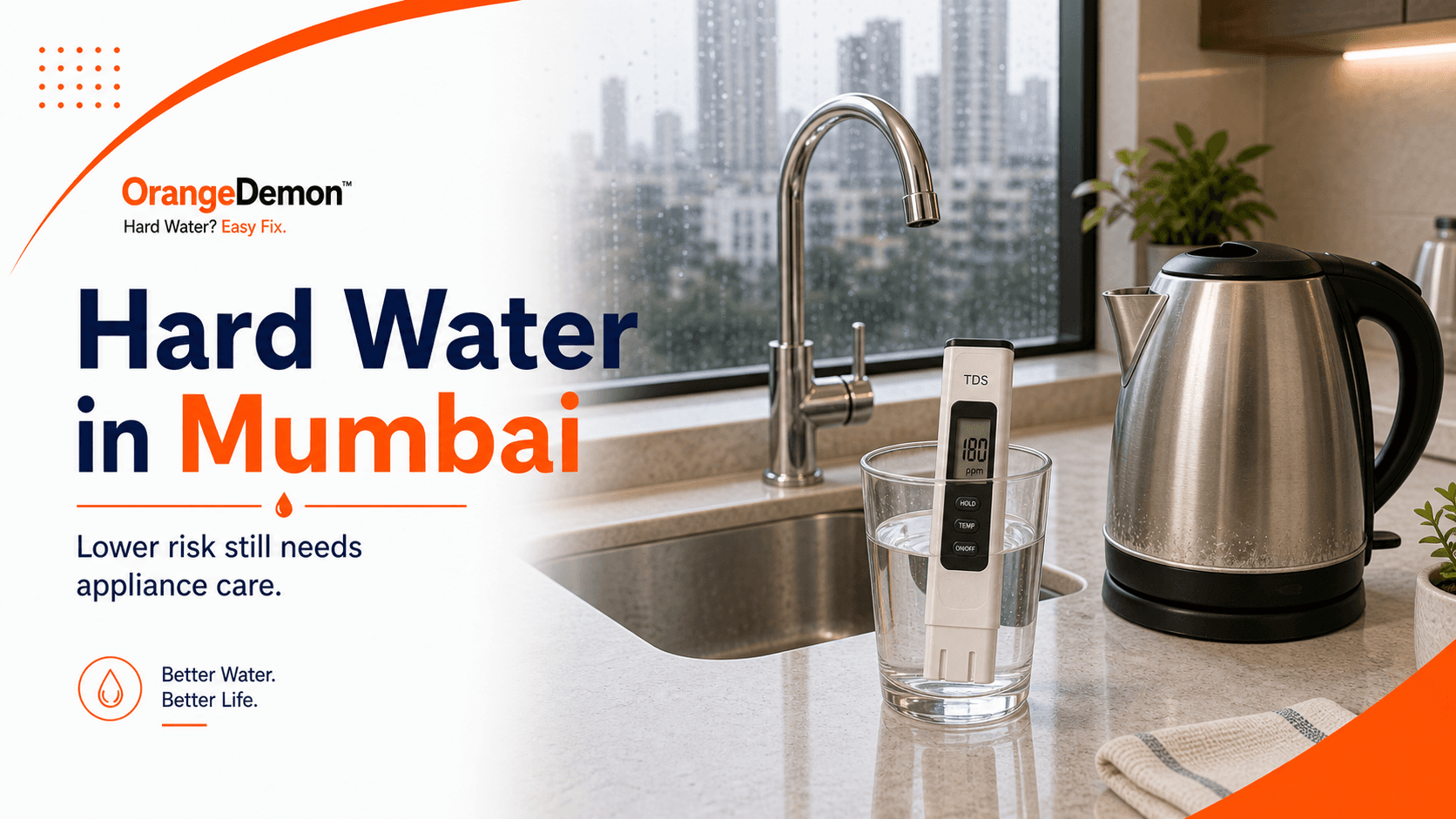
Mumbai is an outlier in the Indian hard water story. While Delhi, Bangalore, Hyderabad, and Ahmedabad residents battle 500--900 mg/L borewell water, most of Mumbai runs on some of the softest municipal water of any major Indian city. Understanding why helps explain the geographic distribution of India's hard water problem. (See what TDS and hard water mean.)
Mumbai's Water Sources
The Brihanmumbai Municipal Corporation (BMC) draws from a system of seven lakes in the Sahyadri mountain range: Vihar, Tulsi, Bhatsa, Tansa, Upper Vaitarna, Middle Vaitarna, and Modak Sagar. These are surface water reservoirs in the Western Ghats - volcanic Deccan basalt geology with high annual rainfall (2,500--3,000 mm per year in the catchment area).
Rainwater and surface runoff in a high-rainfall, volcanic geology catchment is relatively soft - it hasn't had extended contact with sedimentary limestone or gypsum formations. The Western Ghats basalt dissolves calcium and magnesium slowly. The BMC supply consistently delivers water at TDS of 50--200 mg/L to most of the city - moderate to soft by any measure.
The Differential Within Mumbai
The soft water story applies to areas served by BMC piped supply: South Mumbai, the established western and eastern suburbs, and most of the city proper. The situation is different in newer peripheral developments and in areas that augment BMC supply with borewell backup.
Parts of Navi Mumbai, some areas in Thane, and new township developments on the outer periphery of Greater Mumbai increasingly rely on borewell water that can test at 400--700 mg/L - approaching the harder water profiles of other metros. As Mumbai's real estate market pushes development further from the city core, the soft water advantage of the city is being eroded in these peripheral zones.
Maintenance Implications
For residents on BMC supply at 100--200 mg/L TDS: you have a significantly lower hard water challenge than most of India's urban population. Monthly acid treatment is likely sufficient for glass maintenance. Standard bathroom cleaners will be more effective for you than for counterparts in Delhi or Bangalore. The squeegee habit is still good practice.
For residents in peripheral Mumbai or Navi Mumbai on borewell water: test your TDS. If it's above 400 mg/L, you're in a different category from central Mumbai's soft-water norm and need an appropriate maintenance approach.
TapStrike Intense is OrangeDemon's heavy-duty spray for limescale, hard-water marks and soap scum on taps, sinks, washbasins and glazed tiles. See TapStrike Intense.
Seen results with OrangeDemon? Share a before/after on Instagram @orangedemon.in or tag us on Twitter/X @OrangeDemonIn.
Follow OrangeDemon: Instagram / YouTube / Twitter / X