
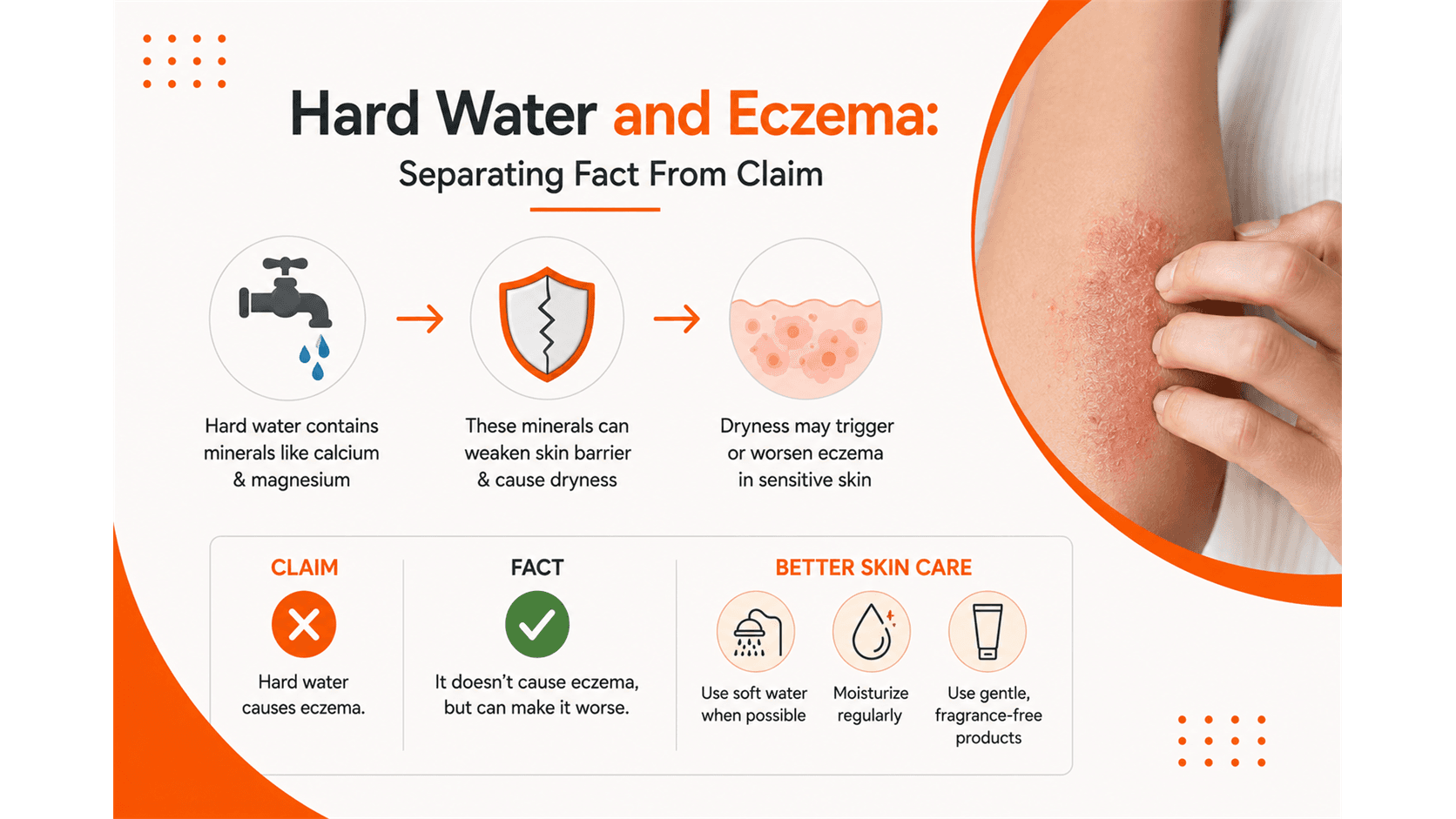
Atopic dermatitis - eczema - affects 7--10% of Indian children and a meaningful proportion of adults. For people in hard water cities, the question of whether their water is worsening their condition is legitimate and deserves an evidence-based answer.
The Research Evidence
The most rigorous investigation of the hard water-eczema link was the SOFTER (Softened Water Eczema Trial) study published in the Lancet (2011), a randomised controlled trial comparing children with eczema in households with and without whole-house water softeners. The study found that water softeners did not significantly reduce eczema severity versus controls, though there was a non-significant trend toward improvement.
A 2017 observational study of over 8,000 children published in the British Journal of Dermatology found a significant correlation between living in hard water areas and eczema prevalence, after controlling for other factors. The correlation persisted even when controlling for socioeconomic variables, suggesting a real association. (New to hard water? See what TDS and hard water mean.)
The honest scientific summary: the correlation between hard water and eczema is real and consistently observed. Whether hard water causes eczema or worsens existing eczema is less certain. The SOFTER trial's null result complicates the causal story, though critics noted methodological limitations.
The Mechanism --- Why a Link Is Biologically Plausible
Hard water disrupts the skin's barrier function. Calcium and magnesium deposits on skin after bathing increase the skin's pH from its natural 4.5--5.5 toward neutral. This higher pH makes the skin more permeable to allergens and irritants - the fundamental problem in eczema. Hard water also reduces the effectiveness of soap and body wash, meaning more surfactant residue remains on skin after rinsing, further disrupting the barrier.
For a person with genetically compromised skin barrier (the genetic predisposition to eczema), these effects are amplified. Hard water may not cause eczema in someone without the genetic predisposition, but it likely worsens it in someone who has it.
Practical Management
Dermatologists consistently recommend: shorter, cooler showers (hot water further dries and irritates eczema skin), immediate moisturiser application after bathing (within 3 minutes, while skin is still slightly damp), soap-free body wash at skin-neutral pH (pH 5.5), and if possible, a shower filter or whole-house softener. Emollient therapy - prescribed barrier creams - remains the primary medical management regardless of water hardness.
TapStrike Intense is OrangeDemon's heavy-duty spray for limescale, hard-water marks and soap scum on taps, sinks, washbasins and glazed tiles. See TapStrike Intense.
Seen results with OrangeDemon? Share a before/after on Instagram @orangedemon.in or tag us on Twitter/X @OrangeDemonIn.
Follow OrangeDemon: Instagram / YouTube / Twitter / X