
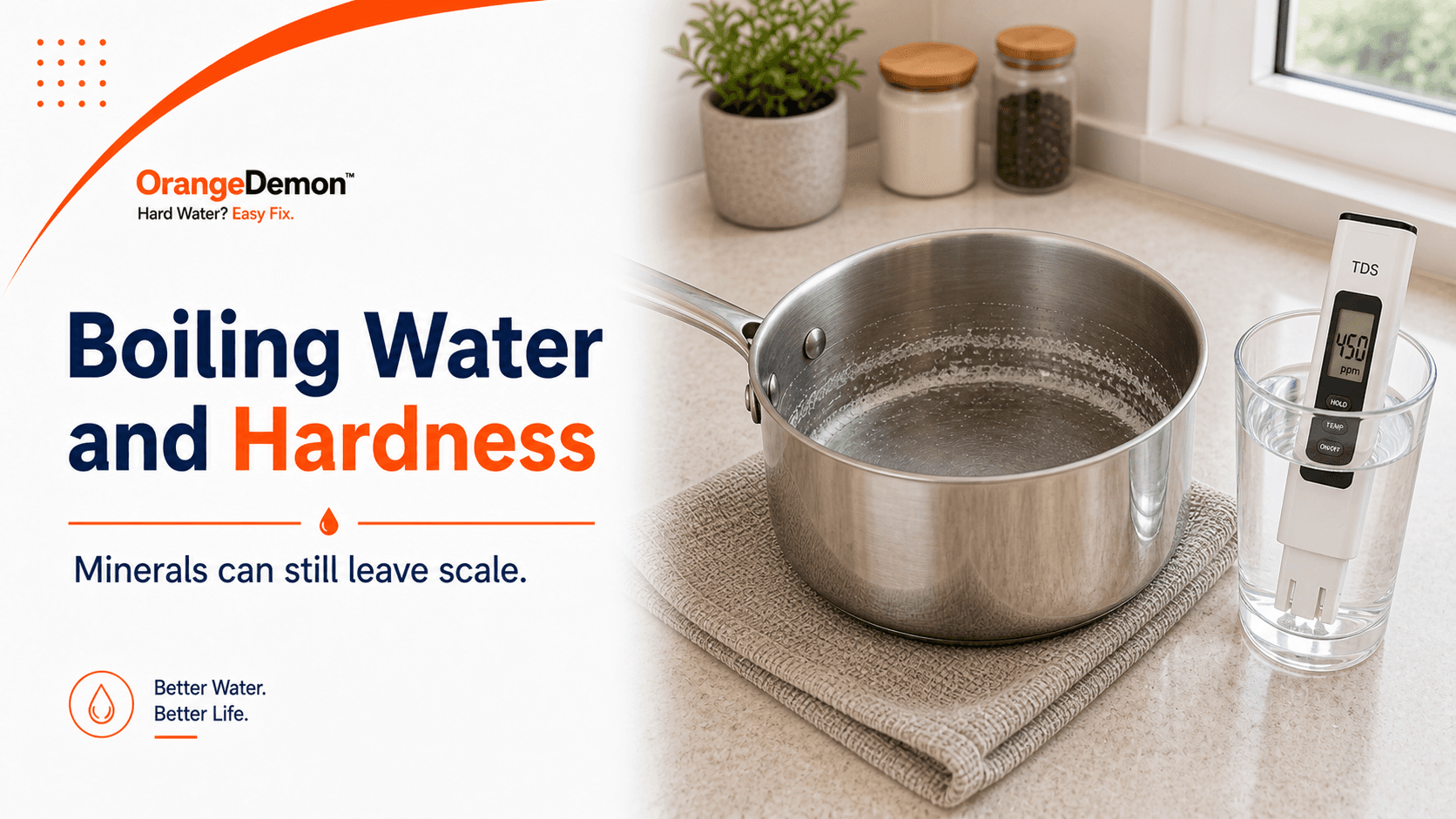
When Indians boil water for drinking, the white flakes or film that forms inside the kettle or vessel are a visible demonstration of what hard water does. But does boiling remove hardness, or does it just make the scale visible by concentrating it
Two Types of Hardness
Water hardness is classified into two types. Temporary hardness is caused by calcium bicarbonate - Ca(HCO3)2 - dissolved in water. When this water is heated, the bicarbonate decomposes: Ca(HCO3)2 -> CaCO3 + H2O + CO2. The calcium carbonate precipitates out as a solid - that's the scale in your kettle. The water's calcium content drops. Boiling does remove temporary hardness.
Permanent hardness is caused by calcium sulphate (CaSO4), magnesium sulphate (MgSO4), calcium chloride, and magnesium chloride. These compounds remain soluble at high temperatures and do not precipitate when water is boiled. Boiling has no effect on permanent hardness. For the bigger picture on hardness and TDS, see what TDS and hard water mean.
Which Type Is in Indian Water
Both. Indian groundwater - particularly from the Gangetic plains, Rajasthan, and peninsular granite formations - contains mixtures of calcium bicarbonate (temporary hardness) and calcium/magnesium sulphates and chlorides (permanent hardness). The proportions vary by location and geology. Most Indian borewell water has both components.
This means boiling partially reduces hardness - the temporary component precipitates - but the permanent component remains. Boiled water from a 600 mg/L borewell is not soft water. It may be somewhat softer, but it still has meaningful levels of dissolved calcium and magnesium.
The Practical Implication for Your Kettle and Bathroom
The white scale in your kettle is calcium carbonate precipitated from temporary hardness during boiling - visible proof that boiling is doing something to your water chemistry. The scale needs to be removed periodically with acid (citric acid or vinegar works fine for kettle scale - it's thin and relatively fresh). Left to accumulate, kettle scale insulates the heating element and reduces efficiency.
For your bathroom, the relevant point is that your shower water is not boiled - it's cold or warm at most. The full mineral content of your borewell water hits your glass and chrome directly. Boiling as a hardness treatment only matters for drinking water and appliances that heat water.
For bathroom hard water problems, only an ion exchange water softener or consistent acid cleaning addresses the problem. Boiling is useful but not relevant to scale on bathroom surfaces.
TapStrike Intense is OrangeDemon's heavy-duty spray for limescale, hard-water marks and soap scum on taps, sinks, washbasins and glazed tiles. See TapStrike Intense.
Seen results with OrangeDemon? Share a before/after on Instagram @orangedemon.in or tag us on Twitter/X @OrangeDemonIn.
Follow OrangeDemon: Instagram / YouTube / Twitter / X