
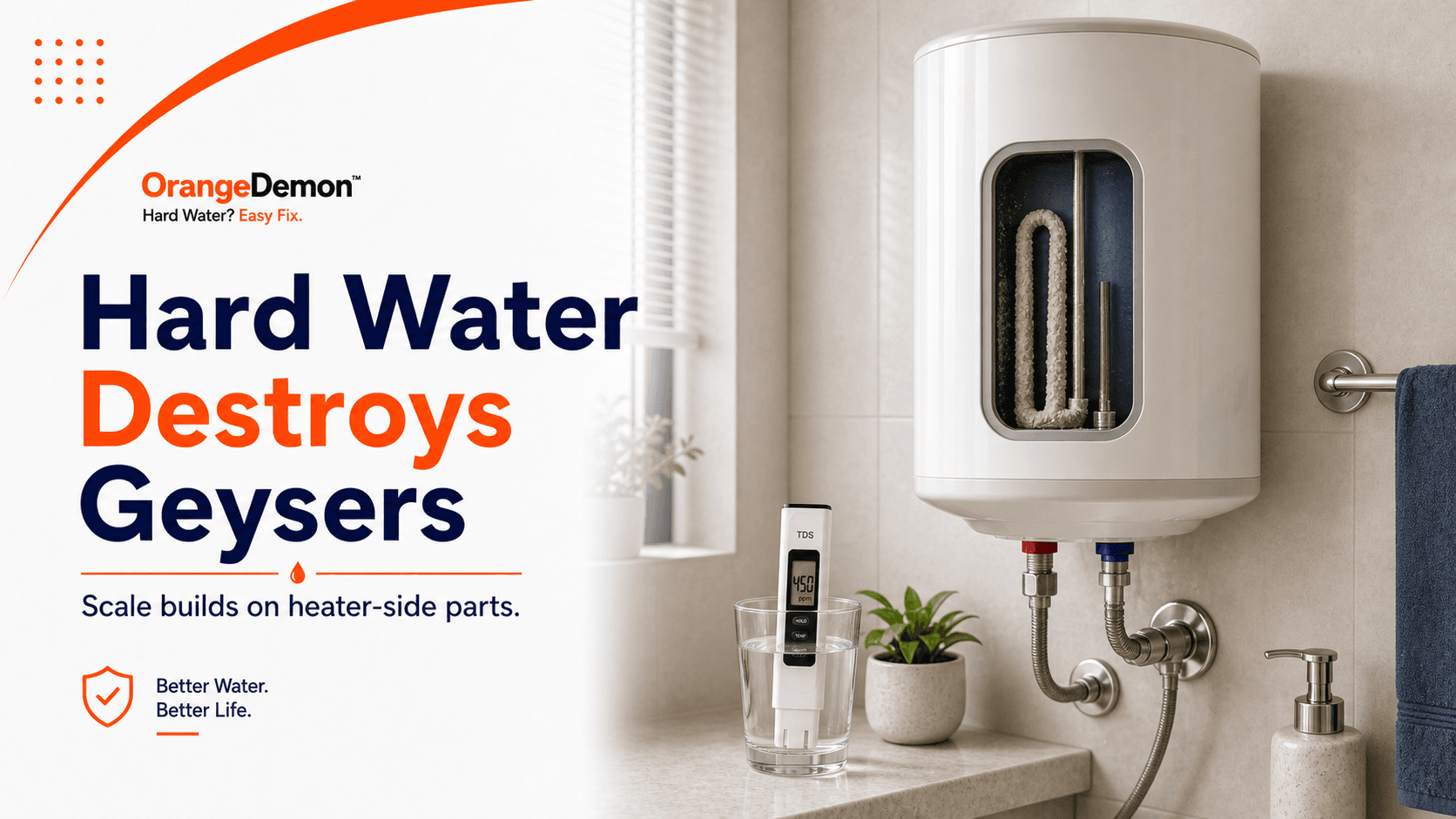
The bathroom consequences of hard water that people notice are visual
- stained glass, cloudy chrome. The consequence that actually costs money is invisible: scale buildup inside your electric geyser. Left untreated, it can cut a geyser's working life in half and meaningfully increase your electricity bill.
How Scale Forms in a Geyser
When hard water is heated, the solubility of calcium carbonate decreases
- the opposite of most soluble substances. This means hot water deposits calcium carbonate faster than cold water, and the heating element of your geyser is the primary site of scale deposition in your plumbing system.
At 400 mg/L TDS, a 15-litre geyser heating water to 60 deg C can deposit several grams of calcium carbonate on the heating element per week. Over a year, that accumulates into a visible white crust coating the element. At 700 mg/L, the rate is proportionally higher.
What Scale Does to Heating Efficiency
Calcium carbonate is an effective thermal insulator. A 1mm scale layer on a heating element reduces its heat transfer efficiency by approximately 7--10%. A 3mm layer - which can form in 1--2 years at high TDS - reduces efficiency by 20--30%. Your geyser uses more electricity to heat the same volume of water to the same temperature. The element also runs hotter than designed, reducing its lifespan.
A scaled element is more likely to fail due to thermal stress - the uneven heating caused by varying scale thickness creates stress points that eventually crack the element. This is why geyser element failure is so common in high-TDS areas - it's not product quality, it's water chemistry.
Detection and Maintenance
Signs your geyser has significant scale: longer time to heat water, higher electricity bills (hard to isolate, but a rough indicator), a rumbling or gurgling sound when heating (scale cracking under thermal stress), and discoloured or slightly cloudy hot water.
Most geyser manufacturers recommend annual descaling for hard water areas. This involves draining the tank, introducing an acid descaling solution, allowing dwell time, then flushing completely. Many plumbers offer this as a service; it typically costs Rs.500--Rs.1500 and takes 1--2 hours. Alternatively, anti-scale sacrificial magnesium anode rods inside the tank can slow calcium deposition - check your geyser's manual to see if it supports this.
Prevention is more practical: reducing the thermostat setting from 65--70 deg C to 50--55 deg C slows scale deposition (calcium carbonate precipitates faster at higher temperatures), reduces electricity consumption, and is adequate for normal hot water use. Most households have no functional reason to set geysers above 55 deg C.
TapStrike Intense is OrangeDemon's heavy-duty spray for limescale, hard-water marks and soap scum on taps, sinks, washbasins and glazed tiles. See TapStrike Intense.
Seen results with OrangeDemon? Share a before/after on Instagram @orangedemon.in or tag us on Twitter/X @OrangeDemonIn.
Follow OrangeDemon: Instagram / YouTube / Twitter / X