

People usually ask this question in one of two moods:
- skeptical: "Is hard water really that big a deal"
- frustrated: "Why are all my appliances aging so fast"
The honest answer sits in the middle.
Quick answer
Hard water is generally more of an appliance-maintenance problem than a health panic. But yes, it can absolutely be bad for kettles, washing machines, and geysers because heating and repeated water contact cause mineral deposits to build up over time.
What "hard water" actually means
According to the U.S. Geological Survey,
hardness in water mainly comes from dissolved calcium and magnesium.
USGS classifies water above 180 mg/L as calcium carbonate as
very hard.
The same source notes that hard water is not usually a health concern, but it can be a nuisance and can damage equipment when scale builds up.
That is the key distinction:
- not usually a health panic
- definitely an appliance problem
What hard water does to a kettle
Kettles usually show the problem first because they keep boiling the same mineral-bearing water.
That leads to:
- white crust inside the kettle
- slower boiling
- flakes in poured water
- more frequent cleaning
Philips recommends regular kettle descaling and more frequent descaling in harder water, which tells you this is routine maintenance, not an edge case.
What hard water does to a washing machine
Washing machines suffer more quietly.
Hard water can lead to:
- scale on internal heated parts
- duller wash results
- recurring smell because mineral residue traps grime
- more cleaning product use
Bosch recommends regular descaling for washing machines and separately distinguishes descaling from cleaning greasy residue. That difference is important: hard water is not just making the machine dirty, it is adding mineral burden.
What hard water does to a geyser
Geysers and water heaters are classic hard-water victims because they heat mineral-heavy water over and over.
Rheem's maintenance guidance points to sediment and mineral buildup as a reason heaters can become noisy, less efficient, and more energy-hungry over time.
In real homes, that often shows up as:
- slower heating
- rumbling or popping
- white particles in hot water
- a heater that seems older than it is
Why heated appliances suffer more
The pattern is simple:
- the more an appliance heats water
- the more often it repeats that job
- the more likely scale becomes visible and expensive
That is why kettles and geysers usually reveal the issue faster than some other household products.
Does this mean every hard-water home needs panic-level treatment
No.
Hard water does not mean every appliance is about to fail.
What it does mean is that maintenance needs to happen earlier and more regularly than many people expect.
That is the real mindset shift.
Which OrangeDemon product fits which problem
- DescaleX: coffee machines, dishwashers
- DescaleX Bio: kettles and food-contact appliances
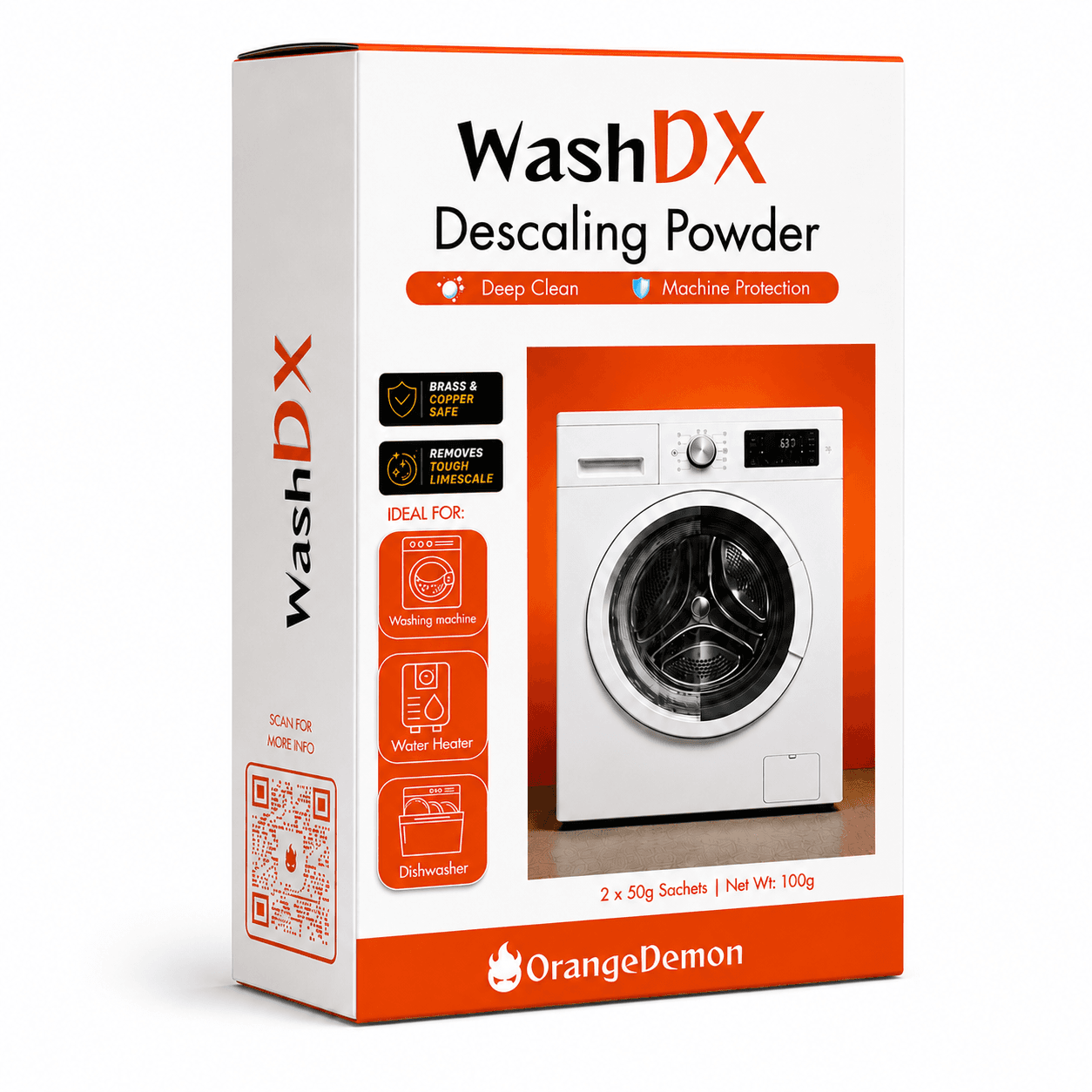
- WashDX: washing machines, geysers, boilers, water tanks, immersion rods
If hard water is showing up across multiple appliances, that split makes daily ownership easier.
Short FAQs
Is hard water bad for health
USGS notes that hardness itself is usually not a health concern. The larger issue for most households is maintenance and scale.
Why does hard water damage appliances more than people
Because appliances keep heating and moving mineral-loaded water through the same parts repeatedly, which encourages scale buildup.
Which appliance usually shows the problem first
Kettles often show it first because the scale becomes visible very quickly.
Does hard water make washing machines smell
It can contribute by creating mineral residue that traps grime and makes maintenance less effective if you only use cleaners and never descale.
What is the simplest response to hard water at home
Do not wait for symptoms to become severe. Match the appliance to the right descale routine and repeat it on schedule.
The honest answer
Hard water is not mainly a scare story. It is a maintenance reality.
If your kettle, washing machine, or geyser is behaving worse over time, hard water is one of the first things worth blaming.
Read next: How Often to Descale Appliances in India by TDS
References
- U.S. Geological Survey: Hardness of Water
- Philips: Kettle descaling guidance
- Bosch: Washing machine descaling guidance
- Rheem: Signs of water-heater sediment buildup
If hard water is hitting more than one appliance, stop treating each symptom like a separate mystery. See all products.
Follow OrangeDemon: Instagram | YouTube | Twitter / X